ACP-620 Exam Questions & Answers
Managing Jira Projects for Cloud Exam • Atlassian
100% money-back guarantee
Sample ACP-620 Questions
Practice with real exam-style questions, each with the verified correct answer and explanation.
One issue type is always included in the same sprint as its parent issue. Identify it.
A Sub-task is always tied to its parent issue and cannot exist independently in a sprint. It is automatically included in the same sprint as its parent, ensuring the work is tracked together.
Service managers are tired of assigning issues manually.
Identify four ways that issue assignments can be done without manual effort (Choose four.)
Bulk operations: Allow assigning multiple issues at once without manual assignment of each individual issue.
Project default assignment: Automatically assigns new issues to a default user (e.g., Project Lead).
Component lead assignment: Assigns issues based on the lead of the selected component.
Automation rules: Automatically assign issues based on conditions such as issue type, priority, or custom field values.
You want to configure a Kanban board so that issues disappear from the Done column as soon as they are dragged into it. But you need to see Done issues in reports.
How can you achieve this behavior?
Modifying the board sub-filter allows you to exclude Done issues from the board view after they are moved to that status, while still keeping them in Jira and visible in reports. This way, they disappear from the board immediately but remain part of historical and reporting data.
You are the project administrator of two Scrum projects, MOBI and TIS.
Team members find it difficult to switch between both projects to work on separate sprints.
They need the ability to work on issues from both projects in a single sprint.
Identify two ways that you can satisfy this requirement. (Choose two.)
Create a new Scrum board that includes both MOBI and TIS issues: This allows the teams to plan and manage sprints using a single board that pulls issues from both projects.
Change the TIS project board filter to include issues from MOBI project: Modifying the board filter to include issues from both projects enables the board to support a shared sprint across MOBI and TIS.
A user wants to add the label VIP to an issue when any member of the Executives group adds a comment to it.
The configuration of the automation rule is shown.
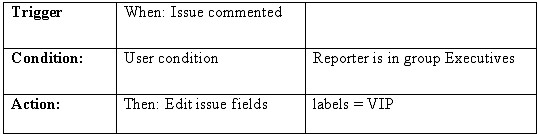
The automation rule does not always execute as expected.
What is the cause of the problem?
The user condition is checking whether the reporter is in the Executives group, but the rule is triggered when the issue is commented on. To work as intended, the condition should check whether the commenter (i.e., user who triggered the rule) is in the Executives group - not the reporter.
Get access to all 56 verified questions with detailed answers.
Unlock All ACP-620 Questions