CFA-Level-II Exam Questions & Answers
CFA Level II Chartered Financial Analyst • CFA Institute
100% money-back guarantee
Sample CFA-Level-II Questions
Practice with real exam-style questions, each with the verified correct answer and explanation.
Fashion Inc. is a major U .S . distributor of high quality women's jewelry and accessories. The company's growth in recent years has been moderately above the industry average. However, competition is intensifying as a number of overseas competitors have entered this mature market. Although Fashion has been a publicly held company for many years, members of senior management and their families control 20% of the outstanding common stock. Martin Silver, the Chief Executive Officer, has been under intense pressure from both internal and external large shareholders to find ways to increase the company's future growth.
Silver has consulted with the company's investment bankers concerning possible merger targets. The most promising merger target is Flavoring International, a distributor of a broad line of gourmet spices in the United States and numerous other countries. In recent years, Flavoring's earnings growth rate has been above competitors' and also has exceeded Fashion's experience. Superior income growth is projected to continue over at least the next five years. Silver is impressed with the appeal of the company's products to upscale customers, its strong operating and financial performance, and Flavoring's dynamic management team. He is contemplating retirement in three years and believes that Flavoring's younger, more aggressive senior managers could boost the combined company's growth through increasing Fashion's operating efficiency and expanding Fashion's product line in countries outside the United States. Alan Smith, who is Silver's key contact at the investment banking firm, indicates that a key appeal of this merger to Flavoring would be Fashion's greater financial flexibility and access to lower cost sources of financing for expansion of its products in new geographic areas. Fashion has a very attractive performance based stock option plan. Flavoring's incentive plan is entirely based on cash compensation for achieving performance goals. Additionally, the 80% of Fashion's stock not controlled by management interests is very widely held and trades actively. Flavoring became a publicly held company three years ago and doesn't trade as actively.
Silver has asked Smith to prepare a report summarizing key points favoring the acquisition and an acceptable acquisition price. In preparing his report, Smith relics on the following financial data on Fashion, Flavoring, and four recently acquired food and beverage companies.
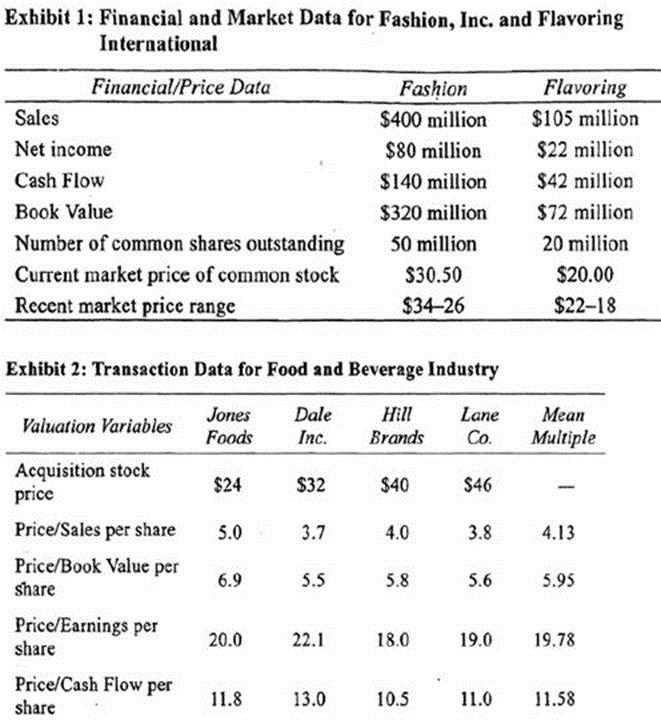
The strongest motivations for Fashion to acquire Flavoring would most likely be:
Management incentives are a key factor in light of Mr. Silvers desire to retire in three years and his interest in Flavoring management's capabilities to help guide the combined firm. Diversification is another key motivation as Flavoring's products are consumer based but serve a different market than Fashions focus on consumer accessories. Because the companies have different product lines, synergies in the form of cost savings or revenue enhancement are unlikely to occur. In addition, the companies are in very different industries making increased market power in either industry unlikely to occur as a result of the merger. (Study Session 9, LOS 31.b,d)
Engineered Packaging Inc. (EPI) is a manufacturer of industrial and consumer packaging products. The company's products include composite and plastic rigid packaging, flexible packaging, as well as metal and plastic ends and closures. In January 2008, EPI entered into a joint venture with BMI Enterprises. EPI contributed ownership of five plants, while BMI contributed a new manufacturing technology. The joint venture is known as EP/BM LLC . EPI owns 50% of EP/BM LLC and uses the equity method to account for its investment. The following information for 2008 is provided:
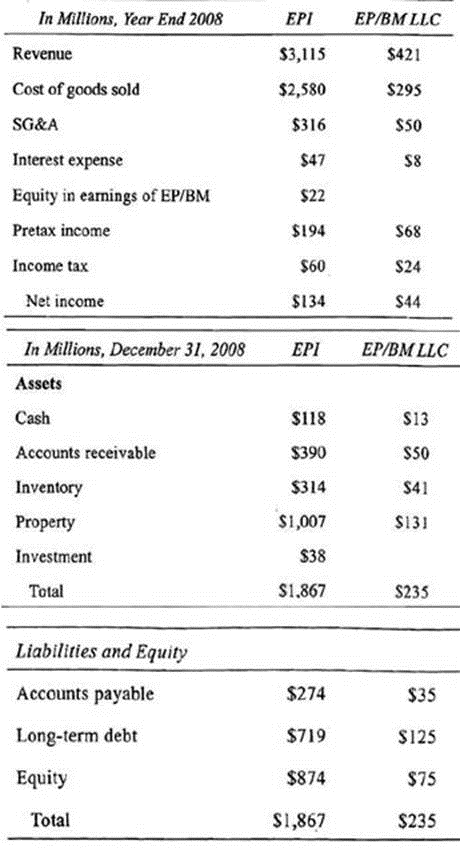
In January 2009, EPI decides to sell its interest in EP/BM LLC . This is the fifth divesture in the last five years. Which of the following statements is least likely regarding this sale? The divestiture:
Divestitures should be a rare event. A divestiture usually sends a negative signal. It is unlikely that investors want management to sell profitable assets. The other statements are all accurate. (Study Session 9, LOS 31.o,p)
Kevin Rathbun, CFA, is a financial analyst at a major brokerage firm. His supervisor, Elizabeth Mao, CFA, asks him to analyze the financial position of Wayland, Inc. (Wayland), a manufacturer of components for high quality optic transmission systems. Mao also inquires about the impact of any unconsolidated investments.
On December 31,2007, Wayland purchased a 35% ownership interest in a strategic new firm called Optimax for $300,000 cash. The pre-acquisition balance sheets of both firms are found in Exhibit 1.
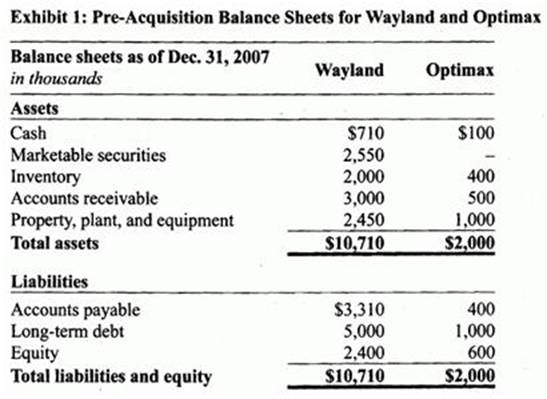
On the acquisition date, all of Optimax's assets and liabilities were stated on its balance sheet at their fair values except for its property, plant, and equipment (PP&E), which had a fair value of $1.2 million. The remaining useful life of the PP&E is ten years with no salvage value. Both firms use the straight-line depreciation method.
For the year ended 2008, Optimax reported net income of $250,000 and paid dividends of $100,000.
During the first quarter of 2009, Optimax sold goods to Wayland and recognized $15,000 of profit from the sale. At the end of the quarter, half of the goods purchased from Optimax remained in Wayland's inventory.
Wayland currently uses the equity method to account for its investment in Optimax. However, given the potential significance of the investment in the future, Rathbun believes that a proportionate consolidation of Optimax may give a clearer picture of the financial and operating characteristics of Wayland.
Rathbun also notes that Wayland owns shares in Vanry, Inc. (Vanry). Rathbun gathers the data in Exhibit 2 from Wayland's financial statements. The year-end portfolio value is the market value of all Vanry shares held on December 31. All security transactions occurred on July 1, and the transaction price is the price that Wayland actually paid for the shares acquired. Vanry pays a cash dividend of $1 per share at the end of each year. Wayland expects to sell its investment in Vanry in the near term and accounts for it as held-for-trading.
Wayland owns some publicly traded bonds of the Rotor Corporation that it reports as held-to-maturity securities.
Regarding the Rotor Corporation bonds, Wayland would have the option to report them at fair value rather than as held-to-maturity under:
The fair value option is available under both IFRS and U .S . GAAP. (Study Session 5. LOS 21.a)
Kylie Autumn, CFA, is a consultant with Tri-Vision Group. Robert Lullum, Senior Vice President ai Langsford Investments, has asked for assistance with the evaluation of mortgage-backed and collateralized mortgage obligation (CMO) derivative securities for potential inclusion in several client portfolios. Langsford Investments mainly deals with equity investments and REITs, but the company recently purchased a small firm that invests mainly in fixed-income securities.
Lullum has done some research on the appropriate spread measures and option valuation models for fixed-income securities and wants to clarify some points. He wants to know if the following statements are correct:
Statement 1: The proper spread measure for option-free corporate bonds is the nominal spread.
Statement 2: Callable corporate bonds and mortgage-backed securities should be measured using the option-added spread.
Statement 3: The Z-spread is appropriate for credit card ABS and auto loan ABS.
While Lullum meets with Autumn, Janet Van Ark, CFA charterholder and equity-income portfolio manager for Langsford, is attempting to purchase bonds that may also provide her with equity exposure in the future. She has decided to analyze an 8% annual coupon bond with exactly 20 years to maturity. The bonds are convertible into 10 common shares for each $ 1,000 of par (face) value. The bond's market price is $920, and the common stock has a market price of $40. Van Ark estimates that the stock will increase in value to $70 within the next two years. The stock's annual dividend is $0.40 per share, and the market yield on comparable non-convertible bonds'is 9.5%.
Carl Leighton, a Langsford analyst and Level 2 CFA candidate, works with mortgage-backed and other asset-based securities. He provides Lullum with a list of credit enhancements for asset-backed securities, which includes letters of credit, excess servicing spread funds, overcollateralization, and bond insurance. Lullum then asks him for a status report of the firm's exposure to paythrough securities. He also asks Leighton to calculate the single-monthly mortality rate (SMM) and estimate the prepayment for the month for a seasoned mortgage pool with a $500,000 principal balance remaining. The scheduled monthly principal payment is $ 150 and the conditional prepayment rate (CPR) is 7%.
Which of the following statements about interest-only (10) and principal-only (PO) strips is least accurate?
IO investors want prepayments to be slow and thus are more concerned with contraction risk.
Interest-only strips: An interest-only (IO) strip receives all interest payments from the underlying mortgage pool. If market interest rates increase, prepayments will fall. This results in larger than expected principal balances and, thus, larger than expected interest payments. Hence. IO strips have higher realized returns when interest rates increase. If interest rates fall, the pool tends to prepay and interest payments fall, resulting in lower returns to the IO strip.
Principal-only strips: A principal-only (PO) strip receives only the principal payments (both scheduled and prepayments) from the underlying pool of mortgages. If interest rates fall, prepayments increase. Since the PO strips arc discount securities, larger than expected prepayments result in the early return of principal and thus a higher return on the security. Increasing interest rates result in lower than expected prepayments (i.e., extension risk) and lower actual returns.
Volatility: Both IOs and POs have greater price volatility than the passthrough from which they were derived. This occurs because the IO and PO returns are negatively correlated (they respond in opposite directions to changes in interest rates), but the volatility of the combined IO and PO strips equals the price volatility of the source passthrough.
(Study Session 15, LOS 55-i)
William Shears, CFA, has been assigned the task of predicting sales for the specialty retail industry. Shears finds that sales have been increasing at a fairly constant rate over time and decides to estimate the linear trend in sales for the industry using quarterly data over the past 15 years, starting with Quarter 1 of 1994 and ending with Quarter 4 of 2008. On January 1, 2009, Shears estimates the following model:
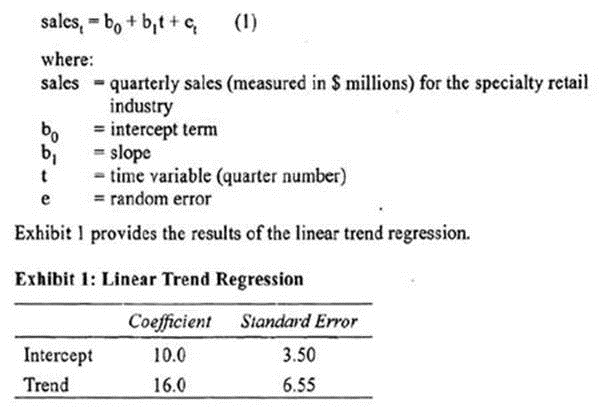
Shears also estimates an autoregressive model of order one, AR(1), using the changes in quarterly sales data for the industry from the first quarter of 1994 through the fourth quarter of 2008. He obtains the following results for his AR(1) model:
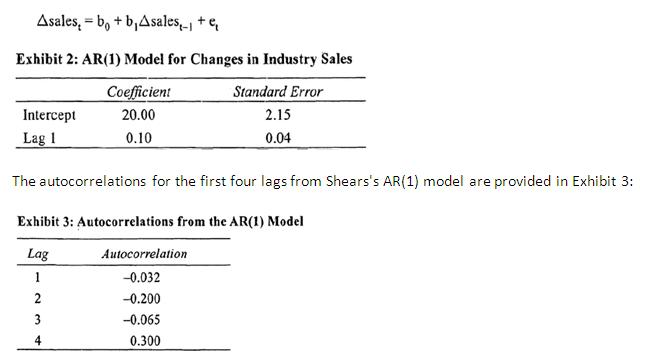
Shears also derives a regression using the residuals from the AR(1) model. He regresses the squared residuals (or estimated errors) against the lagged squared residuals. The results of this regression are reported in Exhibit 4.
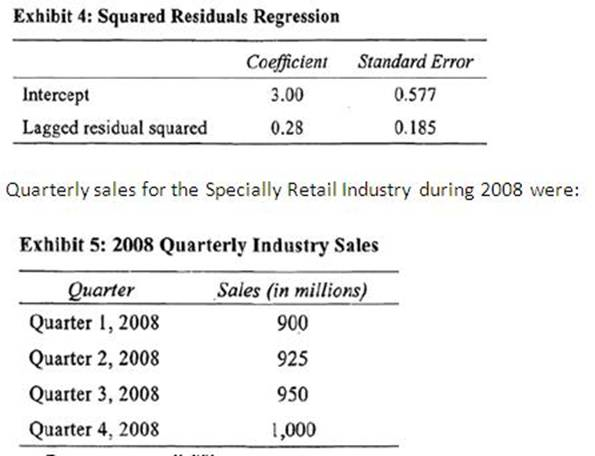
Quarterly sales for the Specially Retail Industry during 2008 were:
Shears's supervisor, Sam Kite, expresses concern that equation (1) might be misspecified. Specifically, Kite refers to the finding that "sales have been increasing at a fairly constant rate over time.
"Which of the following data transformations should be applied to the dependent variable in equation (1) to best address Kite's concern?
A logarithmic transformation of the dependent variable is the most appropriate transformation to apply when the variable grows at a constant rate over time:
ln(sales) = a* + b* t + e
The slope of this equation equals the nominal constant rate. The effective rate equals eb*- 1. (Study Session 3, LOS I3.b)
Get access to all 715 verified questions with detailed answers.
Unlock All CFA-Level-II Questions