Vault-Associate Exam Questions & Answers
HashiCorp Certified: Vault Associate (002) • HashiCorp
100% money-back guarantee
Sample Vault-Associate Questions
Practice with real exam-style questions, each with the verified correct answer and explanation.
The following three policies exist in Vault. What do these policies allow an organization to do?
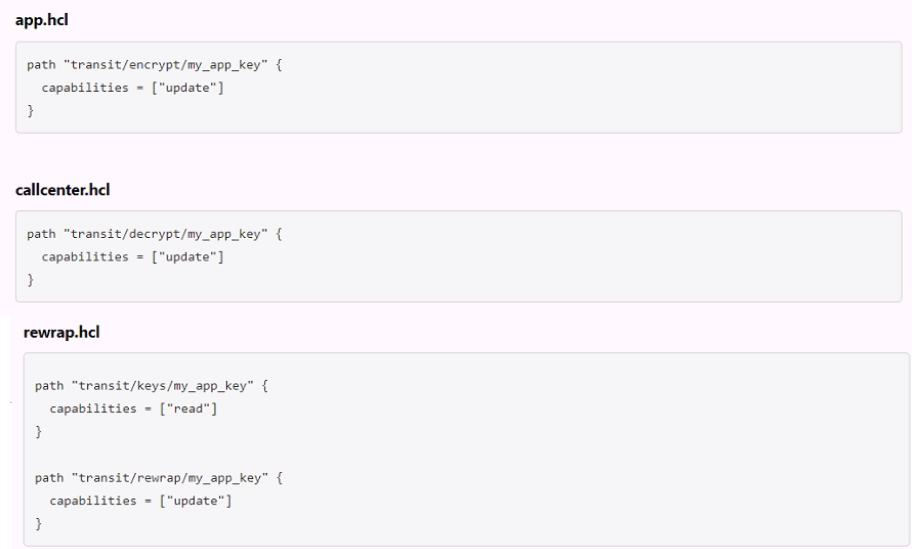
The three policies that exist in Vault are:
admins: This policy grants full access to all secrets and operations in Vault. It can be used by administrators or operators who need to manage all aspects of Vault.
default: This policy grants access to all secrets and operations in Vault except for those that require specific policies. It can be used as a fallback policy when no other policy matches.
transit: This policy grants access only to the transit secrets engine, which handles cryptographic functions on data in-transit. It can be used by applications or services that need to encrypt or decrypt data using Vault.
These policies allow an organization to perform useful tasks such as:
Encrypting, decrypting, and rewrapping data using the transit engine all in one policy: This policy grants access to both the transit secrets engine and the default policy, which allows performing any operation on any secret in Vault.
Creating a transit encryption key for encrypting, decrypting, and rewrapping encrypted data: This policy grants access only to the transit secrets engine and its associated keys, which are used for encrypting and decrypting data in transit using AES-GCM with a 256-bit AES key or other supported key types.
Separating permissions allowed on actions associated with the transit secret engine: This policy grants access only to specific actions related to the transit secrets engine, such as creating keys or wrapping requests. It does not grant access to other operations or secrets in Vault.
Which of these is not a benefit of dynamic secrets?
Dynamic secrets are generated on-demand by Vault and have a limited time-to-live (TTL). They do not ensure that administrators can see every password used, as they are often encrypted and ephemeral. The benefits of dynamic secrets are:
They support systems that do not natively provide a method of expiring credentials, such as databases, cloud providers, SSH, etc. Vault can revoke the credentials when they are no longer needed or when the lease expires.
They minimize the damage of credentials leaking, as they are short-lived and can be easily rotated or revoked. If a credential is compromised, the attacker has a limited window of opportunity to use it before it becomes invalid.
They replace cumbersome password rotation tools and practices, as Vault can handle the generation and revocation of credentials automatically and securely. This reduces the operational overhead and complexity of managing secrets.
You are using Vault's Transit secrets engine to encrypt your dat
a. You want to reduce the amount of content encrypted with a single key in case the key gets compromised. How would you do this?
A developer mistakenly committed code that contained AWS S3 credentials into a public repository. You have been tasked with revoking the AWS S3 credential that was in the code. This credential was created using Vault's AWS secrets engine and the developer received the following output when requesting a credential from Vault.
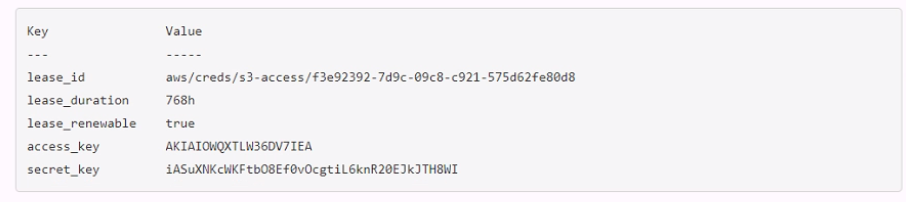
Which Vault command will revoke the lease and remove the credential from AWS?
Which of the following statements describe the CLI command below?
S vault login -method-1dap username-mitche11h
Get access to all 57 verified questions with detailed answers.
Unlock All Vault-Associate Questions