OMG-OCUP2-FOUND100 Exam Questions & Answers
OMG Certified UML Professional 2 (OCUP 2) - Foundation Level • OMG
100% money-back guarantee
Sample OMG-OCUP2-FOUND100 Questions
Practice with real exam-style questions, each with the verified correct answer and explanation.
Choose the correct answer:
The stale machine below is in state1:

When does it transition to state2?
The image depicts a state machine with three states labeled 'state1' and 'state2'. Three events, e1, e2, and e3, are shown triggering transitions.
Analyzing the diagram, we can observe that all three events (e1, e2, and e3) are required for the transition from state1 to state2. The events are arranged sequentially, implying a specific order for the transition to occur.
Here's a breakdown of the reasoning for excluding other options:
Option A (When all of el. e2. and e3 occur in any order) is incorrect because the order of events matters.
Option B (When any one of the events e1. e2. or e3 occurs) is incorrect because all three events are necessary for the transition.
Option D (Never, because a transition cannot have more than one trigger) is incorrect because the state machine can transition with multiple triggers, but in this specific case, the order is crucial.
Therefore, based on the visual representation of the state machine, the correct answer is that the transition to state2 happens only when events e1, e2, and e3 occur in precisely the specified order
Choose the correct answer:
Consider the following diagram:
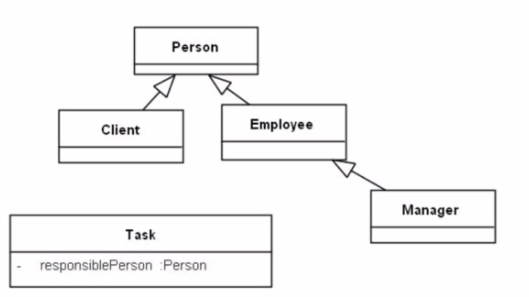
Which statement is correct according to the diagram?
In UML class diagrams, relationships between classes are represented in a number of different ways, including generalization, association, and composition.
Looking at the provided options, let's analyze each one:
A . responsiblePerson inherits from Person -- This is incorrect because the responsiblePerson is an attribute of the Task class, not a class itself, so it cannot inherit from Person.
B . Client and Manager have nothing in common -- This is incorrect because both Client and Manager are specialized types of Person as indicated by the generalization arrows pointing to Person.
C . responsiblePerson can not refer to an object of class Client -- This is incorrect. responsiblePerson is typed by Person, which means that it can refer to an instance of any subclass of Person, including Client.
D . The object referred to as responsiblePerson can be a Manager -- This is correct. Since responsiblePerson is an attribute of the Task class with the type Person, and Manager is a subclass of Person, responsiblePerson can indeed refer to an instance of Manager.
The correct answer is based on the UML 2 Foundation specification that describes how attributes are typed by classes and can refer to instances of these classes or their subclasses (UML 2.5 specification, sections 9.3.3 and 9.5.3). The generalization relationship (represented by a triangle followed by a line) establishes a hierarchy between a more general element and a more specific element, which in this case means that Client and Manager are both specific types of Person and can be used wherever Person is expected (UML 2.5 specification, section 9.4.5).
Choose the correct answer:
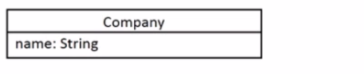
Consider the following class definition:
Which diagram fragment shows an instance of the Company class in which name has the value OMG?
A)

B)
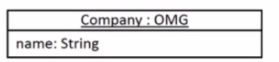
C)
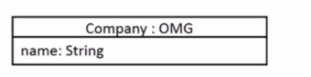
D)

E)

F)

To represent an instance of a class in a UML Object Diagram, the standard notation is to specify the instance name followed by a colon and the class name, and then list the attribute values within the compartment.
The class definition for Company specifies that there is one attribute, name, of type String.
An instance of Company where the name attribute has the value 'OMG' would be shown as follows:
InstanceName : ClassName attributeName = attributeValue
In the provided options, Option D correctly represents an instance of the Company class with the name attribute set to 'OMG'. The name of the instance is not specified, which is allowed in UML when the instance name is not important or is understood from the context.
Thus, the correct answer is:
D . Option D
Choose the correct answer:
Which characteristic should apply to any useful model?
A key characteristic that should apply to any useful model, including those created with UML, is that it abstracts away irrelevant details. This abstraction is crucial for managing complexity by focusing on the essential aspects of the system that are relevant to the current perspective or analysis task. By removing unnecessary information, the model remains understandable and manageable, even as the underlying system grows in complexity. This principle helps maintain a clear and concise representation of the system, enabling stakeholders to focus on strategic decisions without being overwhelmed by details.
Choose the correct answer:
Consider the following diagram:
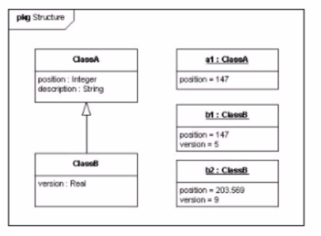
Which change could the modeler make to fix the UML error in this model?
In the UML diagram given, we see two classes, ClassA and ClassB, with ClassB inheriting from ClassA. ClassA has two attributes, position of type Integer and description of type String. ClassB introduces an additional attribute, version of type Real.
Looking at the instance specifications (the right part of the diagram), we have three instances: a1 of type ClassA, b1 of type ClassB, and b2 also of type ClassB.
In UML, an instance specification must comply with the structure of its classifier, which means an instance of ClassA must show slots for both position and description, whereas an instance of ClassB must show slots for position, description, and version.
In the provided diagram, instance a1 of ClassA only shows a slot for position. This is an error because it does not show a slot for description, which is a defined attribute of ClassA. To correct this error, we would need to add a description slot to a1.
This means that the correct answer is:
B . Add a description slot to a1.
The other options do not correct the error in the model:
A) Specifying unique values for position does not address the missing description slot in a1. C) Changing the type of ClassB.version from Real to Integer is not required by any UML constraint in the context given. D) Changing the type of ClassA.position from Integer to Real does not address the missing description slot in a1 and is unrelated to the inheritance structure.
Get access to all 90 verified questions with detailed answers.
Unlock All OMG-OCUP2-FOUND100 Questions