P_SAPEA_2023 Exam Questions & Answers
SAP Certified Professional - SAP Enterprise Architect • SAP
100% money-back guarantee
Sample P_SAPEA_2023 Questions
Practice with real exam-style questions, each with the verified correct answer and explanation.
You design a Solution Architecture, based on SAP S/4HANA, for an internationally active customer that has a national subsidiary in China and other countries that have special requirements for data storage. As the responsible Enterprise Architect, your task is to propose a solution that takes these special requirements into account. How do you proceed when your customer's Architecture Guideline calls for following a "cloud-first" approach?
The customer's architecture guideline calls for following a 'cloud-first' approach, but this does not mean that all solutions must be deployed in the cloud. In some cases, private cloud or on-premise options may be necessary to meet the customer's data protection requirements.
For example, if the customer's subsidiary in China requires that data be stored within China, then a private cloud solution in China may be the best option. Similarly, if the customer's other subsidiaries have different data protection requirements, then a hybrid solution that combines cloud and on-premise deployments may be necessary.
The Enterprise Architect must carefully consider the customer's specific requirements and constraints before making a decision about the deployment environment.
Here are some of the factors that the Enterprise Architect should consider:
The customer's data protection requirements:The Enterprise Architect must understand the customer's specific data protection requirements and ensure that any solution meets those requirements.
The availability of cloud-based solutions that meet the customer's requirements:Not all cloud-based solutions meet the same data protection requirements. The Enterprise Architect must ensure that the cloud-based solutions that are being considered meet the customer's requirements.
The cost of different deployment options:The Enterprise Architect must consider the cost of different deployment options, including cloud, private cloud, and on-premise.
The scalability and performance requirements of the solution:The Enterprise Architect must ensure that the solution meets the customer's scalability and performance requirements, regardless of the deployment environment.
By carefully considering all of these factors, the Enterprise Architect can make a decision about the deployment environment that meets the customer's specific requirements and constraints.
Topic 2, Case Study -- Wanderlust
Introduction
Wanderlust GmbH, headquartered in Germany but with manufacturing facilities and sales globally, is a leading global manufacturer of conventional fuel driven cars. They are renowned for their best-in-class engineering, but not so much for aftermarket customer service. In recent years, Wanderlust has had limited success expanding into the market of electric vehicles. Following is Wanderlust's geographical manufacturing and supply spread:

Wanderlust offers one compact electric Sedan (model ELAN) and one compact electric SUV (model ELUV), each with three variants -- basic (LX), mid-range (VX) and high-end (ZX). Customers can also choose from a range of five metallic colors, two drive trains and two battery ranges.Overall, 50 different combinations are offered for all segments and variants put together.
Extracts from CEO Interviews -- Business Environment
Constraints/Issues
o Stiff water consumption regulations and enormous penalties for violation -- Lithium extraction is a
heavy water intensive process and mine locations are in very arid areas like the Australian outback
and Atacama Desert
o Significant dependence on external suppliers of Lithium batteries due to limited number of
manufacturing units, long lead times and high carbon footprint in all car manufacturing facilities except
Brazil.
o Long delays in spare battery availability, leading to an avalanche of unresolved battery related
customer complaints for vehicles under warranty
o Limited charging infrastructure, long charging cycles (as compared to refilling fuel) and slow resolution
of battery related complaints.
o Dwindling in store footfall due to pandemic (for feature-based vehicle selection prior to test drive)
Wanderlust offers one compact electric Sedan (model ELAN) and one compact electric SUV (model ELUV), each with three variants -- basic (LX), mid-range (VX) and high-end (ZX). Customers can also choose from a range of five metallic colors, two drive trains and two battery ranges.Overall, 50 different combinations are offered for all segments and variants put together.
Extracts from CEO Interviews -- Business Environment
Constraints/Issues
o Stiff water consumption regulations and enormous penalties for violation -- Lithium extraction is a
heavy water intensive process and mine locations are in very arid areas like the Australian outback
and Atacama Desert
o Significant dependence on external suppliers of Lithium batteries due to limited number of
manufacturing units, long lead times and high carbon footprint in all car manufacturing facilities except
Brazil.
o Long delays in spare battery availability, leading to an avalanche of unresolved battery related
customer complaints for vehicles under warranty
o Limited charging infrastructure, long charging cycles (as compared to refilling fuel) and slow resolution
of battery related complaints.
o Dwindling in store footfall due to pandemic (for feature-based vehicle selection prior to test drive)
Extracts from CIO Interviews -- IT Environment
Extracts from CIO Interviews -- IT Environment
Strategic Priorities - IT
o Ease of usage
o Ease of Maintenance
o Total Cost of Ownership Optimization
o Time to Value Acceleration
Transformation Status
o Only at a conceptual stage -- no planning done yet
o Nascent architecture practice
o Unclear on supported processes, required capabilities, applications, and transition path
o Yet to identify, prioritize and sequence initiatives
As-Is Architecture

Wanderlust has a separate organization and setup for their Automobile and Aftermarket businesses
o Wanderlust is reluctant to consider cloud for Core applications due to data privacy concerns, but are
open for Collaboration applications
o Automobile business started off in Europe and grew through acquisitions in Asia and Americas
o Automobile business runs on three continental SAP ECC instances with inherited, disparate
processes, which need to move to S/4HANA
o Automobile business is also looking to harmonize their processes across the continents, adopt a
seamless, transparent global supply chain for batteries and consolidate the continental instances into
a global single instance, data regulations permitting
o Automotive business uses a highly complex custom developed dealer management solution on ECC,
which needs to be replaced
o Automotive business uses SAP APO, which is nearing end of lifecycle and needs to be replaced by
IBP (DP & SNP) & S/4HANA (PP-DS)
o Automotive business uses several bespoke non-SAP applications, which are considered
irreplaceable, except for the Marketing and Sourcing applications, whichare expensive to maintain,
seldom used and henceneed to be replaced
o Aftermarket business processes are largely uniform and handled through a single ECC instance which
also should move to S/4HANA
o Aftermarket business uses SAP SCM which is nearing end of lifecycle and needs to be replaced by
S/4HANA AATP (gATP) and eSPP (SPP)
Extracts from Interview with Enterprise Architect
Enterprise Architecture Dimensions & Maturity
o Wanderlust's Key EA Dimensions, their overall purpose and current maturity level

Top three priorities given the current maturity level, are as follows
o Stakeholder Involvement is the topmost priority, to create a Stakeholder Map that'll identify all key EA stakeholders within Wanderlust
o Business-IT Alignment is also a top priority, to anchor every IT initiative to a Business Strategy Map,
consisting of clearly defined strategic business objectives, tangible goals and measurable value drivers
o Architecture Development is the next priority, beginning with development of business architectures, followed by application architectures and finally opportunities & solutions planning
Enterprise Architecture Practice Structure (Current)

Enterprise Architecture Principles
o Wanderlust's Enterprise Architecture Principles are a collection of crisp and precise one liners
pertaining to business, application, information, integration, technology and security aspects of
transformation
o Some of the EA Principles in the repository are

These EA Principles serve as high level directional statements and long term guard rails to the above
six aspects of transformation programs & projects
o They should ideally correlate (many to many) with the Strategic Objectives, defined in the Business-IT
alignment EA Dimension -- this is yet to be done though
As a result of solution mapping, business capabilities might require services which partners have implemented in SAP BTP. Which SAP components and services, if any, are required to integrate such BTP partner services with an on-premise SAP S/4HANA system (hybrid scenario)?
In a hybrid scenario, where business capabilities require services which partners have implemented in SAP BTP and an on-premise SAP S/4HANA system, the following SAP components and services are required to integrate such BTP partner services with the on-premise system:
SAP Cloud Connector:The SAP Cloud Connector is a software component that allows you to connect your on-premise SAP systems to SAP BTP. The Cloud Connector provides a secure connection between your on-premise system and SAP BTP, and it also makes your on-premise system available to applications and services in SAP BTP.
SAP BTP Destination Service:The SAP BTP Destination Service is a service that provides a single point of entry for accessing on-premise systems from SAP BTP. The Destination Service makes it easy to manage and secure connections to on-premise systems, and it also provides a way to federate data from different on-premise systems.
In order to integrate BTP partner services with an on-premise SAP S/4HANA system, you will need to install the SAP Cloud Connector on your on-premise system and register the Cloud Connector with SAP BTP. You will also need to create a destination in the SAP BTP Destination Service for your on-premise system. Once you have done this, you will be able to access the on-premise system from applications and services in SAP BTP.
It is important to note that you can also use other SAP components to integrate on-premise systems with SAP BTP. However, the SAP Cloud Connector and the SAP BTP Destination Service are the most commonly used components for this purpose.
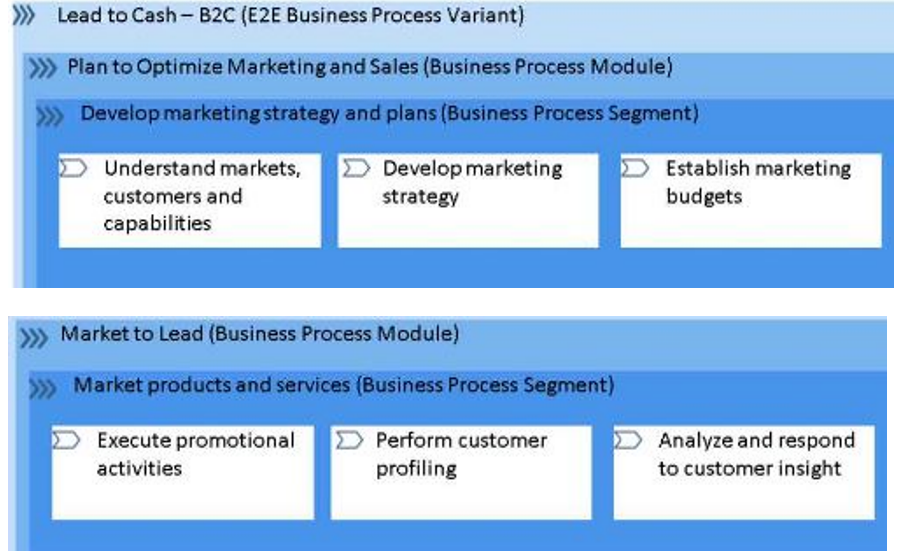
Tho Wanderlust CIO wants to focus loss on marketing strategy and planning, to instead prioritize marketing implement goals in mind to enhance number of leads generated:
* Run effective and highly visible campaigns (for example. on social media)
* Increase cross selling opportunities through online recommendation
AS the Chief Enterprise Architect Of Wanderlust. assisted by the SAP Enterprise Architects, you have been trying to re
goals with the Business Process Modules, Segments and Activities in the Lead to Cash B2C Business Process Varia Business Architecture content repository (see graphic below).
What are relevant combinations Of business activities and goals based on the graphic below?
Note: There are 2 correct answers to this question.
See the Image
The business activities 'Analyze and respond to customer insight' and 'Implement promotional activities' directly relate to the CIO's goals of increasing cross-selling opportunities through online recommendations and running highly visible campaigns. Analyzing customer insights can provide data that enhances recommendation engines, leading to effective cross-selling. Implementing promotional activities, particularly in high-visibility platforms like social media, is key to driving campaign effectiveness. Reference = These relationships between business activities and goals would be informed by best practices in online marketing strategies, as documented within the Lead to Cash - B2C Business Process Variant.
When creating an application architecture roadmap, the WHAT and WHERE are defined in a rather straightforward way, while the WHOM may differ by context. Multiple roadmap clusters may apply a variety of WHOM dimensions. For example, procurement vs. asset management. Which of the following definitions are correct? Note. There are 3 correct answers to this question.
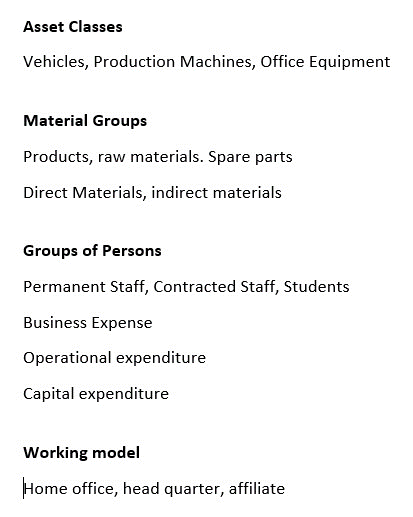
When creating an application architecture roadmap, the 'WHOM' dimension refers to the stakeholders or entities that will be impacted by or interact with the application. This dimension can vary greatly depending on the context and the specific focus areas of the roadmap. The correct answers that define the 'WHOM' dimension in various contexts are:
B . Material Groups/Products: This refers to the categorization of items such as raw materials, spare parts, direct materials, and indirect materials. These groups are relevant stakeholders in the context of procurement and supply chain management applications.
C . Groups of Persons/Business Expense: This includes different categories of personnel such as permanent staff, contracted staff, and students. It also encompasses different types of expenses like operational expenditure and capital expenditure, which are crucial considerations for financial management and human resource management applications.
D . Working model: This pertains to the various operational models such as home office, headquarters, and affiliates. These models are significant for applications that manage organizational structures, remote work capabilities, and location-based access to resources.
A . Asset Classes/Vehiclesis not a correct answer as it describes types of assets rather than stakeholders or entities interacting with the application.
SAP. (n.d.). SAP Enterprise Architecture Framework. SAP Community.
The Open Group. (2018). TOGAF Version 9.2: Enterprise Architecture Framework.
International Organization for Standardization. (2015). ISO/IEC/IEEE 42010:2011 - Systems and software engineering --- Architecture description.
The CIO of Wanderlust strongly feels that the seldom-used legacy Marketing application cannot be the platform to rejuvenate their online marketing business. As Chief Enterprise Architect, the CIO has entrusted you with the responsibility of finding a suitable replacement that can support all current processes and also address the issues plaguing the existing application. Which of the following should you do to conclusively shortlist possible applications to replace the existing one? Note: There are 2 correct answers to this question.
Starting with the current processeswill help to understand the capabilities that are needed in a new application. This will help to narrow down the field of potential applications and identify those that are most likely to meet the needs of Wanderlust.
Mapping business capabilities to these processeswill help to identify the gaps in the current capabilities and the areas where improvement is needed. This will help to ensure that the new application meets the needs of Wanderlust and addresses the issues plaguing the existing application.
Relating Wanderlust processes to industry standard processeswill help to identify applications that are already being used by other organizations. This can be a good way to ensure that the new application is compatible with other systems and that it can be easily integrated with existing systems.
The other two options, Comparing the costs of those market leading online marketing applications and Understanding the features of leading online marketing applications available in the market through product demonstrations and ranking the applications in terms of features, are not as critical at this stage. The costs of the applications can be compared once the shortlist of applications has been finalized. The features of the applications can be understood through product demonstrations once the shortlist has been finalized.
Therefore, the best course of action is to start with the current processes, map business capabilities to these processes, and identify which application(s) in the market can deliver such capabilities. This will help to narrow down the field of potential applications and identify those that are most likely to meet the needs of Wanderlust.
Here are some of the benefits of taking a process-centric approach to selecting a new marketing application:
It can help to ensure that the new application meets the needs of the business.
It can help to identify applications that are already being used by other organizations.
It can help to ensure that the new application is compatible with other systems and that it can be easily integrated with existing systems.
Get access to all 47 verified questions with detailed answers.
Unlock All P_SAPEA_2023 Questions