ARA-C01 Exam Questions & Answers
SnowPro Advanced: Architect Certification Exam • Snowflake
100% money-back guarantee
Sample ARA-C01 Questions
Practice with real exam-style questions, each with the verified correct answer and explanation.
Which technique will efficiently ingest and consume semi-structured data for Snowflake data lake workloads?
Option C is the correct answer because schema-on-read is a technique that allows Snowflake to ingest and consume semi-structured data without requiring a predefined schema. Snowflake supports various semi-structured data formats such as JSON, Avro, ORC, Parquet, and XML, and provides native data types (ARRAY, OBJECT, and VARIANT) for storing them. Snowflake also provides native support for querying semi-structured data using SQL and dot notation. Schema-on-read enables Snowflake to query semi-structured data at the same speed as performing relational queries while preserving the flexibility of schema-on-read. Snowflake's near-instant elasticity rightsizes compute resources, and consumption-based pricing ensures you only pay for what you use.
Option A is incorrect because IDEF1X is a data modeling technique that defines the structure and constraints of relational data using diagrams and notations. IDEF1X is not suitable for ingesting and consuming semi-structured data, which does not have a fixed schema or structure.
Option B is incorrect because schema-on-write is a technique that requires defining a schema before loading and processing data. Schema-on-write is not efficient for ingesting and consuming semi-structured data, which may have varying or complex structures that are difficult to fit into a predefined schema. Schema-on-write also introduces additional overhead and complexity for data transformation and validation.
Option D is incorrect because information schema is a set of metadata views that provide information about the objects and privileges in a Snowflake database. Information schema is not a technique for ingesting and consuming semi-structured data, but rather a way of accessing metadata about the data.
How can the Snowflake context functions be used to help determine whether a user is authorized to see data that has column-level security enforced? (Select TWO).
Snowflake context functions are functions that return information about the current session, user, role, warehouse, database, schema, or object. They can be used to help determine whether a user is authorized to see data that has column-level security enforced by setting masking policy conditions based on the context functions. The following context functions are relevant for column-level security:
current_role: This function returns the name of the role in use for the current session. It can be used to set masking policy conditions that target the current session and are not affected by the execution context of the SQL statement. For example, a masking policy condition using current_role can allow or deny access to a column based on the role that the user activated in the session.
invoker_role: This function returns the name of the executing role in a SQL statement. It can be used to set masking policy conditions that target the executing role and are affected by the execution context of the SQL statement. For example, a masking policy condition using invoker_role can allow or deny access to a column based on the role that the user specified in the SQL statement, such as using the AS ROLE clause or a stored procedure.
is_role_in_session: This function returns TRUE if the user's current role in the session (i.e. the role returned by current_role) inherits the privileges of the specified role. It can be used to set masking policy conditions that involve role hierarchy and privilege inheritance. For example, a masking policy condition using is_role_in_session can allow or deny access to a column based on whether the user's current role is a lower privilege role in the specified role hierarchy.
The other options are not valid ways to use the Snowflake context functions for column-level security:
Set masking policy conditions using is_role_in_session targeting the role in use for the current account. This option is incorrect because is_role_in_session does not target the role in use for the current account, but rather the role in use for the current session. Also, the current account is not a role, but rather a logical entity that contains users, roles, warehouses, databases, and other objects.
Determine if there are ownership privileges on the masking policy that would allow the use of any function. This option is incorrect because ownership privileges on the masking policy do not affect the use of any function, but rather the ability to create, alter, or drop the masking policy. Also, this is not a way to use the Snowflake context functions, but rather a way to check the privileges on the masking policy object.
Assign the accountadmin role to the user who is executing the object. This option is incorrect because assigning the accountadmin role to the user who is executing the object does not involve using the Snowflake context functions, but rather granting the highest-level role to the user. Also, this is not a recommended practice for column-level security, as it would give the user full access to all objects and data in the account, which could compromise data security and governance.
Advanced Column-level Security topics
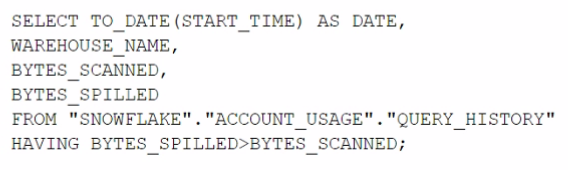
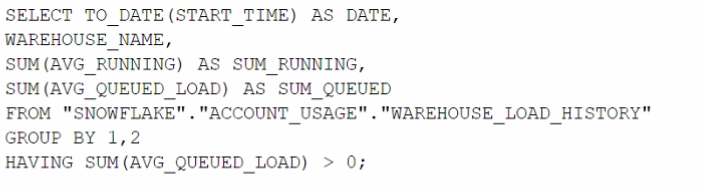
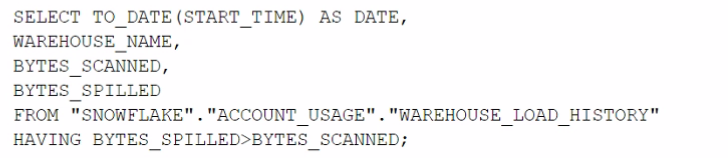
Which query will identify the specific days and virtual warehouses that would benefit from a multi-cluster warehouse to improve the performance of a particular workload?
A)
B)
C)
D)
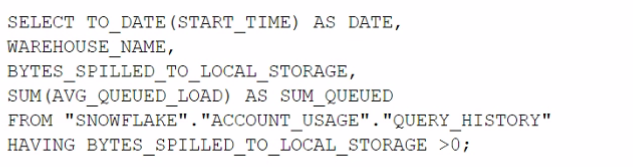
The correct answer is option B. This query is designed to assess the need for a multi-cluster warehouse by examining the queuing time (AVG_QUEUED_LOAD) on different days and virtual warehouses. When the AVG_QUEUED_LOAD is greater than zero, it suggests that queries are waiting for resources, which can be an indicator that performance might be improved by using a multi-cluster warehouse to handle the workload more efficiently. By grouping by date and warehouse name and filtering on the sum of the average queued load being greater than zero, the query identifies specific days and warehouses where the workload exceeded the available compute resources. This information is valuable when considering scaling out warehouses to multi-cluster configurations for improved performance.
An Architect entered the following commands in sequence:

USER1 cannot find the table.
Which of the following commands does the Architect need to run for USER1 to find the tables using the Principle of Least Privilege? (Choose two.)
According to the Principle of Least Privilege, the Architect should grant the minimum privileges necessary for the USER1 to find the tables in the SANDBOX database.
The USER1 needs to have USAGE privilege on the SANDBOX database and the SANDBOX.PUBLIC schema to be able to access the tables in the PUBLIC schema. Therefore, the commands B and C are the correct ones to run.
The command A is not correct because the PUBLIC role is automatically granted to every user and role in the account, and it does not have any privileges on the SANDBOX database by default.
The command D is not correct because it would transfer the ownership of the SANDBOX database from the Architect to the USER1, which is not necessary and violates the Principle of Least Privilege.
The command E is not correct because it would grant all the possible privileges on the SANDBOX database to the USER1, which is also not necessary and violates the Principle of Least Privilege.
A company has a Snowflake environment running in AWS us-west-2 (Oregon). The company needs to share data privately with a customer who is running their Snowflake environment in Azure East US 2 (Virginia).
What is the recommended sequence of operations that must be followed to meet this requirement?
Option C is the correct answer because it allows the company to share data privately with the customer across different cloud platforms and regions. The company can create a new Snowflake account in Azure East US 2 (Virginia) and set up replication between AWS us-west-2 (Oregon) and Azure East US 2 (Virginia) for the database objects to be shared. This way, the company can ensure that the data is always up to date and consistent in both accounts. The company can then create a share and add the database privileges to the share, and alter the share and add the customer's Snowflake account to the share. The customer can then access the shared data from their own Snowflake account in Azure East US 2 (Virginia).
Option A is incorrect because the Snowflake Marketplace is not a private way of sharing data. The Snowflake Marketplace is a public data exchange platform that allows anyone to browse and subscribe to data sets from various providers. The company would not be able to control who can access their data if they use the Snowflake Marketplace.
Option B is incorrect because it requires the customer to create a new Snowflake account in Azure East US 2 (Virginia), which may not be feasible or desirable for the customer. The customer may already have an existing Snowflake account in a different cloud platform or region, and may not want to incur additional costs or complexity by creating a new account.
Option D is incorrect because it involves creating a reader account in Azure East US 2 (Virginia), which is a limited and temporary way of sharing data. A reader account is a special type of Snowflake account that can only access data from a single share, and has a fixed duration of 30 days. The company would have to manage the reader account's URL and credentials, and renew the account every 30 days. The customer would not be able to use their own Snowflake account to access the shared data, and would have to rely on the company's reader account.
Get access to all 162 verified questions with detailed answers.
Unlock All ARA-C01 Questions