SPLK-3003 Exam Questions & Answers
Splunk Core Certified Consultant • Splunk
100% money-back guarantee
About SPLK-3003 Exam
The SPLK-3003 (Splunk Core Certified Consultant) certification is a professional credential that validates expertise in implementing, managing, and optimizing Splunk Enterprise deployments. This advanced certification exam tests candidates on critical knowledge areas including data ingestion, search and reporting, knowledge objects, data analysis, and Splunk administration. Professionals pursuing this certification demonstrate their ability to architect scalable Splunk solutions, troubleshoot complex issues, and drive business intelligence initiatives within their organizations. The SPLK-3003 exam is designed for experienced Splunk practitioners who have hands-on experience with Splunk deployments and seek to advance their careers as certified consultants.
IT professionals, data analysts, system administrators, and Splunk developers should pursue the SPLK-3003 certification to enhance their credentials and increase earning potential in the cybersecurity and data management fields. To successfully pass this challenging exam, candidates benefit significantly from using updated exam dumps and comprehensive practice tests that simulate real exam scenarios. These study materials help learners identify knowledge gaps, reinforce difficult concepts, and build confidence before the actual test. Practice tests provide detailed explanations for each question, enabling candidates to understand not just the correct answers but also the underlying Splunk principles. By combining hands-on experience with structured preparation using quality exam resources, professionals can maximize their chances of achieving SPLK-3003 certification success.
Exam Topics & Objectives
4-Week Study Plan for SPLK-3003
Week 1: Foundation & Data Collection Basics
- Review SPLK-3003 exam blueprint and score weightings
- Study 1.0 Deploying Splunk - installation types, distributed vs standalone, system requirements
- Study 2.0 Monitoring Console - overview, deployment monitoring, health checks
- Complete hands-on: Install Splunk Enterprise in distributed environment
- Study 4.0 Data Collection Part 1 - input methods, HTTP Event Collector (HEC), syslog, TCP/UDP
- Lab: Configure HEC input and send sample data
- Complete practice questions on Deploying Splunk and Monitoring Console
- Review official Splunk documentation on inputs.conf configuration
Week 2: Access Control, Indexing & Configuration Management
- Study 3.0 Access and Roles - authentication, authorization, role-based access control (RBAC)
- Lab: Create custom roles and manage user permissions
- Study 5.0 Indexing Part 1 - indexing process, parsing, field extraction, line breaking
- Study 7.0 Configuration Management - props.conf, transforms.conf, configuration layering
- Complete hands-on: Configure custom field extractions using props.conf and transforms.conf
- Lab: Implement RBAC with custom roles and capabilities
- Study 4.0 Data Collection Part 2 - universal forwarders, data parsing, routing
- Complete practice questions on Access/Roles and Configuration Management
- Review Splunk authentication methods and integration scenarios
Week 3: Indexing Deep Dive & Search Fundamentals
- Study 5.0 Indexing Part 2 - advanced parsing, timestamp extraction, truncation, nullqueue
- Study 6.0 Search Part 1 - search language, pipes, commands, field discovery
- Lab: Build complex searches using multiple pipes and transforming commands
- Study 6.0 Search Part 2 - statistical functions, transactions, advanced searches
- Complete hands-on: Create searches with stats, top, rare, timechart commands
- Lab: Configure index-time field extractions and test search performance
- Study 4.0 Data Collection Part 3 - Splunk Add-ons, inputs.conf, source types
- Complete practice questions on Indexing and Search
- Review performance tuning for search and indexing
Week 4: Clustering & Exam Preparation
- Study 8.0 Indexer Clustering Part 1 - architecture, master node, replication factor, search factor
- Study 8.0 Indexer Clustering Part 2 - cluster management, rebalancing, peer management
- Lab: Configure multi-peer indexer cluster with replication
- Study 9.0 Search Head Clustering - captain election, artifact replication, configuration bundle
- Lab: Set up search head cluster with captain and members
- Complete hands-on scenarios combining indexer and search head clustering
- Take full-length practice exam (SPLK-3003)
- Review weak areas from practice exam results
- Study troubleshooting scenarios for clustering issues
- Final review: Configuration files, best practices, and edge cases across all topics
Sample SPLK-3003 Questions
Practice with real exam-style questions. Reveal answers to verify your knowledge.
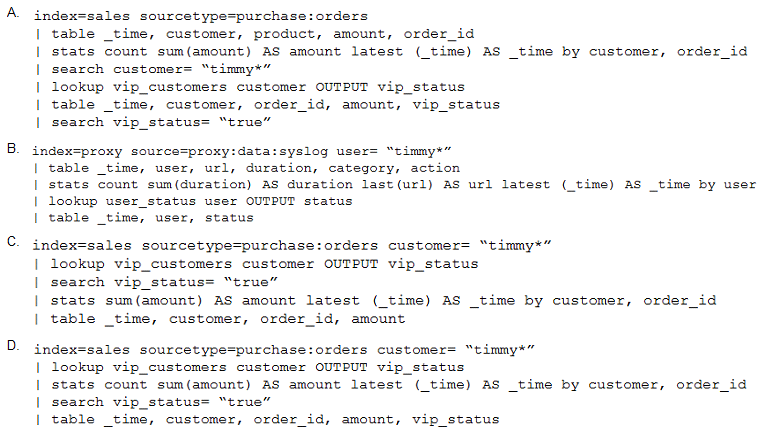
A customer has written the following search:

How can the search be rewritten to maximize efficiency?
What does Splunk do when it indexes events?
Which of the following processor occur in the indexing pipeline?
A customer has downloaded the Splunk App for AWS from Splunkbase and installed it in a search head cluster following the instructions using the deployer. A power user modifies a dashboard in the app on one of the search head cluster members. The app containing an updated dashboard is upgraded to the latest version by following the instructions via the deployer.
What happens?
A Splunk Index cluster is being installed and the indexers need to be configured with a license master. After the customer provides the name of the license master, what is the next step?
Get access to all 85 verified questions with detailed answers.
Unlock All SPLK-3003 Questions