CPA-Auditing Exam Questions & Answers
CPA Auditing and Attestation • AICPA
100% money-back guarantee
Sample CPA-Auditing Questions
Practice with real exam-style questions, each with the verified correct answer and explanation.
Determining that proper amounts of depreciation are expensed provides assurance about management's assertion of:
Choice 'a' is correct. Determining that proper amounts of depreciation are expensed provides assurance with regard to valuation and allocation related to the asset, and accuracy in terms of financial statement presentation.
Choices 'b', 'c', and 'd' are incorrect. Verifying depreciation computations does not provide evidence with respect to completeness, rights and obligations, existence, or occurrence.
When there has been a change in accounting principles, but the effect of the change on the comparability of the financial statements is not material, the auditor should:
Choice 'c' is correct. If an accounting change has no material effect on the comparability of the financial statements, the auditor does not need to recognize the change in the current year's audit report.
Choice 'a' is incorrect. The change would only be referred to in an explanatory paragraph if the effect were material.
Choice 'b' is incorrect. The auditor does not explicitly concur with the change in the report.
Choice 'd' is incorrect. Even if the change had a material effect, the opinion paragraph would not be affected. The explanatory paragraph would follow the opinion paragraph.
For audits of financial statements made in accordance with generally accepted auditing standards, the use of analytical procedures is required to some extent:
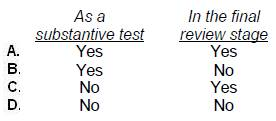
Choice 'c' is correct. Analytical procedures are required to be applied to some extent in planning and in the final review stage. In addition, although not required, analytical procedures may be used as a substantive test when they are more effective or efficient than tests of details.
Choices 'a', 'b', and 'd' are incorrect, per the above Explanation: .
Which of the following fraudulent activities most likely could be perpetrated due to the lack of effective internal controls in the revenue cycle?
Choice 'c' is correct. The function of cash receipts is part of the treasurer's department and should be separate from the role of posting credits to the A/R ledger. Failure to separate the recordkeeping function from the custodial function allows an individual to misappropriate cash and then cover up the theft by posting credits against the related A/R balance.
Choice 'a' is incorrect. If fictitious transactions in the revenue cycle are recorded, then the impact on revenues and receivables would be the same; either both would be overstated (the most likely case) or both would be understated.
Choice 'b' is incorrect. Even the lack of effective internal controls would not allow this fraud to be perpetrated for long, since the customers that submitted the claim would complain that the credit was not properly applied as soon as they received their next statement or invoice.
Choice 'd' is incorrect. The failure to prepare shipping documents may cause inventory to be overstated, but it is unlikely to be perpetrated as a fraud since it does not allow theft of cash. In addition, the internal controls in the revenue cycle typically relate to sales, receivables, and cash, not to inventory.
An analysis of which of the following accounts would best aid in verifying that all fixed assets have been capitalized?
Choice 'd' is correct. An analysis of the repairs and maintenance account would best aid the auditor in verifying that all fixed assets have been capitalized. This account is generally analyzed to test for completeness of asset additions (i.e., the auditor is looking for items recorded as repairs or maintenance that would more properly have been capitalized as betterment of an asset).
Choice 'a' is incorrect. An analysis of cash would not identify fixed assets that were not properly capitalized, since cash would be paid for the purchase regardless of whether the item were expensed or capitalized.
Choice 'b' is incorrect. An analysis of depreciation expense would not identify fixed assets that were not properly capitalized, since no depreciation would be included for items not already classified as assets.
Choice 'c' is incorrect. An analysis of property tax expense would not identify fixed assets that were not properly capitalized, since no property tax would be included for items not already classified as assets.
Get access to all 1025 verified questions with detailed answers.
Unlock All CPA-Auditing Questions