CPA-Financial Exam Questions & Answers
CPA Financial Accounting and Reporting • AICPA
100% money-back guarantee
About CPA-Financial Exam
The CPA-Financial (CPA Financial Accounting and Reporting) certification exam, administered by the American Institute of CPAs (AICPA), is a rigorous assessment designed to evaluate candidates' expertise in financial accounting principles, reporting standards, and regulatory compliance. This critical exam covers essential topics including Generally Accepted Accounting Principles (GAAP), International Financial Reporting Standards (IFRS), consolidated financial statements, non-profit accounting, and governmental accounting. Aspiring CPAs, accounting professionals seeking credential advancement, and financial reporting specialists should prioritize this examination as a cornerstone of their professional development and career growth in the accounting industry.
To achieve success on the CPA-Financial exam, candidates benefit significantly from utilizing updated exam dumps and comprehensive practice tests that mirror the actual test format and difficulty level. These study resources provide invaluable insight into exam structure, question types, and content emphasis, allowing candidates to identify knowledge gaps and strengthen weak areas before test day. By incorporating high-quality practice materials into their study regimen, candidates can build confidence, improve time management skills, and maximize their chances of passing the certification exam on their first attempt, ultimately advancing their career prospects in accounting and finance.
Exam Topics & Objectives
4-Week Study Plan for CPA-Financial
Week 1: Conceptual Framework and Standard-Setting Foundation
- Study FASB Conceptual Framework: objectives of financial reporting, qualitative characteristics of useful financial information
- Review standard-setting bodies: FASB, GASB, SEC, and their roles in financial reporting
- Learn the hierarchy of GAAP and authoritative guidance sources
- Understand recognition and measurement principles including the revenue recognition model
- Study financial statement presentation and disclosure requirements
- Complete practice questions on conceptual framework (target: 20 questions)
- Review case studies on how conceptual framework applies to accounting standards
Week 2: Financial Statement Accounts and Assets
- Master cash, cash equivalents, and restricted cash classification and presentation
- Study accounts receivable: recognition, measurement, valuation allowances, and aging methods
- Learn inventory accounting: cost flow methods (FIFO, LIFO, weighted average), lower of cost or market, obsolescence
- Review property, plant, and equipment: capitalization, depreciation methods, impairment, asset retirement obligations
- Study investment accounting: equity method, fair value through OCI, fair value through earnings
- Review intangible assets: goodwill, indefinite-lived and finite-lived intangibles, impairment testing
- Complete 40+ practice questions on asset valuation and classification
- Work through multi-part scenarios involving mixed asset types
Week 3: Liabilities, Equity, and Select Transactions
- Study accounts payable, accrued liabilities, and contingencies (probable, reasonably possible, remote)
- Master debt accounting: bonds payable, amortization of premiums/discounts, debt modifications, and debt extinguishment
- Review deferred revenue and performance obligations under ASC 606
- Learn stockholders' equity: common and preferred stock, treasury stock, dividends, and earnings per share calculations
- Study revenue recognition: identification of performance obligations, transaction prices, timing of recognition for different business models
- Review expense recognition: matching principle and period costs
- Understand lease accounting: right-of-use assets, lease liability, operating vs. finance classification
- Complete 50+ practice questions on liability, equity, and transaction accounting
- Practice complex journal entry scenarios
Week 4: Comprehensive Review and State/Local Government Accounting
- Study state and local government accounting: governmental fund accounting, proprietary funds, and fiduciary funds
- Learn modified accrual accounting for governmental activities and accrual accounting for proprietary activities
- Review GASB standards on revenue recognition, expense recognition, and fund balance reporting
- Master consolidation and intercompany transactions basics
- Review business combinations and fair value measurements (ASC 820)
- Study segment reporting and interim reporting requirements
- Complete comprehensive practice exams (2-3 full-length simulations)
- Review all flagged topics from weeks 1-3 with focus on application and integration
- Practice essay questions and scenario-based problems addressing multiple topics
- Study explanations for incorrect answers on all practice materials
Sample CPA-Financial Questions
Practice with real exam-style questions. Reveal answers to verify your knowledge.
Tack, Inc. reported a retained earnings balance of $150,000 at December 31,1990. In June 1991, Tack discovered that merchandise costing $40,000 had not been included in inventory in its 1990 financial statements. Tack has a 30% tax rate. What amount should Tack report as adjusted beginning retained earnings in its statement of retained earnings at December 31, 1991?
On January 1, 1991, Brecon Co. installed cabinets to display its merchandise in customers' stores. Brecon expects to use these cabinets for five years. Brecon's 1991 multi-step income statement should include:
Kell Corp.'s $95,000 net income for the quarter ended September 30, 1990, included the following aftertax items:
* A $60,000 extraordinary gain, realized on April 30, 1990, was allocated equally to the second, third, and fourth quarters of 1990.
* A $16,000 cumulative-effect loss resulting from a change in inventory valuation method was recognized on August 2, 1990.
In addition, Kell paid $48,000 on February 1, 1990, for 1990 calendar-year property taxes. Of this amount, $12,000 was allocated to the third quarter of 1990.
For the quarter ended September 30, 1990, Kell should report net income of:
APB Opinion No. 28, Interim Financial Reporting, concluded that interim financial reporting should be viewed primarily in which of the following ways?
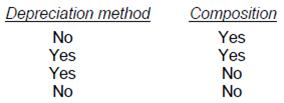
Which of the following facts concerning fixed assets should be included in the summary of significant accounting policies?
Get access to all 163 verified questions with detailed answers.
Unlock All CPA-Financial Questions
