AgilePM-Practitioner Exam Questions & Answers
Agile Project Management (AgilePM) Practitioner • APMG-International
100% money-back guarantee
Sample AgilePM-Practitioner Questions
Practice with real exam-style questions, each with the verified correct answer and explanation.
Xan Insurance Company operates from one location - a large, open-plan
office in the centre of a city. Those employees that will be working within the
Solution Development Team are all based in this office but work at different
ends of the office in separate departments.
What action should the Project Manager suggest to ensure the most effective
collaboration of the Solution Development Team?
The most effective action the Project Manager can suggest to ensure the most effective collaboration of the Solution Development Team is:
C . Relocate these employees to a new project area, with a number of desks where the Solution Development Team can sit together.
Co-locating team members in a shared space is a well-established practice in Agile environments to enhance communication, collaboration, and team dynamics. By having the Solution Development Team sit together, the Project Manager can facilitate more efficient face-to-face interactions, quick resolution of issues, and a better sense of team unity. This approach leverages the benefits of immediate communication and collaborative problem-solving, which are key in Agile project management. Even though the team members are currently in the same office, their separation into different ends of the office could hinder spontaneous communication and collaboration. Creating a dedicated project area for the team can significantly improve their ability to work together effectively.
To ensure that the UniCo change programme is successful, the Chief Executive Officer (CEO) knows that correctly assigning the key change roles will be essential.
Which 2 statements BEST explain why the CEO is appropriate for the role of Sponsor for the Change Programme?
Comprehensive and Detailed Step-by-Step Explanation
A Sponsor is a critical role in any change program, tasked with providing high-level support, ensuring resources are allocated, and maintaining alignment between the change initiative and the organization's strategic priorities. The CEO is best suited for this role because they have the authority, vision, and ability to secure the necessary resources for the program.
1. Why D (Budget Allocation) is Correct
A sponsor's primary responsibility is ensuring that the change initiative has adequate resources, including financial support.
The CEO's ability to assign budgets promptly ensures that the program can progress without delays caused by a lack of funding.
This aligns with the sponsor's role of prioritizing resources to avoid disruptions to the change process.
2. Why E (Commitment and Authority) is Correct
A key attribute of a successful sponsor is their commitment to the change initiative and their authority to prioritize it across the organization.
The CEO's position as the ultimate decision-maker and their endorsement of the change program as UniCo's future direction reinforces the legitimacy and importance of the initiative.
By promoting the change and making it a strategic priority, the CEO ensures alignment at all levels of the organization.
3. Analysis of Incorrect Options
Option A:
While a thoughtful leadership style can be valuable, this alone does not align with the core responsibilities of a sponsor. The sponsor must be proactive in decision-making, resource allocation, and strategic oversight rather than focusing on creating an environment for behavior changes.
Eliminate.
Option B:
While acknowledging unease about the new direction might indicate self-awareness, it does not demonstrate why the CEO is the best fit for the sponsor role. Sponsors are expected to lead with confidence and conviction, even in unfamiliar situations.
Eliminate.
Option C:
Being heavily involved in operational details is not the role of a sponsor. Instead, the sponsor should focus on strategic oversight and delegating operational responsibilities to program managers or change leaders.
Eliminate.
4. Practical Implications
A sponsor like the CEO ensures alignment between the change initiative and organizational goals.
Their ability to secure resources and champion the program ensures its visibility and priority within the organization, fostering commitment at all levels.
During the Foundations phase for Project Increment 4, Sukra Aroon held a meeting with Hira, Mira Bachar, andWanida Anong, to ensure alignment and compliance with EPR company policies, local regulations, and international standards. The meeting also clarified how financial and investment decisions would be made for Project Increment 4, ensuring alignment with EPR business priorities, and how this information will be tracked,
controlled and evidenced.
Wanida Anong, who works across multiple sites worldwide, attended the meeting in person but has limited availability throughout the Project Increment.
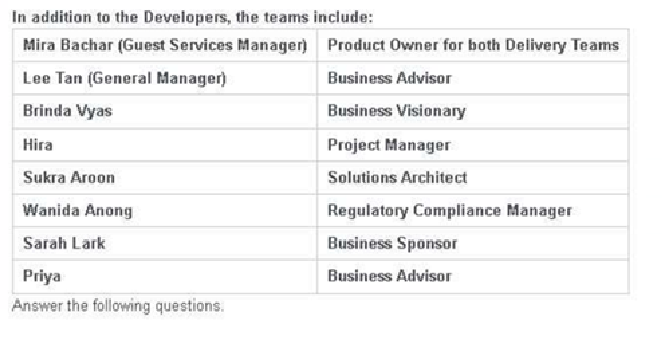
(During the meeting, Hira shared concern that the fixed end date for Project Increment 4, aligned with the start of next season, creates a risk as elements of the Eco-spa may not be ready in time. Based on AgilePM guidance, which of the following is an appropriate response to managing this risk?)
The correct answer is B.
In AgilePM, when the end date is fixed, the primary control mechanism is not to move time, but to manage scope intelligently. That is exactly what MoSCoW prioritization is for.
Why B is correct:
AgilePM protects delivery dates by ensuring that Must Have requirements are delivered first.
Lower-priority items such as Should Have and Could Have can be deferred, reduced, or reshaped if time becomes constrained.
This preserves business viability while maintaining control.
Why the other options are weaker:
A is too narrow. Compliance may be critical, but AgilePM would not automatically prioritize all compliance work ahead of everything else without using agreed prioritization logic.
C is not the primary AgilePM response. Adding temporary resources is not always effective and may introduce more complexity.
D conflicts with the principle of protecting time. AgilePM generally fixes time and cost, flexing scope where needed.
So the most appropriate AgilePM response is B.
(Hira is considering splitting the Developers into two Delivery Teams: one focused on Spa infrastructure and the other on guest experience. Mira Bachar, the Guest Services Manager, will be the Product Owner for both teams.
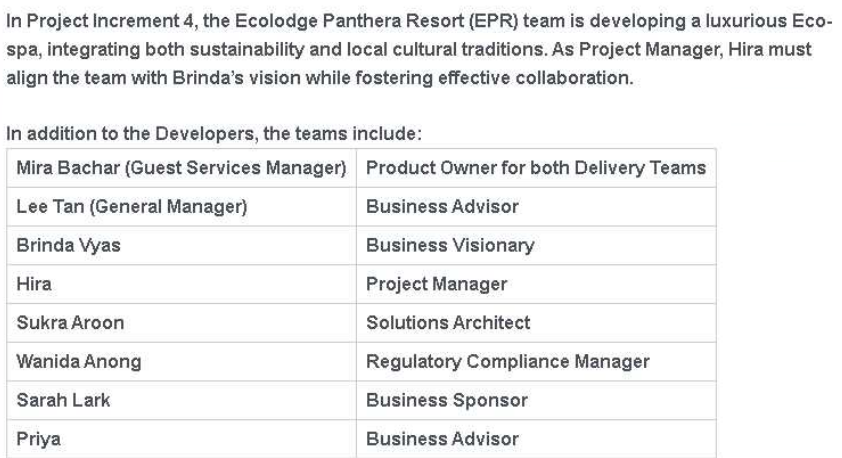
Which one of the following statements support Hira's proposed Delivery Team structure?)
In AgilePM, a Delivery Team structure should support effective collaboration, clear focus, frequent delivery, and alignment to business needs. Hira's proposal to split the Developers into two Delivery Teams can be justified when that structure improves communication, coordination, and commitment around a coherent area of work.
Option D is correct because it best reflects a practical AgilePM reason for organizing teams in this way. If one team concentrates on Spa Infrastructure and the other on Guest Experience / Spa Operations, each team can build stronger collaboration around a shared purpose. Team members working toward closely related outcomes often communicate more effectively, develop stronger ownership, and stay better aligned to their immediate goals. In AgilePM, this supports the principle of creating empowered teams that can focus on delivering business value.
Why the other options are incorrect from an AgilePM perspective:
A is incorrect because one Delivery Team should not dictate another team's priorities. In AgilePM, priorities are driven by the business need and managed through appropriate roles such as the Business Visionary and especially the Product Owner / Business Ambassador-style representation of business needs, not by one team controlling another. Teams collaborate; they do not command each other.
B is incorrect because separate Delivery Teams do not eliminate the need for coordination. In this scenario, the spa infrastructure and guest experience elements are clearly connected. For example, treatment rooms, utilities, hydrotherapy capability, reservations support, and guest experience design are likely to have dependencies. AgilePM supports iterative delivery, but it also recognizes the importance of active coordination where workstreams are interdependent.
C is incorrect because although team focus is valuable, the wording suggests separation from ''other skill sets'' in a way that promotes silos. AgilePM favors collaborative, multi-skilled teams, not isolated specialist groups that avoid interaction. A team may have a specialization in outcome or domain, but Agile ways of working still depend on cross-functional cooperation and shared understanding.
From the case context, Hira is managing a significant initiative that combines:
construction and sustainable infrastructure,
wellness services,
guest operations,
local traditions,
compliance,
and business value delivery.
Because the work spans distinct but related domains, having two specialized Delivery Teams can make sense only if it improves communication and commitment within each area while still preserving overall coordination under shared product direction. That is exactly what Option D captures.
So, from an AgilePM viewpoint, D is the strongest supporting statement because it aligns with the idea that an effective team structure should enhance collaboration, ownership, and focus while contributing to successful incremental delivery.
The Web Content Manager has provided the Web Developer with a mock up
of the 'Contact Us' page, to be created for the new coffee bar insurance
product. When producing the code, the Web Developer has created a button
that reads 'Delete' instead of 'Cancel'.
What action should the Web Content Manager take?
The most constructive and collaborative action the Web Content Manager should take is:
D . Discuss the issue with the Web Developer and decide what action is required to change this detail.
Direct communication and collaboration between the Web Content Manager and the Web Developer are essential in Agile environments to promptly address misunderstandings or mistakes. Discussing the issue openly allows for a quick resolution and ensures that the final product aligns with the project's requirements. This approach fosters a positive working relationship, encourages shared responsibility for the project's success, and avoids unnecessary delays or conflicts.
Get access to all 184 verified questions with detailed answers.
Unlock All AgilePM-Practitioner Questions