201 Exam Questions & Answers
TMOS Administration • F5 Networks
100% money-back guarantee
About 201 Exam
The F5 201 TMOS Administration certification exam is a comprehensive assessment designed for IT professionals seeking to validate their expertise in managing and administering F5 BIG-IP systems. This certification covers essential topics including BIG-IP system architecture, initial configuration, device management, network protocols, virtual servers, pools, and application delivery fundamentals. Candidates will be tested on their ability to implement load balancing solutions, configure network settings, manage user access, and troubleshoot common issues within the TMOS environment. The 201 exam serves as an ideal entry point for networking professionals, system administrators, and application delivery specialists who want to demonstrate their proficiency with F5 technologies.
IT professionals responsible for deploying and maintaining F5 BIG-IP infrastructure should take the 201 certification exam to advance their careers and increase their marketability. Utilizing updated exam dumps and practice tests is crucial for effective preparation, as these resources provide real-world scenarios, sample questions, and detailed explanations that mirror the actual exam format. Practice tests help candidates identify knowledge gaps, build confidence, and develop time management skills needed to pass the exam successfully. By leveraging comprehensive study materials alongside hands-on lab experience, aspiring certified professionals can ensure they're fully prepared to achieve their F5 201 TMOS Administration certification.
Exam Topics & Objectives
4-Week Study Plan for 201
Week 1: Foundation & Virtual Server Connectivity
- Review F5 TMOS architecture and virtual server components
- Study basic virtual server creation and configuration
- Learn troubleshooting methodology for VS connectivity issues
- Practice diagnosing connection problems using tmsh commands
- Review pool member health checks and status indicators
- Study VS state transitions and common failure scenarios
- Complete hands-on lab: basic VS connectivity troubleshooting
Week 2: Hardware Issues & Device Status
- Study F5 hardware components and specifications
- Learn diagnostic procedures for hardware failures
- Review system logs and hardware monitoring tools
- Practice identifying failing network interfaces and cards
- Study power supply and thermal monitoring
- Learn device status reporting and health metrics
- Complete hands-on lab: hardware diagnostics and reporting current device status
- Review system configuration backup procedures
Week 3: Performance Optimization & System Management
- Study performance metrics and monitoring in TMOS
- Learn resource utilization analysis (CPU, memory, throughput)
- Practice diagnosing performance bottlenecks
- Review connection pool settings and optimization
- Study system configuration maintenance best practices
- Learn backup and restore procedures for system configurations
- Practice managing and maintaining configurations via tmsh and GUI
- Complete hands-on lab: performance troubleshooting and configuration management
Week 4: Device Management, Services, and Support
- Study device management connectivity and HA clustering issues
- Learn management interface configuration and troubleshooting
- Review system and application services (LTM, GTM, APM basics)
- Practice managing service states and dependencies
- Study F5 support ticket procedures and requirements
- Learn what information to include in support escalations
- Practice writing clear issue descriptions for support tickets
- Complete full practice exam and review all weak areas
- Final lab covering all 8 sections comprehensively
Sample 201 Questions
Practice with real exam-style questions. Reveal answers to verify your knowledge.
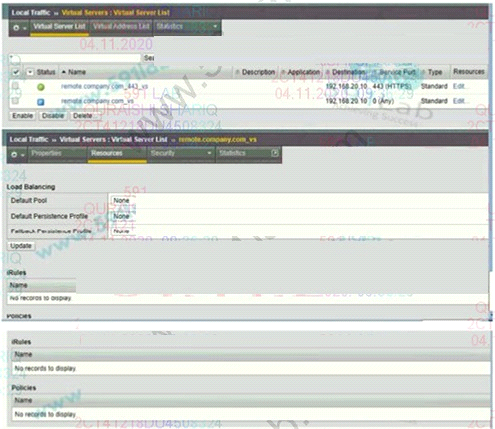
Refer to the exhibit.

A user notifies the BIG-IP Administrator that http://remote company.com is NOT accessible. Remote
access to company resources must be encrypted.
What should the BIG-IP Administrator do to fix the issue?
To increase available bandwidth of an existing Trunk, the BIG-IP Administrator is adding additional
interfaces.
Which command should the BIG-IP Administrator run from within bosh shell?
How is persistence configured?
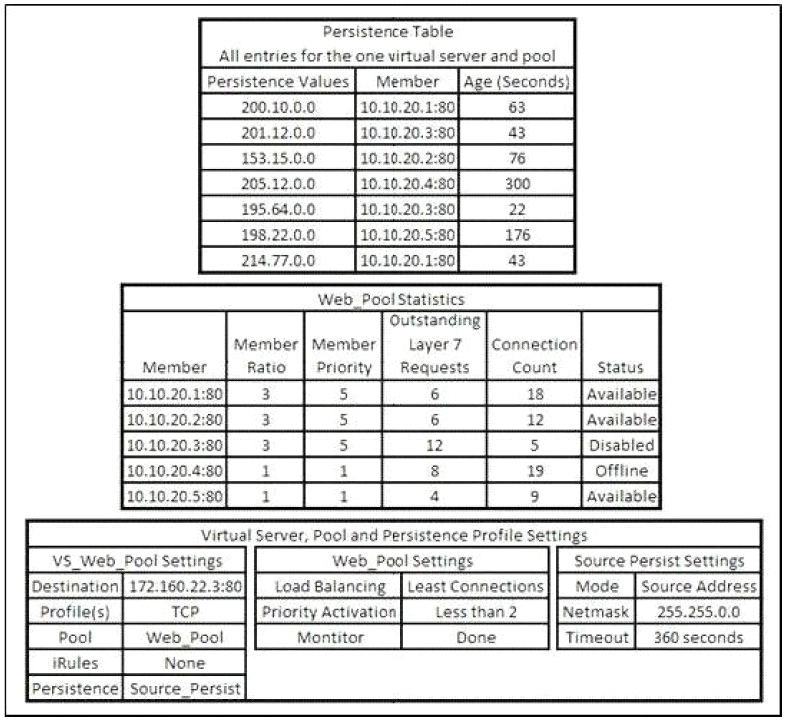
A BIG-IP has a virtual server at 150.150.10.10:80 with SNAT automap configured. This BIG-IP also has a SNAT at 150.150.10.11 set for a source address range of 200.200.1.0 / 255.255.255.0. All other settings are at
their default states. If a client with the IP address 200.200.1.1 sends a request to the virtual server, what is the source IP address when the associated packet is sent to the pool member?
A BIG-IP Administrator reviews the Plane CPU Usage performance chart and discovers a high percentage
of Control Plane utilization.
Which type of traffic does this indicate a higher usage of?
Get access to all 254 verified questions with detailed answers.
Unlock All 201 Questions