Limited-Time Offer: Enjoy 50% Savings! - Ends In 0d 00h 00m 00s Coupon code: 50OFF
Free Exam Questions

GED-Mathematical-Reasoning Exam Questions & Answers

GED Mathematical Reasoning Exam  •  GED

299 Questions Updated Jul 2026 99% Pass Rate
Get Full Access

100% money-back guarantee

About GED-Mathematical-Reasoning Exam

The GED Mathematical Reasoning exam is a comprehensive assessment designed to evaluate your proficiency in essential math concepts and problem-solving skills. This critical component of the GED certification tests your understanding of algebra, geometry, statistics, and basic arithmetic, ensuring you possess the mathematical competencies required for success in higher education and the modern workforce. Whether you're pursuing a high school equivalency diploma or advancing your career prospects, mastering the GED Mathematical Reasoning exam is a crucial step toward achieving your educational goals.

Candidates preparing for the GED Mathematical Reasoning exam benefit significantly from utilizing updated exam dumps and practice tests that mirror the actual test format and difficulty level. These study materials provide invaluable insights into question types, time management strategies, and content focus areas that examiners emphasize most frequently. Students, working professionals, and individuals seeking high school equivalency credentials should invest in reliable practice tests to identify knowledge gaps, build confidence, and develop effective test-taking strategies. By combining comprehensive study resources with consistent practice, candidates can optimize their preparation efforts and achieve passing scores on this essential GED component.

Exam Topics & Objectives

Basic Math
Geometry
Basic Algebra
Graphs and Functions

4-Week Study Plan for GED-Mathematical-Reasoning

Week 1: Foundations of Basic Math and Number Operations

  • Review whole numbers, integers, and rational numbers on the GED exam
  • Practice addition, subtraction, multiplication, and division with whole numbers
  • Work through fraction operations: adding, subtracting, multiplying, and dividing fractions
  • Study decimal operations and convert between fractions, decimals, and percentages
  • Complete 50 practice problems on basic arithmetic operations
  • Take diagnostic test on Basic Math skills to identify weak areas

Week 2: Algebra Fundamentals and Equation Solving

  • Learn and practice variables, expressions, and basic algebraic notation
  • Solve linear equations with one variable
  • Work through multi-step equations and equations with variables on both sides
  • Study and apply the distributive property and combining like terms
  • Practice word problems that translate to algebraic equations
  • Complete 60 algebra practice problems focusing on equation solving
  • Review common algebraic mistakes on the GED exam

Week 3: Geometry and Spatial Reasoning

  • Study properties of angles, triangles, and quadrilaterals
  • Learn formulas for perimeter and area of 2D shapes
  • Work through surface area and volume calculations for 3D shapes
  • Practice the Pythagorean theorem and distance formula applications
  • Study coordinate geometry and plotting points on the coordinate plane
  • Complete 55 geometry problems including word problems
  • Review geometric diagrams and interpreting scale drawings

Week 4: Graphs, Functions, and Data Analysis

  • Study functions, notation, and function evaluation
  • Practice interpreting and creating graphs of linear functions
  • Work through slope and y-intercept concepts and applications
  • Learn to read and interpret bar graphs, line graphs, and scatter plots
  • Study statistics concepts: mean, median, mode, and standard deviation
  • Practice probability and combinations/permutations problems
  • Complete full-length practice exams and review all four content areas
  • Analyze incorrect answers and target final weak areas before test day

Sample GED-Mathematical-Reasoning Questions

Practice with real exam-style questions. Reveal answers to verify your knowledge.

Q1 MultipleChoice

Hattie, the manager of Speedy Burgers, wants to know the average amount of time it takes customers to order once they reach the counter. Hattie recorded these ordering times in seconds: 45, 52, 64, 87, 56, 21, 34, 49, 55, 29, 36. What was the mean (average) time in seconds it took customers to order?

Q2 MultipleChoice

Over time, a leaky faucet can waste many gallons of water. If a faucet drips at a rate of 2 ounces per minute, how many gallons of water will be wasted in one week? (1 gallon = 128 ounces)

Q3 MultipleChoice

The base and sides of the roof of an A-frame structure are all 30 feet long. A front view of the structure is shown in the diagram below.
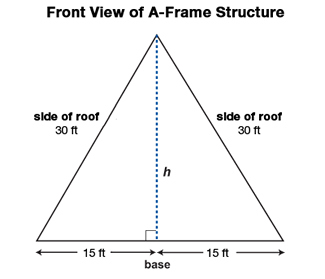
What is the approximate height (h), in feet, of the structure?

Q4 MultipleChoice

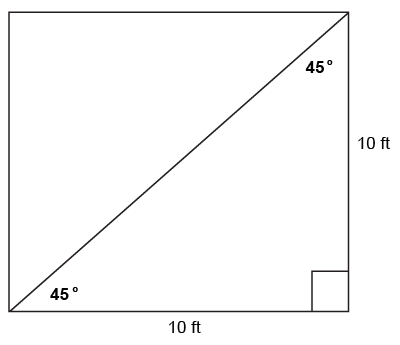
Exhibit.

The boards on the surface of an outdoor deck are often placed at a 45 angle for decorative appeal. The hypotenuse of a 45-45-90 right triangle is found by multiplying the length of a leg by 2 . To the nearest tenth of a foot, how long must a board be to cover the diagonal of the square deck shown at the left?

Q5 MultipleChoice

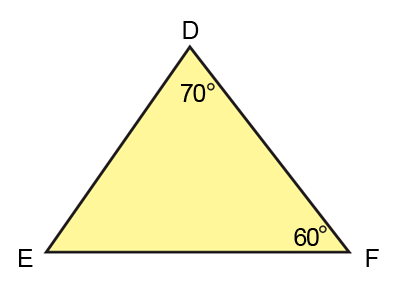
Exhibit.

What is the measure of angle E?

Get access to all 299 verified questions with detailed answers.

Unlock All GED-Mathematical-Reasoning Questions

Frequently Asked Questions

The GED Mathematical Reasoning exam covers algebra, geometry, basic statistics, and number operations. The test focuses on problem-solving skills and the ability to apply mathematical concepts to real-world situations rather than memorizing formulas.

The GED Mathematical Reasoning exam is divided into two parts with a total testing time of approximately 115 minutes. Part 1 lasts 45 minutes without a calculator, and Part 2 lasts 45 minutes with a calculator, plus additional time for tutorials and breaks.

You need to score at least 145 on the GED Mathematical Reasoning exam to pass, on a scale that goes up to 164. A score of 145-164 indicates you have passed the test and met the GED requirement for mathematics.

No, the GED Mathematical Reasoning exam is split into two sections. Part 1 does not allow calculator use, while Part 2 permits the use of an on-screen graphing calculator provided by the testing center.

You can prepare by using official GED study materials, taking practice tests, and reviewing key mathematical concepts through online resources or adult education classes. Many test-takers benefit from focusing on word problems and real-world applications rather than pure computation.
Exam Details
  • Exam CodeGED-Mathematical-Reasoning
  • VendorGED
  • Total Questions299
  • LanguageEnglish
  • Last UpdatedJul 22, 2026
4.9/5

Pass GED-Mathematical-Reasoning First Time

Get all 299 exam questions with verified answers and 90-day free updates.

Buy Now & Pass
  • PDF + Practice Test Bundle
  • 90-Day Free Updates
  • 100% Money-Back Guarantee
  • Instant Download
  • 24/7 Customer Support
99% Pass Rate Trusted by 50,000+ IT professionals