GED-Reading Exam Questions & Answers
GED Reasoning Through Language Arts • GED
100% money-back guarantee
About GED-Reading Exam
The GED Reasoning Through Language Arts (RLA) exam is a comprehensive assessment designed to measure critical reading, writing, and language skills essential for educational and professional success. This certification validates a high school-level proficiency in reading comprehension, grammar, vocabulary, and written expression. The exam covers diverse topics including literary texts, informational passages, and persuasive writing, requiring candidates to analyze complex materials and demonstrate strong communication abilities. Key content areas include identifying main ideas and supporting details, understanding author's purpose and tone, applying standard English conventions, and composing well-organized written responses that effectively convey ideas to intended audiences.
The GED RLA exam is ideal for adult learners seeking high school equivalency, career changers pursuing better employment opportunities, and individuals looking to advance their education through college enrollment. Updated exam dumps and comprehensive practice tests are invaluable preparation tools that help candidates familiarize themselves with question formats, manage time effectively, and identify knowledge gaps before test day. These resources simulate real exam conditions, boost confidence, and significantly improve pass rates by allowing test-takers to practice with authentic materials and receive targeted feedback on their performance in reading comprehension and writing skills.
Exam Topics & Objectives
4-Week Study Plan for GED-Reading
Week 1: Reading Comprehension & Argument Identification
- Read 3-5 short passages (200-400 words each) from diverse sources: fiction, non-fiction, social studies, science
- Practice identifying main ideas and supporting details in each passage
- Complete 20 multiple-choice questions on "Reading for Meaning" focusing on inference and context clues
- Analyze 2-3 argumentative texts to identify claims, evidence, and reasoning
- Create a study guide listing common argument structures (claim-evidence-reasoning)
- Take a 30-minute timed reading comprehension mini-test with 10 questions
Week 2: Arguments, Grammar Fundamentals & Basic Conventions
- Distinguish between fact, opinion, and reasoned judgment in 5 sample texts
- Evaluate argument strength: identify logical fallacies in 10 argumentative passages
- Complete 25 grammar exercises covering: subject-verb agreement, pronoun-antecedent agreement, verb tenses
- Review comma usage rules and complete 15 comma placement exercises
- Practice identifying parts of speech in complex sentences (10 sentences daily for 4 days)
- Create flashcards for 30 commonly confused words (their/there/they're, its/it's, etc.)
Week 3: Sentence Structure, Organization & Advanced Conventions
- Identify and correct 20 sentence fragments and run-on sentences
- Practice parallel structure: complete 15 exercises correcting faulty parallelism
- Review modifier placement rules and correct 12 misplaced/dangling modifier sentences
- Analyze paragraph organization in 4 multi-paragraph texts; map logical flow and transitions
- Complete 20 grammar exercises covering: semicolons, colons, apostrophes, and quotation marks
- Rewrite 3 poorly organized paragraphs to improve coherence and sentence variety
Week 4: Editing, Revising & Full-Length Practice
- Edit 2 full passages (300+ words) with multiple grammar, spelling, and punctuation errors
- Revise 3 paragraphs for clarity, concision, and effectiveness of arguments
- Complete 30 mixed grammar and language convention questions across all topics
- Take a full-length practice Reasoning Through Language Arts test (3 hours); answer all sections
- Review practice test results; identify weak areas and complete 15 targeted review questions per weak topic
- Do final review of high-difficulty argument analysis and editing questions from weeks 1-3
Sample GED-Reading Questions
Practice with real exam-style questions. Reveal answers to verify your knowledge.
-- Exhibit --

-- Exhibit --
What idea does Maggie propose to the Gunnarsens?
-- Exhibit --
-- Exhibit --
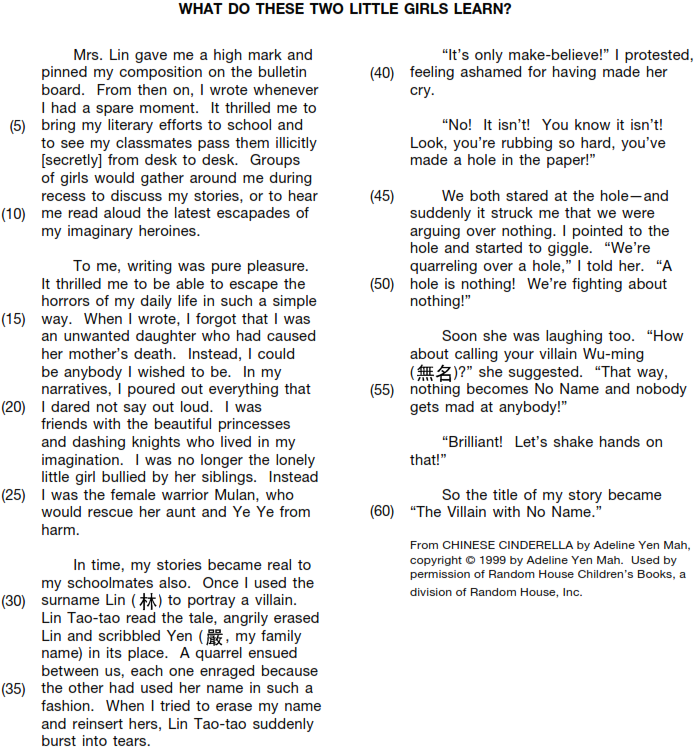
The first two paragraphs (lines 1--27) establish a contrast between which two parts of the narrator's life?
-- Exhibit --
-- Exhibit --
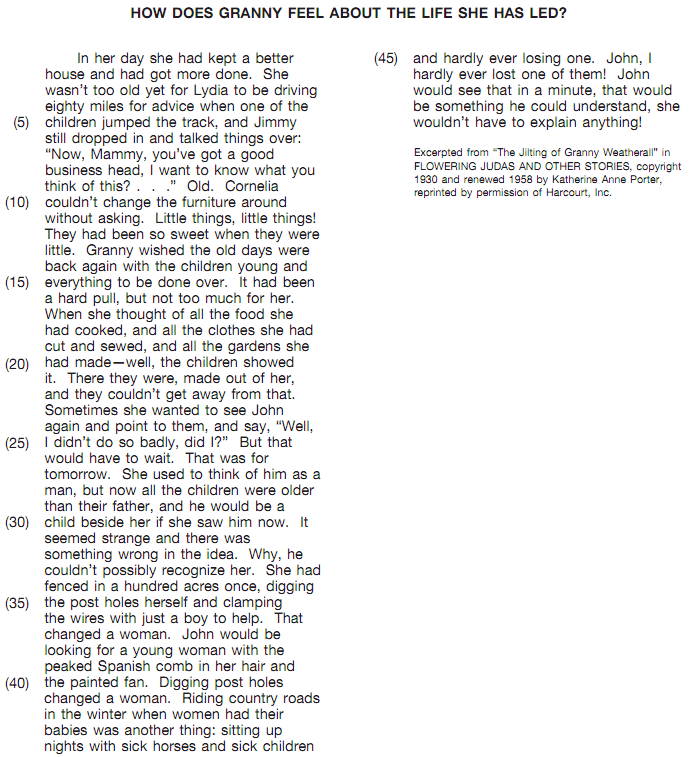
Granny's name is "Weatherall" Based on the information about her in the excerpt, why is this a good name for her?
-- Exhibit --
-- Exhibit --
Suppose that Granny saw a robbery in progress. Based on her character as revealed in this excerpt and assuming she was healthy, what might she do?
-- Exhibit --
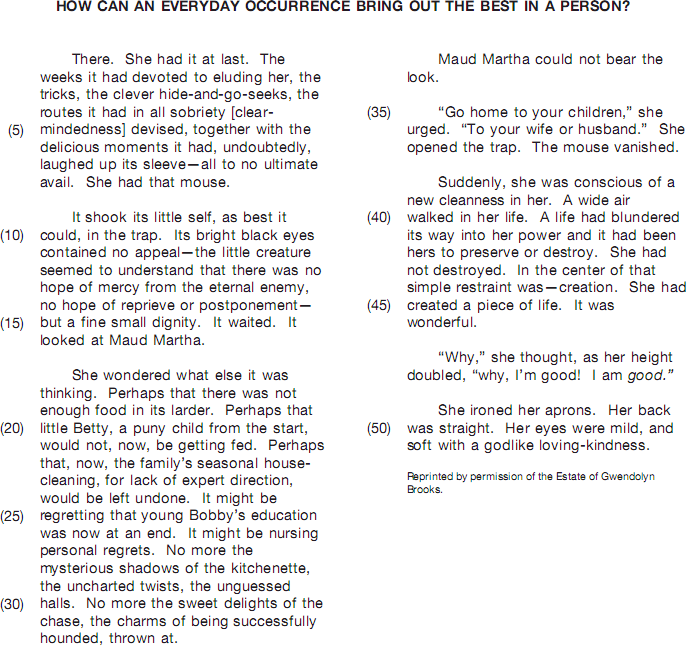
-- Exhibit --
After reading this excerpt, when might a reader go back to it for inspiration and guidance?
Get access to all 240 verified questions with detailed answers.
Unlock All GED-Reading Questions