SPHR Exam Questions & Answers
SPHR - Senior Professional in Human Resources • HRCI
100% money-back guarantee
Sample SPHR Questions
Practice with real exam-style questions, each with the verified correct answer and explanation.
When designing a training evaluation form, it is important to:
Comprehensive and Detailed Explanatio n:
Clarity in evaluation questions ensures accurate, consistent feedback and allows for reliable analysis. Ambiguity leads to inconsistent data that hinders improvements.
SPHR LandD standards support ''valid evaluation design, with clear behavioral-based questions that capture learner feedback and instructional effectiveness.''
It is illegal for an organization to close a facility and move to another state to:
Organizations generally have broad discretion to make business decisions regarding facility closures and relocations; however, this discretion is limited when actions violate federal labor laws. It is illegal to close a facility in order to escape an incumbent union's jurisdiction (D) because this constitutes an unfair labor practice under the National Labor Relations Act (NLRA).
SPHR-level HR practice emphasizes that employers may not take adverse employment actions that interfere with employees' protected rights to organize, bargain collectively, or engage in concerted activity. Closing or relocating a facility with the intent to eliminate union representation or avoid collective bargaining obligations is considered anti-union discrimination and unlawful interference. The National Labor Relations Board (NLRB) has consistently ruled that such actions violate the NLRA.
In contrast, reducing state tax liability (A) and benefiting from a more favorable labor climate (B) are generally lawful business considerations, provided they are not a pretext for union avoidance or retaliation. Employers may relocate operations to manage costs, access talent, or improve operational efficiency, as long as decisions are not motivated by anti-union animus.
Meeting affirmative action goals (C) would also not be illegal in itself; however, affirmative action efforts must comply with equal employment opportunity principles and cannot involve discriminatory practices. This option does not address the legality of facility relocation.
From an SPHR perspective, this question tests knowledge of labor relations, management rights, and prohibited employer conduct. HR leaders must ensure that business decisions are documented, legitimate, and free from unlawful motives---particularly when unionized employees are involved.
HRCI SPHR Exam Content Outline --- Functional Area: Employee Relations and Engagement (labor relations; unfair labor practices; management rights).
HRCI SPHR Study Guide --- Application of NLRA principles to organizational restructuring and facility relocation decisions.
Which of the following is the first question to ask when a department is seeking HR support to hire additional staff?
Before initiating any recruitment process, HR must determine the strategic justification for the request. ''Business necessity'' ensures that the hire aligns with organizational objectives and addresses a critical need. This is essential for headcount control, budget allocation, and workforce planning.
Extract from HRCI-aligned HR knowledge (Leadership and Strategy / Talent Planning domains):
In SPHR, strategic HR must begin by ''evaluating the alignment of talent requests with business needs.'' It's not about filling roles reactively, but about supporting long-term organizational value. HR leaders must act as consultants to internal clients, beginning with ''What is the business case?''
While going through a merger, what is the best way to retain employees with critical skill sets?
The most effective way to retain employees with critical skill sets during a merger is to utilize retention bonuses (B). At the SPHR level, retention bonuses are recognized as a targeted, short-term incentive designed specifically to reduce flight risk during periods of uncertainty.
Mergers create anxiety about job security, role changes, and future direction. Retention bonuses provide a clear financial incentive for key employees to remain through defined transition milestones, protecting deal value and operational continuity.
Stay interviews (A) are useful diagnostic tools but do not provide a tangible retention incentive. Flexible schedules (C) may support engagement but are insufficient alone during high-risk transitions. Non-compete agreements (D) restrict post-employment activity but do not motivate employees to stay.
SPHR exam content emphasizes that retention strategies during MandA must be proactive, targeted, and time-bound, with retention bonuses being the most effective mechanism for critical talent.
HRCI SPHR Exam Content Outline --- Functional Area: Leadership and Strategy (MandA retention; change management).
HRCI SPHR Study Guide --- Retention strategies for key talent during mergers.
Based on the results of a general abilities test below, which of the following decisions should the organization make"?
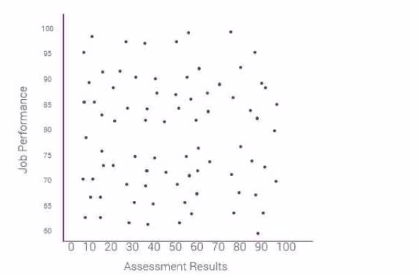
If test results indicate poor validity, fairness, or consistency across job roles, it should not be used at all. Continuing its use could risk legal exposure under EEOC or ADA guidelines.
Per SPHR standards in Talent Planning, any tool used in selection must demonstrate job-relatedness and consistency. If not defensible, it must be removed to avoid adverse impact or discrimination claims.
Get access to all 308 verified questions with detailed answers.
Unlock All SPHR Questions