CIPT Exam Questions & Answers
Certified Information Privacy Technologist • IAPP
100% money-back guarantee
Sample CIPT Questions
Practice with real exam-style questions, each with the verified correct answer and explanation.
SCENARIO
Clean-Q is a company that offers house-hold and office cleaning services. The company receives requests from consumers via their website and telephone, to book cleaning services. Based on the type and size of service, Clean-Q then contracts individuals that are registered on its resource database - currently managed in-house by Clean-Q IT Support. Because of Clean-Q's business model, resources are contracted as needed instead of permanently employed.
The table below indicates some of the personal information Clean-Q requires as part of its business operations:
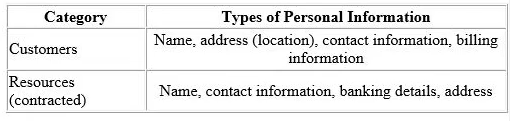
Clean-Q has an internal employee base of about 30 people. A recent privacy compliance exercise has been conducted to align employee data management and human resource functions with applicable data protection regulation. Therefore, the Clean-Q permanent employee base is not included as part of this scenario.
With an increase in construction work and housing developments, Clean-Q has had an influx of requests for cleaning services. The demand has overwhelmed Clean-Q's traditional supply and demand system that has caused some overlapping bookings.
Ina business strategy session held by senior management recently, Clear-Q invited vendors to present potential solutions to their current operational issues. These vendors included Application developers and Cloud-Q's solution providers, presenting their proposed solutions and platforms.
The Managing Director opted to initiate the process to integrate Clean-Q's operations with a cloud solution (LeadOps) that will provide the following solution one single online platform: A web interface that Clean-Q accesses for the purposes of resource and customer management. This would entail uploading resource and customer information.
A customer facing web interface that enables customers to register, manage and submit cleaning service requests online.
A resource facing web interface that enables resources to apply and manage their assigned jobs.
An online payment facility for customers to pay for services.
What is a key consideration for assessing external service providers like LeadOps, which will conduct personal information processing operations on Clean-Q's behalf?
A key consideration for assessing external service providers like LeadOps, which will conduct personal information processing operations on Clean-Q's behalf, is obtaining knowledge of LeadOps' information handling practices and information security environment.
Due Diligence: Evaluating LeadOps' data handling practices ensures that they follow robust data protection principles, including data minimization, purpose limitation, and data retention policies.
Security Measures: Understanding their information security environment involves assessing technical and organizational measures in place to protect personal data. This includes encryption, access controls, incident response plans, and regular security audits.
Compliance and Certification: Verifying compliance with recognized standards such as ISO/IEC 27001 can provide assurance that LeadOps follows best practices in information security management.
Privacy Impact Assessments (PIAs): Conducting a PIA can help identify and mitigate privacy risks associated with outsourcing to LeadOps. It involves evaluating the potential impact on data subjects and implementing appropriate controls to protect their data.
Contractual Safeguards: Ensuring that contracts with LeadOps include specific data protection clauses, such as data processing agreements (DPAs), to delineate responsibilities and ensure compliance with data protection laws.
IAPP Privacy Management, Information Privacy Technologist Certification Textbooks
ISO/IEC 27001 -- Information Security Management Systems
GDPR Article 28 -- Processor
Which of the following is an example of drone ''swarming''?
Drone 'swarming' refers to multiple drones communicating and coordinating with each other to accomplish a task. This involves a group of drones that work together in a cohesive and synchronized manner. In the example given, drones performing a search and rescue by communicating and working together fits the definition of swarming. This collaborative approach leverages the capabilities of multiple drones to cover more ground efficiently and effectively, as supported by IAPP documents on the application of drone technology in coordinated activities.
How can a hacker gain control of a smartphone to perform remote audio and video surveillance?
Hackers can exploit various vulnerabilities to gain unauthorized access to smartphones and perform remote surveillance. Here's how a roving bug can be used:
Roving Bug Installation: A roving bug is a type of software that can be covertly installed on a smartphone to enable remote audio and video surveillance. This malicious software can activate the phone's microphone and camera without the user's knowledge.
Unauthorized Access: The installation of such software can occur through various means, including phishing attacks, malicious apps, or exploiting vulnerabilities in the phone's operating system.
Surveillance Capabilities: Once installed, the hacker can remotely control the phone to eavesdrop on conversations, capture video footage, and monitor the user's activities.
Privacy Breach: This type of intrusion represents a significant privacy breach, as it allows continuous monitoring and recording of the user's private moments and conversations.
Which of the following statements best describes the relationship between privacy and security?
Security systems are essential for protecting data and ensuring that privacy policies are followed. Effective security measures can enforce access controls, encryption, and other protections that help maintain data confidentiality, integrity, and availability. By implementing robust security systems, organizations can ensure that personal information is handled according to privacy policies and regulatory requirements. The IAPP highlights that security is a foundational component for achieving privacy compliance.
IAPP Certification Textbooks, specifically the sections on the relationship between privacy and security.
'Privacy and Data Protection: An Integrated Approach,' IAPP White Paper.
SCENARIO
You have just been hired by Ancillary.com, a seller of accessories for everything under the sun, including waterproof stickers for pool floats and decorative bands and cases for sunglasses. The company sells cell phone cases, e-cigarette cases, wine spouts, hanging air fresheners for homes and automobiles, book ends, kitchen implements, visors and shields for computer screens, passport holders, gardening tools and lawn ornaments, and catalogs full of health and beauty products. The list seems endless. As the CEO likes to say, Ancillary offers, without doubt, the widest assortment of low-price consumer products from a single company anywhere.
Ancillary's operations are similarly diverse. The company originated with a team of sales consultants selling home and beauty products at small parties in the homes of customers, and this base business is still thriving. However, the company now sells online through retail sites designated for industries and demographics, sites such as ''My Cool Ride" for automobile-related products or ''Zoomer'' for gear aimed toward young adults. The company organization includes a plethora of divisions, units and outrigger operations, as Ancillary has been built along a decentered model rewarding individual initiative and flexibility, while also acquiring key assets. The retail sites seem to all function differently, and you wonder about their compliance with regulations and industry standards. Providing tech support to these sites is also a challenge, partly due to a variety of logins and authentication protocols.
You have been asked to lead three important new projects at Ancillary:
The first is the personal data management and security component of a multi-faceted initiative to unify the company's culture. For this project, you are considering using a series of third- party servers to provide company data and approved applications to employees.
The second project involves providing point of sales technology for the home sales force, allowing them to move beyond paper checks and manual credit card imprinting.
Finally, you are charged with developing privacy protections for a single web store housing all the company's product lines as well as products from affiliates. This new omnibus site will be known, aptly, as ''Under the Sun.'' The Director of Marketing wants the site not only to sell Ancillary's products, but to link to additional products from other retailers through paid advertisements. You need to brief the executive team of security concerns posed by this approach.
If you are asked to advise on privacy concerns regarding paid advertisements, which is the most important aspect to cover?
When dealing with paid advertisements, the most important privacy concern is the collection of personal information by cookies linked to the advertising network.
Cookies and Advertising Networks: Cookies are small data files stored on the user's device by websites to track user behavior and preferences. Advertising networks use these cookies to collect personal information and build detailed user profiles for targeted advertising.
Privacy Concerns: The primary concern is that these cookies can collect a vast amount of personal data without explicit user consent. This data can include browsing habits, location, and sometimes even more sensitive information.
Regulatory Compliance: Various regulations, such as the General Data Protection Regulation (GDPR) in Europe and the California Consumer Privacy Act (CCPA) in the U.S., mandate strict guidelines on how personal data can be collected, stored, and used. Non-compliance can lead to significant legal penalties.
Best Practices: Companies need to ensure transparency about data collection practices, obtain user consent, provide options to opt-out, and implement robust security measures to protect collected data.
IAPP Privacy Management, Information Privacy Technologist Certification Textbooks
GDPR Articles 4, 7, and 21
CCPA Sections 1798.100 - 1798.199
Get access to all 220 verified questions with detailed answers.
Unlock All CIPT Questions