NS0-593 Exam Questions & Answers
NetApp certified support engineer - ONTAP specialist • NetApp
100% money-back guarantee
Sample NS0-593 Questions
Practice with real exam-style questions, each with the verified correct answer and explanation.
You have a new VMware vSphere cluster with ESXI 7.0U2 hosts. The hosts are connected to a 4-node AFF A400 NetApp ONTAP 9.8 cluster with FC LUNs. You have a requirement to identify and follow I/Os from each VM on the shared FC LUN-backed datastores for troubleshooting purposes.
In this scenario, which VMware feature Is supported by ONTAP software to accomplish this task?
The VMware feature that is supported by ONTAP software to identify and follow I/Os from each VM on the shared FC LUN-backed datastores is Virtual machine ID (VMID). VMID is a unique identifier assigned to each VM by the vCenter Server. ONTAP software can use VMID to map the VMs to the FC LUNs and provide visibility into the I/O performance and latency of each VM.This feature is also known as Virtual Storage Console (VSC) for VMware vSphere12.Reference:1: Virtual Storage Console for VMware vSphere | NetApp Documentation2: How to use Virtual Storage Console (VSC) to monitor the performance of virtual machines - NetApp Knowledge Base
A customer calls you to troubleshoot a network issue. The customer wants to create a packet trace for all clients on the 192.168.9.0/24 subnet.
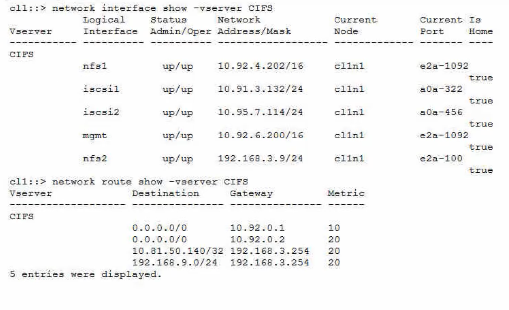
Referring to the exhibit, on which interface do you have to run the packet trace?
To create a packet trace for all clients on the 192.168.9.0/24 subnet, you have to run the packet trace on the interface that has an IP address in the same subnet. According to the exhibit, the only interface that matches this criterion is e2a-100, which has an IP address of 192.168.3.1/24. The other interfaces have IP addresses in different subnets, such as 10.92.4.202/16, 10.91.3.132/24, 10.95.7.114/24, and 10.92.6.200/16. Therefore, the correct answer is B. e2a-100.Reference=How to capture packet traces on ONTAP 9.10+ systems,How to capture packet traces (tcpdump) on ONTAP 9.2 to 9.9 systems,How to download captured packet traces from ONTAP
A customer reports that while Installing Windows updates on their external Vscan servers, clients could not access any files on their CIF-S SVM. The problem disappeared after the update process was completed. The customer wants to prevent this issue from happening during the next patch window.
In this scenario, what are two ways to accomplish this task? (Choose two.)
Updating the Vscan servers one at a time can prevent the clients from losing access to the files on the CIFS SVM, as there will always be at least one Vscan server available for scanning. Disabling the -scan-mandatory flag in the Vscan policy can also avoid the issue, as it allows the clients to access the files even if there are no Vscan servers online, but this may compromise the security of the data. Enabling the -scan-mandatory flag or modifying the CIFS shares to be CA shares will not help, as they do not affect the availability of the Vscan servers or the scanning process.Reference=Vscan server installation and configuration,Update the Vscan On-Access policy configuration for an SVM
A user reports that a colleague saved a file called Test.txt from a UNIX system to a multiprotocol volume. When opening the file later from a Windows system, it was not the file that they wanted. The file that they wanted was named TEST~1.TXT.
Which statement explains this behavior?
= The multiprotocol volume allows clients to access files using both NFS and SMB protocols. The NFS protocol is case-sensitive, meaning that Test.txt and TEST~1.TXT are two different files. The SMB protocol is case-insensitive, meaning that it treats uppercase and lowercase letters as the same when searching for a file. Therefore, when the user opened the file from a Windows system using SMB, the system could not distinguish between Test.txt and TEST~1.TXT and displayed one of them arbitrarily. This could lead to confusion and data loss if the user modified or deleted the wrong file.Reference=Client protocols;Multiprotocol NAS in NetApp ONTAP Overview and Best Practices, page 30-31.
When you review performance data for a NetApp ONTAP cluster node, there are back-to-back (B2B) type consistency points (CPs) found occurring on the loot aggregate.
In this scenario, how will performance of the client operations on the data aggregates be affected?
A B2B type consistency point (CP) occurs when a new CP is triggered before the previous CP is completed, due to the second memory buffer reaching a watermark. This can cause write latency to increase as user write operations are not replied until a write buffer frees up. However, this only affects the aggregate that is undergoing the B2B processing, and not the other aggregates on the same node. Therefore, the performance of the client operations on the data aggregates will not be affected by B2B processing on the root aggregate.Reference=What is the Back-to-Back (B2B) Consistency Point Scenario?,What are the different Consistency Point types and how are they measured in ONTAP 9?,What are the different Consistency Point types and how are they measured?
Get access to all 60 verified questions with detailed answers.
Unlock All NS0-593 Questions