1Z0-076 Exam Questions & Answers
Oracle Database 19c: Data Guard Administration • Oracle
100% money-back guarantee
Sample 1Z0-076 Questions
Practice with real exam-style questions, each with the verified correct answer and explanation.
Which three Data Guard monitoring activities may be performed using Enterprise Manager Cloud Control?
Enterprise Manager Cloud Control offers comprehensive monitoring capabilities for Oracle Data Guard environments. It enables monitoring the rate at which redo is being applied on a logical standby database (A), which is crucial for ensuring that the standby database is keeping up with the changes from the primary. It also allows setting thresholds on performance metrics, such as the redo generation rate on the primary database (B), to alert administrators when values exceed critical or warning thresholds. Additionally, it provides the capability to estimate the potential data loss in the event of a disaster (E), helping in disaster recovery planning and ensuring business continuity.
Reference: Oracle Enterprise Manager Cloud Control documentation provides extensive information on its monitoring features for Oracle Data Guard, including setting thresholds, estimating potential data loss, and tracking redo apply rates.
Your Data Guard environment has one physical standby database using Real-Time Query. Two sequences have been created by these SQL statements:
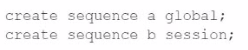
Neither sequence has been used since being created.
Session 1 connects to the primary database instance and issues these two SQL statements:
SELECT a.nextval FROM DUAL; SELECT b.nextval FROM DUAL;
Then session 2 connects to the physical standby database instance and issues the same SQL statements. Which output will be seen for session 2?
Then session 2 connects to the physical standby database instance and issues the same SQL statements. Which output will be seen for session 2?
A)
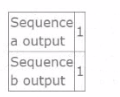
B)
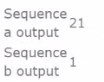
C)
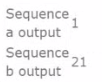
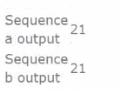
In Oracle, a sequence created with the GLOBAL keyword is available and can produce values across all sessions and instances. However, a sequence created with the SESSION keyword is only specific to the session it was created in. When the NEXTVAL is called for a sequence, it will increment according to the sequence's properties set during its creation.
Given the sequence creation statements and the actions performed:
The a sequence is global, which means it is available across the entire database, including the standby database with Real-Time Query enabled. So, when session 2 calls a.nextval, it will get the next value in the sequence, which is 21 since session 1 already retrieved 1.
The b sequence is session-specific, so when session 2 calls b.nextval, it will get the value 1 because for this new session on the standby, this is the first time the sequence is being accessed.
Therefore, the output for session 2 will be a output as 21 and b output as 1, which corresponds to Option C.
A customer asks you to propose the most appropriate solution for this set of requirements:
We need a disaster recovery solution that enables us to fail over from our production database with zero data loss.
We want to generate reports from the proposed standby database at the same time that it is used for data protection.
Developers may need to test occasionally on a copy of the live database
Which TWO solutions would you recommend?
Which three can be done using Data Guard Broker?
A customer has these requirements for their proposed Data Guard implementation:
1. Zero data loss must still be guaranteed through the loss of any one configuration component.
2. The primary database must be protected against a regional disaster.
3. Performance overheads on the primary should be minimized as much as possible given these requirements.
4. Downtime on the primary database for any reason must be kept to a minimum.
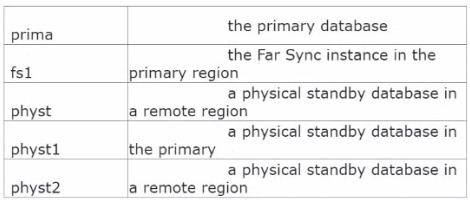
Components referred to in the broker commands are:
A)

B)

C)

D)

According to the requirements stated:
Zero data loss must be guaranteed despite the loss of any one component: This necessitates synchronous redo transport to at least one standby database (for no data loss).
The primary database must be protected against a regional disaster: This implies that there must be a standby database in a different region.
Performance overhead on the primary should be minimized: This suggests that asynchronous transport should be used where possible to reduce the performance impact on the primary.
Downtime on the primary for any reason must be kept to a minimum: This is indicative of a requirement for a fast failover mechanism, possibly with a fast-start failover (FSFO) and high availability.
Given these requirements, the appropriate option that fulfills all these is:
Option C, where 'prima' is the primary database, 'fs1' is the Far Sync instance in the primary region, and 'physt' and 'physt2' are physical standby databases in the primary and remote regions, respectively. In this configuration:
'prima' is set to send redo to 'fs1' using SYNC to guarantee zero data loss.
'fs1' is set to send redo to 'physt' (local standby) using FASTSYNC, which is a low-latency synchronous transport that is optimized for performance.
The Data Guard configuration's protection mode is set to MAXAVAILABILITY to provide the highest level of data protection that is possible without compromising the availability of the primary database.
This configuration ensures that there is zero data loss even if the primary region is completely lost, maintains performance by limiting the synchronous transport to the local region with a Far Sync instance, and has a remote standby database in a separate region for disaster recovery purposes.
Oracle Data Guard Concepts and Administration
Oracle Data Guard Broker documentation
Get access to all 107 verified questions with detailed answers.
Unlock All 1Z0-076 Questions