PCAP-31-03 Exam Questions & Answers
Certified Associate in Python Programming Exam • Python Institute
100% money-back guarantee
About PCAP-31-03 Exam
The PCAP-31-03 certification exam, offered by the Python Institute, is a professional credential that validates your practical knowledge of Python programming fundamentals. This intermediate-level certification demonstrates your ability to write and understand Python code, covering essential topics including object-oriented programming, data structures, file handling, exception management, and working with built-in functions. The PCAP-31-03 exam is ideal for developers, software engineers, IT professionals, and students who want to prove their Python programming competency and advance their careers in software development and data science fields.
To successfully pass the PCAP-31-03 exam, candidates benefit significantly from using updated exam dumps and comprehensive practice tests that simulate the real testing environment. These study materials help you identify knowledge gaps, build confidence, and familiarize yourself with the exam format and question types. Quality practice tests provide detailed explanations for each answer, reinforcing your understanding of Python concepts and improving your problem-solving skills. By combining official study guides with reliable practice materials, candidates can effectively prepare for the exam, achieve higher scores, and earn a credential that stands out to employers and enhances their professional opportunities in the competitive programming industry.
Exam Topics & Objectives
4-Week Study Plan for PCAP-31-03
Week 1: Foundation - Modules, Packages, and Exceptions Basics
- Study module creation and importing: understand import statements, from...import syntax, and module aliasing
- Learn package structure: __init__.py files, nested packages, and package initialization
- Practice relative and absolute imports with hands-on coding exercises
- Understand exception hierarchy: BaseException, Exception, and built-in exception types
- Study try-except-else-finally blocks with multiple except clauses
- Complete 15 practice questions on modules, packages, and basic exception handling
- Create a small project with multiple modules to reinforce import concepts
Week 2: Exceptions Deep Dive and Strings Fundamentals
- Master raising exceptions: raise statement, custom exceptions, and exception chaining
- Study exception handling best practices and exception context
- Learn else and finally clauses in exception handling
- Complete 10 practice questions specifically on exceptions (14% exam weight)
- Study string basics: string literals, escape sequences, and string concatenation
- Learn string indexing, slicing, and immutability properties
- Master built-in string methods: upper(), lower(), strip(), split(), join(), replace(), find()
- Practice string formatting: %, .format(), and f-strings
- Complete 20 practice questions on strings (18% exam weight)
Week 3: Object-Oriented Programming Core Concepts
- Study class definition and instantiation: __init__ and self
- Learn instance attributes and methods with practical examples
- Master class attributes vs instance attributes
- Study inheritance: single and multiple inheritance, method resolution order (MRO)
- Learn super() function and cooperative multiple inheritance
- Practice method overriding and polymorphism concepts
- Study special methods: __str__, __repr__, __eq__, __lt__, __add__, __getitem__
- Learn encapsulation: private attributes (name mangling with __), properties with @property
- Complete 25 practice questions on OOP basics (first half of 34% exam weight)
- Create a multi-class project demonstrating inheritance and method overriding
Week 4: Advanced OOP, Miscellaneous Topics, and Full Practice
- Study abstract base classes and class methods with @classmethod and @staticmethod
- Learn composition and design patterns in Python
- Review special methods and operator overloading
- Complete 20 practice questions on advanced OOP (second half of 34% exam weight)
- Master list comprehensions: syntax, conditions, and nested comprehensions
- Study lambda functions: syntax, use cases, and integration with map(), filter(), sorted()
- Learn closures: nested functions, variable scope, and closure behavior
- Study I/O operations: open(), read(), write(), file modes, context managers with with statement
- Practice file operations: reading lines, iterating files, and file positioning
- Complete 20 practice questions on miscellaneous topics (22% exam weight)
- Take a full-length practice exam (60 questions, 90 minutes)
- Review missed questions and weak topic areas
Sample PCAP-31-03 Questions
Practice with real exam-style questions. Reveal answers to verify your knowledge.
A two-parameter lambda function raising its first parameter to the power of the second parameter should be declared as:
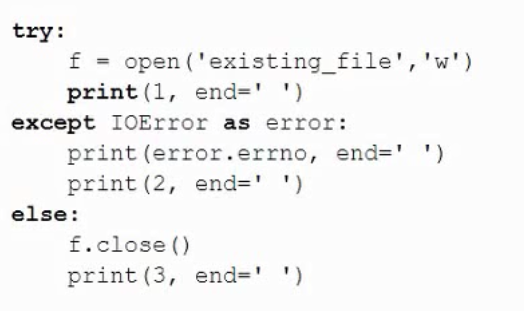
What is the expected output of the following code if existing_file is the name of a file located inside the working directory?
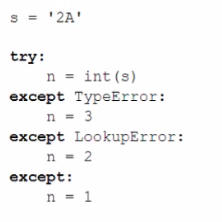
What is the expected behavior of the following code?
Select the valid fun () invocations:
(select two answers)
def fun (a, b=0):
return a*b
Python's built-in function named open () tries to open a file and returns:
Get access to all 147 verified questions with detailed answers.
Unlock All PCAP-31-03 Questions