PCEP-30-02 Exam Questions & Answers
PCEP - Certified Entry-Level Python Programmer • Python Institute
100% money-back guarantee
Sample PCEP-30-02 Questions
Practice with real exam-style questions, each with the verified correct answer and explanation.
Assuming that the following assignment has been successfully executed:

Which of the following expressions evaluate to True? (Select two expressions.)
The code snippet that you have sent is assigning a list of four values to a variable called ''the_list''. The code is as follows:
the_list = ['1', 1, 1, 1]
The code creates a list object that contains the values '1', 1, 1, and 1, and assigns it to the variable ''the_list''. The list can be accessed by using the variable name or by using the index of the values. The index starts from 0 for the first value and goes up to the length of the list minus one for the last value. The index can also be negative, in which case it counts from the end of the list. For example, the_list[0] returns '1', and the_list[-1] returns 1.
The expressions that you have given are trying to evaluate some conditions on the list and return a boolean value, either True or False. Some of them are valid, and some of them are invalid and will raise an exception. An exception is an error that occurs when the code cannot be executed properly. The expressions are as follows:
A) the_List.index {''1''} in the_list: This expression is trying to check if the index of the value '1' in the list is also a value in the list. However, this expression is invalid, because it uses curly brackets instead of parentheses to call the index method. The index method is used to return the first occurrence of a value in a list. For example, the_list.index('1') returns 0, because '1' is the first value in the list. However, the_list.index {''1''} will raise a SyntaxError exception and output nothing.
B) 1.1 in the_list |1:3 |: This expression is trying to check if the value 1.1 is present in a sublist of the list. However, this expression is invalid, because it uses a vertical bar instead of a colon to specify the start and end index of the sublist. The sublist is obtained by using the slicing operation, which uses square brackets and a colon to get a part of the list. For example, the_list[1:3] returns [1, 1], which is the sublist of the list from the index 1 to the index 3, excluding the end index. However, the_list |1:3 | will raise a SyntaxError exception and output nothing.
C) len (the list [0:2]} <3: This expression is trying to check if the length of a sublist of the list is less than 3. This expression is valid, because it uses the len function and the slicing operation correctly. The len function is used to return the number of values in a list or a sublist. For example, len(the_list) returns 4, because the list has four values. The slicing operation is used to get a part of the list by using square brackets and a colon. For example, the_list[0:2] returns ['1', 1], which is the sublist of the list from the index 0 to the index 2, excluding the end index. The expression len (the list [0:2]} <3 returns True, because the length of the sublist ['1', 1] is 2, which is less than 3.
D) the_list. index {'1'} -- 0: This expression is trying to check if the index of the value '1' in the list is equal to 0. This expression is valid, because it uses the index method and the equality operator correctly. The index method is used to return the first occurrence of a value in a list. For example, the_list.index('1') returns 0, because '1' is the first value in the list. The equality operator is used to compare two values and return True if they are equal, or False if they are not. For example, 0 == 0 returns True, and 0 == 1 returns False. The expression the_list. index {'1'} -- 0 returns True, because the index of '1' in the list is 0, and 0 is equal to 0.
Therefore, the correct answers are C. len (the list [0:2]} <3 and D. the_list. index {'1'} -- 0.
What is true about tuples? (Select two answers.)
Tuples are one of the built-in data types in Python that are used to store collections of data. Tuples have some characteristics that distinguish them from other data types, such as lists, sets, and dictionaries. Some of these characteristics are:
Therefore, the correct answers are A. Tuples are immutable, which means that their contents cannot be changed during their lifetime. and D. Tuples can be indexed and sliced like lists.
What is the expected output of the following code?
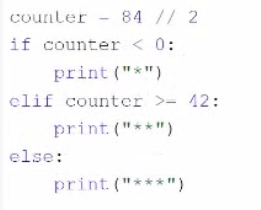
The code snippet that you have sent is a conditional statement that checks if a variable ''counter'' is less than 0, greater than or equal to 42, or neither. The code is as follows:
if counter < 0: print('''') elif counter >= 42: print('''') else: print('''')
The code starts with checking if the value of ''counter'' is less than 0. If yes, it prints a single asterisk () to the screen and exits the statement. If no, it checks if the value of ''counter'' is greater than or equal to 42. If yes, it prints three asterisks () to the screen and exits the statement. If no, it prints two asterisks () to the screen and exits the statement.
The expected output of the code depends on the value of ''counter''. If the value of ''counter'' is 10, as shown in the image, the code will print two asterisks (**) to the screen, because 10 is neither less than 0 nor greater than or equal to 42. Therefore, the correct answer is C. * *
Assuming that the following assignment has been successfully executed:
My_list -- [1, 1, 2, 3]
Select the expressions which will not raise any exception.
(Select two expressions.)
The code snippet that you have sent is assigning a list of four numbers to a variable called ''my_list''. The code is as follows:
my_list = [1, 1, 2, 3]
The code creates a list object that contains the elements 1, 1, 2, and 3, and assigns it to the variable ''my_list''. The list can be accessed by using the variable name or by using the index of the elements. The index starts from 0 for the first element and goes up to the length of the list minus one for the last element. The index can also be negative, in which case it counts from the end of the list. For example, my_list[0] returns 1, and my_list[-1] returns 3.
The code also allows some operations on the list, such as slicing, concatenation, repetition, and membership. Slicing is used to get a sublist of the original list by specifying the start and end index. For example, my_list[1:3] returns [1, 2]. Concatenation is used to join two lists together by using the + operator. For example, my_list + [4, 5] returns [1, 1, 2, 3, 4, 5]. Repetition is used to create a new list by repeating the original list a number of times by using the * operator. For example, my_list * 2 returns [1, 1, 2, 3, 1, 1, 2, 3]. Membership is used to check if an element is present in the list by using the in operator. For example, 2 in my_list returns True, and 4 in my_list returns False.
The expressions that you have given are trying to access or manipulate the list in different ways. Some of them are valid, and some of them are invalid and will raise an exception. An exception is an error that occurs when the code cannot be executed properly. The expressions are as follows:
A) my_list[-10]: This expression is trying to access the element at the index -10 of the list. However, the list only has four elements, so the index -10 is out of range. This will raise an IndexError exception and output nothing.
B) my_list|my_Li1st | 3| I: This expression is trying to perform a bitwise OR operation on the list and some other operands. The bitwise OR operation is used to compare the binary representation of two numbers and return a new number that has a 1 in each bit position where either number has a 1. For example, 3 | 1 returns 3, because 3 in binary is 11 and 1 in binary is 01, and 11 | 01 is 11. However, the bitwise OR operation cannot be applied to a list, because a list is not a number. This will raise a TypeError exception and output nothing.
C) my list [6]: This expression is trying to access the element at the index 6 of the list. However, the list only has four elements, so the index 6 is out of range. This will raise an IndexError exception and output nothing.
D) my_List- [0:1]: This expression is trying to perform a subtraction operation on the list and a sublist. The subtraction operation is used to subtract one number from another and return the difference. For example, 3 - 1 returns 2. However, the subtraction operation cannot be applied to a list, because a list is not a number. This will raise a TypeError exception and output nothing.
Only two expressions will not raise any exception. They are:
B) my_list|my_Li1st | 3| I: This expression is not a valid Python code, but it is not an expression that tries to access or manipulate the list. It is just a string of characters that has no meaning. Therefore, it will not raise any exception, but it will also not output anything.
D) my_List- [0:1]: This expression is a valid Python code that uses the slicing operation to get a sublist of the list. The slicing operation does not raise any exception, even if the start or end index is out of range. It will just return an empty list or the closest possible sublist. For example, my_list[0:10] returns [1, 1, 2, 3], and my_list[10:20] returns []. The expression my_List- [0:1] returns the sublist of the list from the index 0 to the index 1, excluding the end index. Therefore, it returns [1]. This expression will not raise any exception, and it will output [1].
Therefore, the correct answers are B. my_list|my_Li1st | 3| I and D. my_List- [0:1].
What is the expected output of the following code?
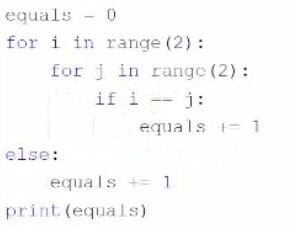
The code snippet that you have sent is checking if two numbers are equal and printing the result. The code is as follows:
num1 = 1 num2 = 2 if num1 == num2: print(4) else: print(1)
The code starts with assigning the values 1 and 2 to the variables ''num1'' and ''num2'' respectively. Then, it enters an if statement that compares the values of ''num1'' and ''num2'' using the equality operator (==). If the values are equal, the code prints 4 to the screen. If the values are not equal, the code prints 1 to the screen.
The expected output of the code is 1, because the values of ''num1'' and ''num2'' are not equal. Therefore, the correct answer is C. 1.
Get access to all 30 verified questions with detailed answers.
Unlock All PCEP-30-02 Questions