OGB-001 Exam Questions & Answers
TOGAF Business Architecture Part 1 • The Open Group
100% money-back guarantee
Sample OGB-001 Questions
Practice with real exam-style questions, each with the verified correct answer and explanation.
Which of the following best describes a TOGAF Business Scenario?
This answer is based on the definition of a TOGAF Business Scenario as ''a technique for articulating, developing, and validating the requirements of the business''1. A TOGAF Business Scenario is a complete description of a business problem in both business and architectural terms, which enables individual requirements to be viewed in relation to one another in the context of the overall problem. A TOGAF Business Scenario consists of six elements: business environment, actors, roles, business process, desired outcome, and quality attributes. The other options are not correct, as they do not describe a TOGAF Business Scenario.
Which input to Phase A provides context for the architecture work by describing the needs and ways of working of the enterprise?
This answer is based on the TOGAF Standard, Version 9.2 - Phase A: Architecture Vision1, which states that ''Business principles, business goals, and strategic drivers of the organization are already defined elsewhere in the enterprise. If so, the activity in Phase A is involved with ensuring that existing definitions are current, and clarifying any areas of ambiguity. Otherwise, it involves defining these essential items from scratch.'' Business principles, goals, and drivers provide context for the architecture work by describing the needs and ways of working of the enterprise. They define the desired outcomes, the guiding values, and the strategic direction of the enterprise. They also help to align the architecture work with the business strategy and objectives. The other options are not correct, as they do not provide context for the architecture work in Phase A.
Which of the following best describes what a business model is?
A business model is a plan that describes how a business intends to make money by providing value to its customers or clients. It defines the value proposition, the target market, the revenue streams, and the cost structure of the business.According to Investopedia1, a business model is ''a company's plan for making a profit.It identifies the products or services the business plans to sell, its identified target market, and any anticipated expenses
In which pan of a business scenario are business capabilities and value streams modelled?
This answer is based on the TOGAF Standard, Version 9.2 - Business Scenarios , which states that ''The business and technology environment is a description of the current situation in terms of business processes (including business capabilities), people (including skills), information (including data), applications (including software), infrastructure (including hardware), and governance (including standards).'' Business capabilities and value streams are modeled when identifying the business and technology environment, as they provide a high-level view of what the business does or can do, and how it delivers value to its stakeholders. The other options are not correct, as they are not parts of a business scenario where business capabilities and value streams are modeled.
Consider the following definition of the elements of a value stream:
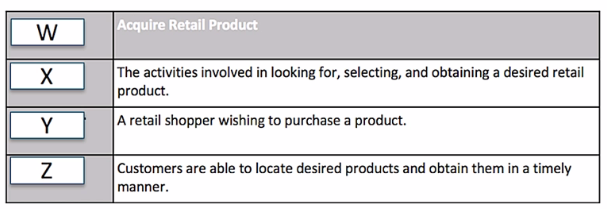
What is the element labeled 7?
This answer is based on the TOGAF Series Guide: Value Streams2, which states that ''Value is a measurable improvement to a stakeholder's situation that is perceived to be positive by that stakeholder.'' Value is the element labeled 7 in the image, as it represents the benefit or outcome that is delivered to the stakeholder by the value stream. Value is always defined from the perspective of the stakeholder, and it can be expressed in quantitative or qualitative terms. The other options are not correct, as they do not match the element labeled 7 in the image.
Get access to all 30 verified questions with detailed answers.
Unlock All OGB-001 Questions