OGBA-101 Exam Questions & Answers
TOGAF Business Architecture Foundation Exam • The Open Group
100% money-back guarantee
Sample OGBA-101 Questions
Practice with real exam-style questions, each with the verified correct answer and explanation.
Consider the following example value stream:

Which of the following statements is most correct?
According to the TOGAF Series Guide to Value Streams (Version 1), a value stream stage is defined as ''a distinct part of a value stream that represents a group of activities contributing to an overall result''5.A value stream stage can be expressed as a noun phrase that indicates what outcome or state is achieved by completing the stage5. For example, some possible value stream stages are ''Product Ordered'', ''Payment Processed'', or ''Customer Satisfied''.The example value stream shows how an online retailer creates and delivers value for its customers by performing five value stream stages: ''Acquire Retail Product'', ''Advertise Channels'', ''Display Products'', ''Enable Selection'', ''Process Payment'', and ''Deliver Product(s)''5. Therefore, the value stream is decomposed into five value stream stages.
https://pubs.opengroup.org/togaf-standard/business-architecture/value-streams.html Table 1: Acquire Retail Product Value Stream Stages
Which of the following best describes this diagram?
The diagram presented is best described as a Business Capability Map. Here's a detailed explanation:
Business Capability Map:
Definition: A Business Capability Map represents the various capabilities an organization requires to deliver its products and services and achieve its strategic objectives. It typically categorizes capabilities into different levels or tiers, such as strategic, core, and supporting capabilities.
Diagram Analysis:
Layers and Groupings: The diagram shows capabilities grouped into three categories: Strategic, Core, and Supporting. Each group lists specific business capabilities necessary for the organization's functioning.
Color Coding: The use of different colors (green, red, yellow, purple) may indicate various aspects such as priority, status, or different business units. However, the primary purpose is to visually represent and categorize capabilities.
TOGAF Reference:
Phase B: Business Architecture: In this phase, creating a Business Capability Map is a crucial activity. It helps in understanding the business functions and aligning them with strategic goals.
Capability-Based Planning: TOGAF promotes capability-based planning, which involves identifying, mapping, and analyzing business capabilities to ensure they support the overall strategy and objectives.
Purpose and Benefits:
Strategic Alignment: The Business Capability Map helps in aligning business capabilities with the strategic objectives of the organization. It provides a clear view of what the organization needs to do to achieve its goals.
Gap Analysis: It is useful for conducting gap analysis by comparing current capabilities with the desired state, helping to identify areas for improvement.
Resource Allocation: By understanding the different capabilities, organizations can allocate resources more effectively to areas that need development or enhancement.
In summary, the diagram is best described as a Business Capability Map because it visually represents and categorizes the various capabilities needed by the organization into strategic, core, and supporting layers, aligning them with the business strategy and objectives.
Consider the following ADM phases objectives.
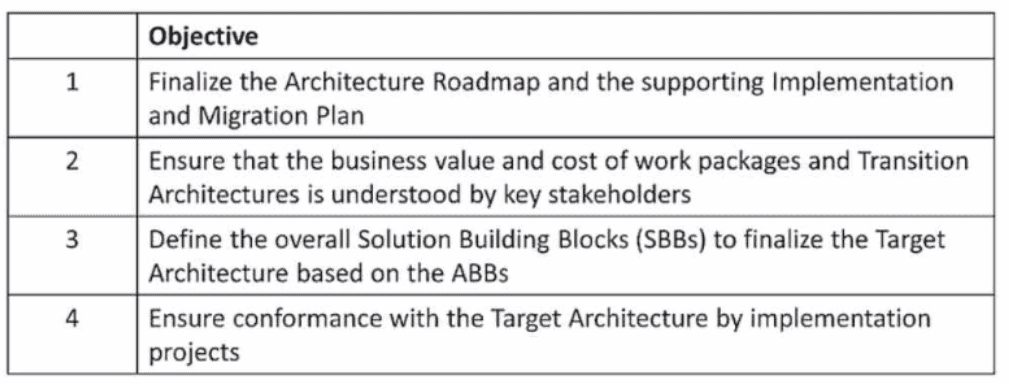
Which phase does each objective match?
Which of the following best describes a benefit of business models?
Business models are essential tools within TOGAF for providing different perspectives on the business operations, strategies, and value propositions. Here's a detailed explanation:
Purpose of Business Models:
Business models are designed to represent various aspects of the business, such as value creation, delivery, and capture mechanisms. They provide a structured way to analyze and understand the business.
Different Viewpoint:
Cross-Check Assumptions: Business models offer a different viewpoint that helps in validating and cross-checking assumptions made about the business. By presenting a visual and structured representation of the business, these models enable stakeholders to identify gaps, inconsistencies, and areas that need further analysis.
Holistic Understanding: They help in gaining a holistic understanding of how different components of the business interact, which is crucial for ensuring that the enterprise architecture aligns with the business strategy and goals.
TOGAF Reference:
Phase A: Architecture Vision: During this phase, business models are used to articulate the vision and scope of the architecture effort. They help in ensuring that all assumptions are validated and that the architecture aligns with business objectives.
Phase B: Business Architecture: Business models are also utilized in this phase to analyze business capabilities, processes, and value streams. They provide a different viewpoint that aids in identifying areas for improvement and ensuring alignment with the strategic intent.
In summary, business models provide a different viewpoint that helps cross-check assumptions, ensuring that the enterprise architecture is aligned with the business strategy and objectives.
Consider the following statements;
1. A whole corporation or a division of a corporation
2. A government agency or a single government department
3. Partnerships and alliances of businesses working together, such as a consortium or supply chain
What are those examples of according to the TOGAF Standard?
According to the TOGAF Standard, an enterprise is defined as any collection of organizations that has a common set of goals and/or a single bottom line1.The examples given in the question are all types of enterprises that can be the subject of enterprise architecture1.
In the context of TOGAF, the term 'enterprise' encompasses more than just a single organization. It refers to any collection of organizations that has a common set of goals. This can include, as described in the statements provided, entire corporations or their divisions, government agencies or departments, as well as business partnerships such as consortia or supply chains. TOGAF uses the term 'enterprise' to define the full scope of the entity that is the subject of planning, design, implementation, and operation of an Enterprise Architecture.
Get access to all 128 verified questions with detailed answers.
Unlock All OGBA-101 Questions