2V0-13.24 Exam Questions & Answers
VMware Cloud Foundation 5.2 Architect Exam • VMware
100% money-back guarantee
Sample 2V0-13.24 Questions
Practice with real exam-style questions, each with the verified correct answer and explanation.
An architect is designing a VMware Cloud Foundation (VCF)-based Private Cloud solution. During the requirements gathering workshop with customer stakeholders, the following information was captured:
The solution must be capable of deploying 50 concurrent workloads.
The solution must ensure that once submitted, each service does not take longer than 6 hours to provision.
When creating the design documentation, which design quality should be used to classify the stated requirements?
In VMware Cloud Foundation (VCF) 5.2, design qualities (or non-functional requirements) categorize how the solution meets its objectives. The requirements---''deploying 50 concurrent workloads'' and ''provisioning each service within 6 hours''---must be classified under a quality that reflects their intent. Let's evaluate each option:
Option A: Availability
Availability ensures the solution is accessible and operational when needed (e.g., uptime percentage). While deploying workloads and provisioning services assume availability, the requirements focus on speed and capacity (50 concurrent workloads, 6-hour limit), not uptime or fault tolerance. This quality doesn't directly address the stated needs, making it incorrect.
Option B: Recoverability
Recoverability addresses the ability to restore services after a failure (e.g., disaster recovery). The requirements don't mention failure scenarios, backups, or restoration---they focus on provisioning speed and concurrency during normal operation. Recoverability is unrelated to these operational metrics, so this is incorrect.
Option C: Performance
This is the correct answer. Performance measures how well the solution executes tasks, including speed, throughput, and capacity. In VCF 5.2:
''Deploying 50 concurrent workloads'' is a throughput requirement, ensuring the system can handle multiple deployments simultaneously.
''Each service does not take longer than 6 hours to provision'' is a latency or response time requirement, setting a performance boundary.
Both align with the performance quality, which governs resource efficiency and user experience in provisioning workflows (e.g., via SDDC Manager or Aria Automation). This classification fits VMware's design framework.
Option D: Manageability
Manageability focuses on ease of administration, monitoring, and maintenance (e.g., automation, UI simplicity). While provisioning workloads involves management, the requirements emphasize how fast and how many---performance metrics---not the ease of managing the process. Manageability might apply to tools enabling this, but it's not the primary quality here.
Conclusion:
The design quality to classify these requirements is Performance (Option C). It directly reflects the solution's ability to handle 50 concurrent workloads and provision services within 6 hours, aligning with VCF 5.2's focus on operational efficiency.
VMware Cloud Foundation 5.2 Planning and Preparation Guide (Section: Design Qualities)
VMware Cloud Foundation 5.2 Architecture and Deployment Guide (Section: Performance Considerations)
An architect is designing a VMware Cloud Foundation (VCF)-based private cloud solution for a customer. The customer has stated the following requirement:
All components within the solution must be resilient to N+1.
During discovery, the following information has also been provided:
Over the next 3 years, due to various applications being retired, no overall growth in resource consumption is expected.
Following a review of a demand-based capacity report from Aria Operations, the architect has calculated that all of the existing workloads should fit into a 4-node cluster. Once all workloads are migrated, the resources of the cluster will be 90% utilized.
Given the information provided, a combination of which three design decisions satisfy the requirement? (Choose three.)
The requirement for N+1 resiliency means the solution must tolerate the failure of one component (in this case, one ESXi host) without disrupting workloads. In VMware Cloud Foundation (VCF), this is typically achieved through vSphere High Availability (HA) settings and sufficient host capacity. The scenario provides key constraints: a 4-node cluster can handle all workloads at 90% utilization, and no growth is expected. Let's evaluate each option:
Option A: Set the DRS Automation level to Partially Automated
DRS (Dynamic Resource Scheduling) balances workloads across hosts, but the automation level (Partially Automated vs. Fully Automated) doesn't directly impact N+1 resiliency. Partially Automated requires manual approval for migrations, which doesn't enhance or detract from HA-based resiliency. While DRS is useful, this specific setting isn't critical to the N+1 requirement, per the VMware Cloud Foundation 5.2 Architectural Guide.
Option B: Deploy a workload cluster consisting of five VMware vSphere hosts
A 5-node cluster provides N+1 resiliency when paired with HA configured to tolerate one host failure. If one host fails, the remaining four can handle the workload, assuming capacity planning accounts for this. The Aria Operations report indicates a 4-node cluster is sufficient at 90% utilization, but adding a fifth host ensures capacity remains after a failure (reducing utilization to ~72% across four hosts: 90% / 1.25). This aligns with VCF's standard architecture recommendations for resiliency (VMware Cloud Foundation 5.2 Architectural Guide).
Option C: Set the Host failures cluster tolerates for the workload cluster to 1
This HA setting ensures the cluster reserves capacity (e.g., CPU and memory) to failover VMs from one failed host. In VCF, setting ''Host failures cluster tolerates'' to 1 is a direct implementation of N+1 resiliency, making it a required design decision (vSphere Availability Guide and VCF 5.2 Administration Guide).
Option D: Deploy a workload cluster consisting of four VMware vSphere hosts
A 4-node cluster meets capacity needs at 90% utilization but lacks N+1 resiliency without additional capacity. If one host fails, the remaining three would be overcommitted (120% utilization: 90% / 0.75), risking performance or availability. Thus, this doesn't satisfy the requirement alone.
Option E: Configure vSphere High Availability (HA) for the workload cluster
HA is foundational to N+1 resiliency in vSphere and VCF, enabling VM restarts on surviving hosts after a failure. Without HA, N+1 cannot be achieved, making this a mandatory choice (VMware Cloud Foundation 5.2 Administration Guide).
Option F: Configure vSphere Dynamic Resource Scheduling (DRS) for the workload cluster
DRS enhances performance by balancing workloads but isn't strictly required for N+1 resiliency, which focuses on availability, not optimization. It's a best practice in VCF but not one of the three critical decisions for this requirement.
Conclusion:
B: A 5-node cluster provides the extra host for N+1.
C: HA set to tolerate 1 host failure implements N+1 policy.
E: HA configuration enables failover, a core N+1 component.
Options B, C, and E together ensure the cluster can lose one host without service disruption, meeting the customer's requirement.
VMware Cloud Foundation 5.2 Architectural Guide (docs.vmware.com): Section on Workload Domain Design and HA/DRS Configuration.
vSphere Availability Guide (docs.vmware.com): Chapter on Configuring High Availability.
VMware Cloud Foundation 5.2 Administration Guide (docs.vmware.com): HA and Cluster Sizing Guidelines.
As part of a new VMware Cloud Foundation (VCF) deployment, a customer is planning to implement vSphere IaaS control plane. What component could be installed and enabled to implement the solution?
The vSphere IaaS (Infrastructure-as-a-Service) control plane in VCF 5.2 enables self-service provisioning and automation of virtualized resources, integrating with vSphere's Supervisor Cluster for cloud-like functionality. Option A, 'Aria Automation' (formerly vRealize Automation), is the correct component, providing orchestration, cloud templates, and self-service portals to manage IaaS workloads in VCF. It integrates with vSphere and NSX to deliver this capability. Option B, 'NSX Edge networking,' focuses on networking, not IaaS control. Option C, 'Storage DRS,' optimizes storage but isn't a control plane. Option D, 'Aria Operations,' is for monitoring, not provisioning. VMware's documentation confirms Aria Automation's role in VCF IaaS.
When sizing a VMware Cloud Foundation VI Workload Domain, which three factors should be considered when calculating usable compute capacity? (Choose three.)
When sizing a VMware Cloud Foundation (VCF) VI Workload Domain, calculating usable compute capacity involves determining the resources available for workloads after accounting for overheads and system-level requirements. In VCF 5.2, a VI Workload Domain integrates vSphere, vSAN, and NSX, and certain factors directly impact the compute capacity available to virtual machines. Based on the official VMware Cloud Foundation 5.2 documentation, the three key factors to consider are vSphere HA, vSAN, and NIOC.
During a requirement capture workshop, the customer expressed a plan to use Aria Operations Continuous Availability. The customer identified two datacenters that meet the network requirements to support Continuous Availability; however, they are unsure which of the following datacenters would be suitable for the Witness Node.
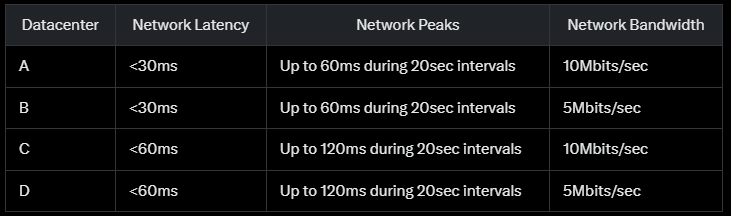
Which datacenter meets the minimum network requirements for the Witness Node?
VMware Aria Operations Continuous Availability (CA) is a feature in VMware Aria Operations (integrated with VMware Cloud Foundation 5.2) that provides high availability by splitting analytics nodes across two fault domains (datacenters) with a Witness Node in a third location to arbitrate in case of a split-brain scenario. The Witness Node has specific network requirements for latency and bandwidth to ensure reliable communication with the primary and replica nodes. These requirements are outlined in the VMware Aria Operations documentation, which aligns with VCF 5.2 integration.
VMware Aria Operations CA Witness Node Network Requirements:
Network Latency:
The Witness Node requires a round-trip latency of less than 100ms between itself and both fault domains under normal conditions.
Peak latency spikes are acceptable if they are temporary and do not exceed operational thresholds, but sustained latency above 100ms can disrupt Witness functionality.
Network Bandwidth:
The minimum bandwidth requirement for the Witness Node is 10Mbits/sec (10 Mbps) to support heartbeat traffic, state synchronization, and arbitration duties. Lower bandwidth risks communication delays or failures.
Network Stability:
Temporary latency spikes (e.g., during 20-second intervals) are tolerable as long as the baseline latency remains within limits and bandwidth supports consistent communication.
Evaluation of Each Datacenter:
Datacenter A: <30ms latency, peaks up to 60ms during 20sec intervals, 10Mbits/sec bandwidth
Latency: Baseline latency is <30ms, well below the 100ms threshold. Peak latency of 60ms during 20-second intervals is still under 100ms and temporary, posing no issue.
Bandwidth: 10Mbits/sec meets the minimum requirement.
Conclusion: Datacenter A fully satisfies the Witness Node requirements.
Datacenter B: <30ms latency, peaks up to 60ms during 20sec intervals, 5Mbits/sec bandwidth
Latency: Baseline <30ms and peaks up to 60ms are acceptable, similar to Datacenter A.
Bandwidth: 5Mbits/sec falls below the required 10Mbits/sec, risking insufficient capacity for Witness Node traffic.
Conclusion: Datacenter B does not meet the bandwidth requirement.
Datacenter C: <60ms latency, peaks up to 120ms during 20sec intervals, 10Mbits/sec bandwidth
Latency: Baseline <60ms is within the 100ms limit, but peaks of 120ms exceed the threshold. While temporary (20-second intervals), such spikes could disrupt Witness Node arbitration if they occur during critical operations.
Bandwidth: 10Mbits/sec meets the requirement.
Conclusion: Datacenter C fails due to excessive latency peaks.
Datacenter D: <60ms latency, peaks up to 120ms during 20sec intervals, 5Mbits/sec bandwidth
Latency: Baseline <60ms is acceptable, but peaks of 120ms exceed 100ms, similar to Datacenter C, posing a risk.
Bandwidth: 5Mbits/sec is below the required 10Mbits/sec.
Conclusion: Datacenter D fails on both latency peaks and bandwidth.
Conclusion:
Only Datacenter A meets the minimum network requirements for the Witness Node in Aria Operations Continuous Availability. Its baseline latency (<30ms) and peak latency (60ms) are within the 100ms threshold, and its bandwidth (10Mbits/sec) satisfies the minimum requirement. Datacenter B lacks sufficient bandwidth, while Datacenters C and D exceed acceptable latency during peaks (and D also lacks bandwidth). In a VCF 5.2 design, the architect would recommend Datacenter A for the Witness Node to ensure reliable CA operation.
VMware Cloud Foundation 5.2 Architecture and Deployment Guide (Section: Aria Operations Integration)
VMware Aria Operations 8.10 Documentation (integrated in VCF 5.2): Continuous Availability Planning
VMware Aria Operations 8.10 Installation and Configuration Guide (Section: Network Requirements for Witness Node)
Get access to all 90 verified questions with detailed answers.
Unlock All 2V0-13.24 Questions