C90.03 Exam Questions & Answers
Cloud Technology Lab • Arcitura Education
100% money-back guarantee
Sample C90.03 Questions
Practice with real exam-style questions, each with the verified correct answer and explanation.
Organization A has been expanding and, as a result, is outgrowing the processing capacity of its on-premise Service A implementation. It is determined that this is due to usage thresholds of Service A and complex data processing limitations in Database A . The diagram depicts Organization A's current on-premise environment, where Service Consumers A . B and C attempt to access Service A at the same time. Service Consumer A successfully accesses Service A, which then successfully retrieves the requested data (1). Service Consumer B successfully accesses Service A, but due to the complex data structure, the request for the data times out and fails (2). Finally, Service Consumer C attempts to access Service A, but is rejected because Service A is unable to accept more concurrent requests.
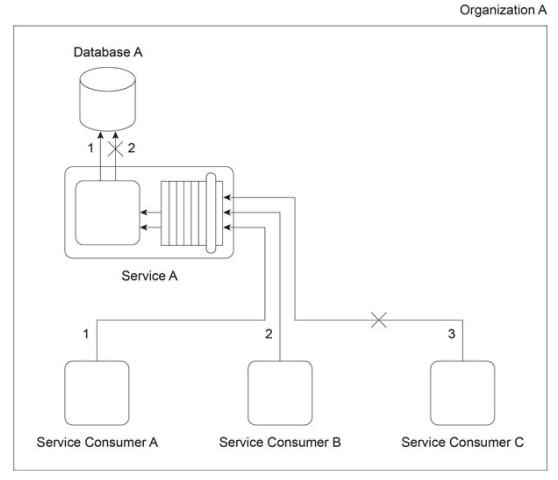
Organization A is required to continue using its on-premise Service A implementation, with the exception of Database A, which does not need to remain on-premise. Database A is dedicated to Service A and is comprised of relational data. Which of the following statements provides a solution that uses cloud-based IT resources to solve the performance limitations of Service A and Database A?
Cloud Provider X has deployed a virtualization environment in Cloud X comprised of Physical Server A hosting Virtual Servers A and B. Cloud Provider X implements Cloud Service A on Virtual Server A and makes it available to Cloud Service Consumer A, which interacts with Cloud Service A by sending and receiving messages (1, 2). Cloud Provider Y has deployed a virtualization environment comprised of Physical Server B hosting Virtual Servers C and D. Virtual Server C is made available to Cloud Service Consumer B, which interacts with Virtual Server C (3,4) in order to prepare for the deployment of a new cloud service that will be used internally by Cloud Provider Y to process data obtained from Cloud Service A .
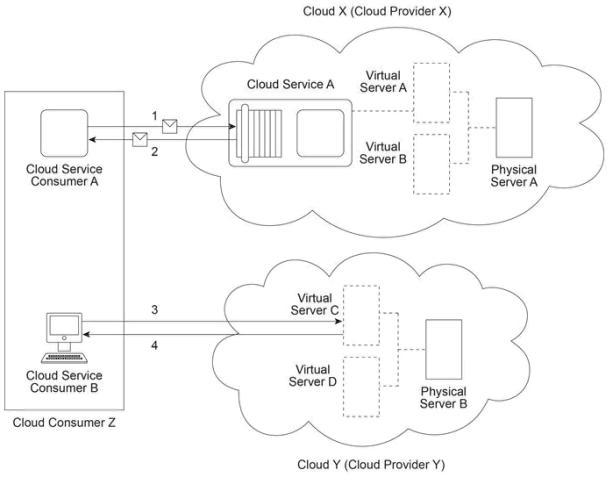
Cloud X is administered by a group of organizations and makes Cloud Service A available only to cloud service consumers from that group. Cloud Consumer Z belongs to one of the organizations within this group. Cloud Y and Cloud Consumer Z are owned by the same organization. Which of the following statements provides a valid scenario that accurately describes the involvement of cloud deployment models, cloud delivery models, roles and/or boundaries? (Note that the correct answer represents one of multiple valid scenarios that can exist.)
Cloud Consumer A (the organization that owns Cloud Service Consumer A) needs regular access to an external, cloud-based Weather Service that provides up-to-date weather forecast information. Cloud Providers X, Y and Z are competing public cloud providers, each offering a Weather Service with the features required by Cloud Consumer A .
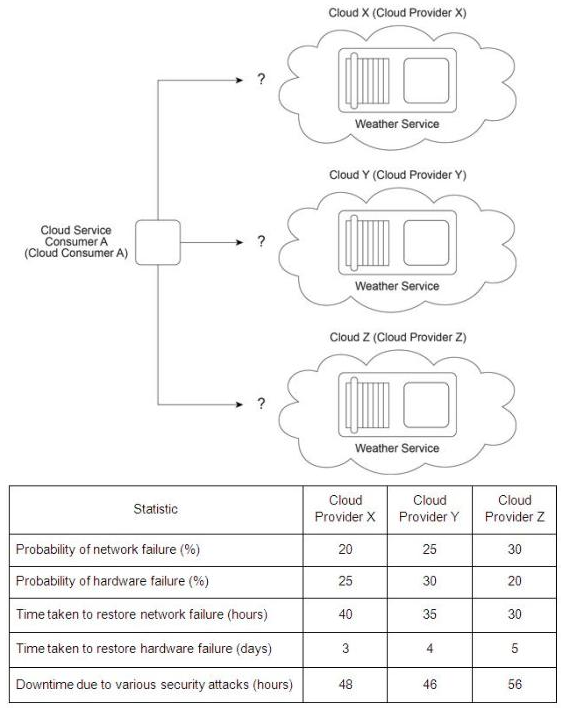
Based on the provided statistics, which cloud provider can offer a Weather Service with the least amount of projected downtime?
Cloud Provider X has deployed a virtualization environment in Cloud X comprised of Physical Server A hosting Virtual Servers A and B. Cloud Provider X implements Cloud Service A on Virtual Server A and makes it available to Cloud Service Consumer A, which interacts with Cloud Service A by sending and receiving messages (1, 2). Cloud Provider Y has deployed a virtualization environment comprised of Physical Server B hosting Virtual Servers C and D. Virtual Server C is made available to Cloud Service Consumer B, which interacts with Virtual Server C (3,4) in order to prepare for the deployment of a new cloud service that will be used internally by Cloud Provider Y to process data obtained from Cloud Service A .
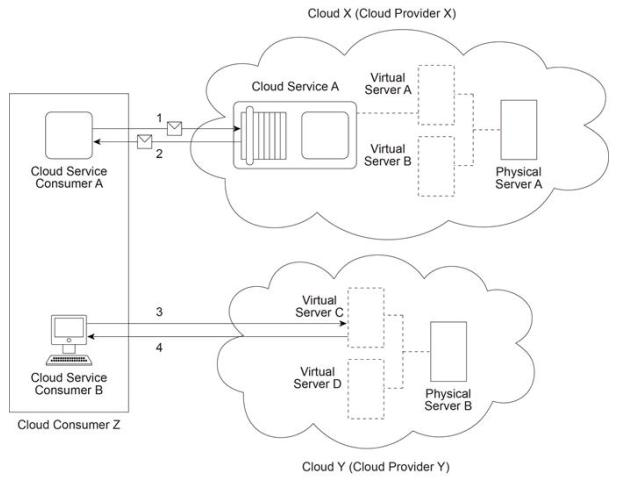
Cloud Consumer Z and Cloud Provider X belong to the same organization. Cloud Provider Y is a third-party organization. Which of the following statements provides a valid scenario that accurately describes the involvement of cloud deployment models, cloud delivery models, roles and/or boundaries? (Note that the correct answer represents one of multiple valid scenarios that can exist.)
Cloud Provider X (which owns Cloud X) deploys two physical servers (Physical Servers A and B) and two databases (Databases A and B). Virtual Servers A and B are hosted by Physical Server A and Ready-Made Environments A and B are hosted by Virtual Server B . Virtual Servers C and D are hosted by Physical Server B . Cloud Service Consumer A regularly accesses Virtual Server D in order to test and deploy a new cloud service that was developed on-premise by the cloud consumer organization operating Cloud Service Consumer A . Cloud Service Consumer B (operated by a different cloud consumer organization) has been regularly accessing Ready-Made Environment A in order to develop and deploy a different new cloud service. The cloud consumer organizations that own and operate Cloud Service Consumers A and B will soon be ready to launch their respective cloud services for use by their customers. Both cloud consumer organizations are concerned that Cloud X does not provide sufficient security and they demand that Cloud Provider X take the necessary steps to mitigate the denial of service, insufficient authorization and overlapping trust boundaries security threats.
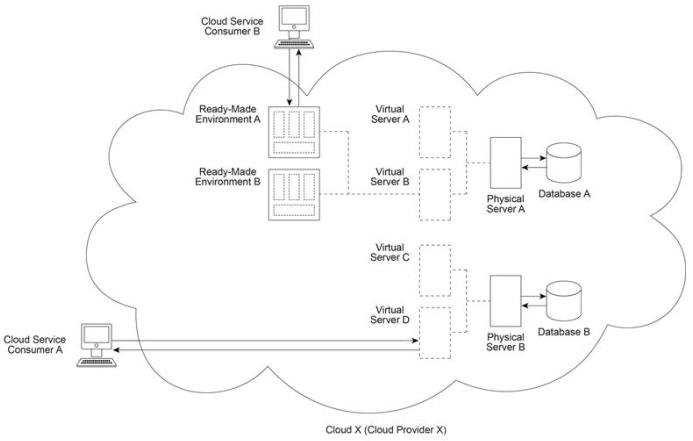
Which of the following statements accurately describes the cloud delivery models used now by the cloud service consumers and in the future by their customers - and - further describes a solution that fulfills the identified security requirements by implementing a single cloud security mechanism?
Get access to all 21 verified questions with detailed answers.
Unlock All C90.03 Questions