S90.20 Exam Questions & Answers
SOA Security Lab • Arcitura Education
100% money-back guarantee
Sample S90.20 Questions
Practice with real exam-style questions, each with the verified correct answer and explanation.
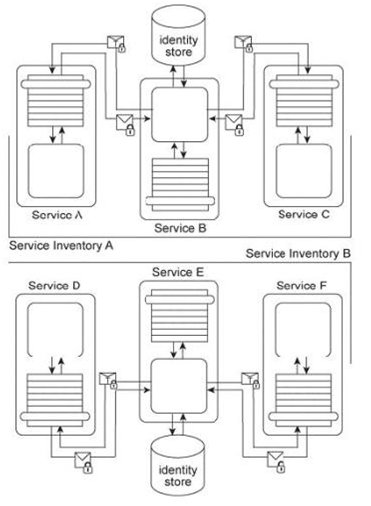
Services A, B, and C reside in Service Inventory A and Services D, E, and F reside in Service Inventory B .Service B is an authentication broker that issues WS-Trust based SAML tokens to Services A and C upon receiving security credentials from Services A and C .Service E is an authentication broker that issues WS-Trust based SAML tokens to Services D and F upon receiving security credentials from Services D and E .Service B uses the Service Inventory A identify store to validate the security credentials of Services A and C .Service E uses the Service Inventory B identity store to validate the security credentials of Services D and F .To date, the two service inventories have existed independently from each other. However, a requirement has emerged that the services in Service Inventory A need to be able to use the services in Service Inventory B, and vice versa. How can cross-service inventory message exchanges be enabled with minimal changes to the existing service inventory architectures and without introducing new security mechanisms?
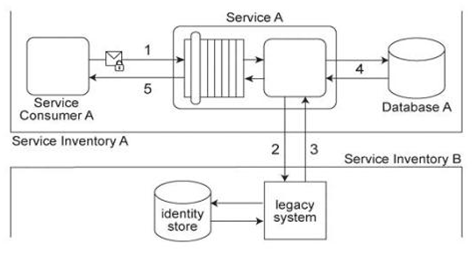
Service Consumer A submits a request message with security credentials to Service A (1). The identity store that Service A needs to use in order to authenticate the security credentials can only be accessed via a legacy system that resides in a different service inventory. Therefore, to authenticate Service Consumer A, Service A must first forward the security credentials to the legacy system (2). The legacy system then returns the requested identity to Service A (3). Service A authenticates Service Consumer A against the identity received from the legacy system. If the authentication is successful, Service A retrieves the requested data from Database A (4), and returns the data in a response message sent back to Service Consumer A (5). Service A belongs to Service Inventory A which further belongs to Security Domain A and the legacy system belongs to Service Inventory B which further belongs to Security Domain B .(The legacy system is encapsulated by other services within Service Inventory B, which are not shown in the diagram.) These two security domains trust each other. Communication between Service A and the legacy system is kept confidential using transport-layer security. No intermediary service agents currently exist between the two service inventories. However, it has been announced that due to the introduction of new systems, some intermediary service agents may be implemented in the near future. Additionally, the legacy system has been scheduled for retirement and will be replaced by a new identity management system that will provide a new identity store. Because the new identity store will need to serve many different systems, there are concerns that it could become a performance bottleneck. As a result, services (including Service A and other services in Security Domains A and B) will not be allowed to directly access the new identity store. Which of the following statements describes a solution that can accommodate the requirements of the new identity store, the authentication requirements of Service A, and can further ensure that message exchanges between Security Domains A and B remain confidential after intermediary service agents are introduced?
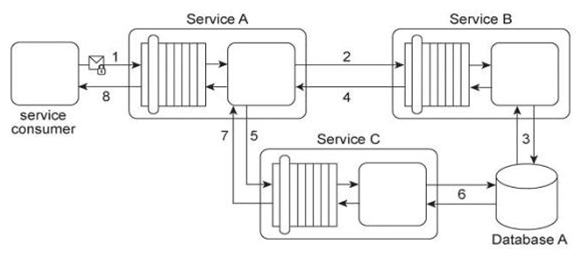
Service A provides a customized report generating capability. Due to infrastructure limitations, the number of service consumers permitted to access Service A concurrently is strictly controlled. Service A validates request messages based on the supplied credentials (1). If the authentication of the request message is successful, Service A sends a message to Service B (2) to retrieve the required data from Database A (3). Service A stores the response from Service B (4) in memory and then issues a request message to Service C (5). Service C retrieves a different set of data from Database A (6) and sends the result back to Service A (7). Service A consolidates the data received from Services B and C and sends the generated report in the response message to the service consumer (8). It has been discovered that attackers have been gaining access to confidential data exchanged between Service A and Service B, and between Service A and its service consumers. What changes can be made to this service composition architecture in order to counter this threat?
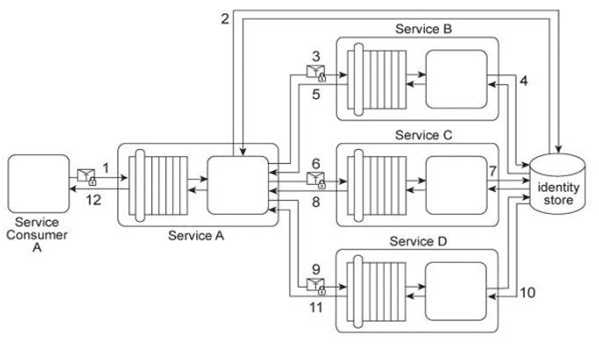
Service Consumer A sends a request message with a Username token to Service A (1). Service B authenticates the request by verifying the security credentials from the Username token with a shared identity store (2), To process Service Consumer A's request message. Service A must use Services B, C, and D .Each of these three services also requires the Username token (3. 6, 9) in order to authenticate Service Consumer A by using the same shared identity store (4, 7, 10). Upon each successful authentication, each of the three services (B, C, and D) issues a response message back to Service A (5, 8, 11). Upon receiving and processing the data in all three response messages, Service A sends its own response message to Service Consumer A (12). There are plans implement a single sign-on security mechanism in this service composition architecture. The service contracts for Services A, C, and D can be modified with minimal impact in order to provide support for the additional messaging requirements of the single sign-on mechanism. However, Service B's service contract is tightly coupled to its implementation and, as a result, this type of change to its service contract is not possible as it would require too many modifications to the underlying service implementation. Given the fact that Service B's service contract cannot be changed to support single sign-on, how can a single sign-on mechanism still be implemented across all services?
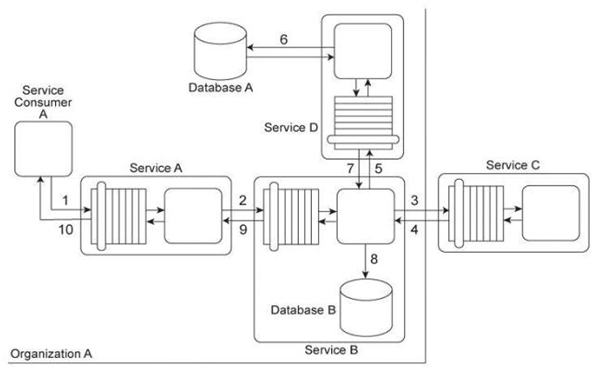
Service Consumer A sends a request message to Service A (1), after which Service A sends a request message to Service B (2). Service B forwards the message to have its contents calculated by Service C (3). After receiving the results of the calculations via a response message from Service C (4), Service B then requests additional data by sending a request message to Service D (5). Service D retrieves the necessary data from Database A (6), formats it into an XML document, and sends the response message containing the XML-formatted data to Service B (7). Service B appends this XML document with the calculation results received from Service C, and then records the entire contents of the XML document into Database B (8). Finally, Service B sends a response message to Service A (9) and Service A sends a response message to Service Consumer A (10). Services A, B and D are agnostic services that belong to Organization A and are also being reused in other service compositions. Service C is a publicly accessible calculation service that resides outside of the organizational boundary. Database A is a shared database used by other systems within Organization A and Database B is dedicated to exclusive access by Service B .Recently, Service D received request messages containing improperly formatted database retrieval requests. All of these request messages contained data that originated from Service C .There is a strong suspicion that an attacker from outside of the organization has been attempting to carry out SOL injection attacks. Furthermore, it has been decided that each service that writes data to a database must keep a separate log file that records a timestamp of each database record change. Because of a data privacy disclosure requirement used by Organization A, the service contracts of these services need to indicate that this logging activity may occur. How can the service composition architecture be improved to avoid SQL injection attacks originating from Service C - and - how can the data privacy disclosure requirement be fulfilled?
Get access to all 30 verified questions with detailed answers.
Unlock All S90.20 Questions