S90.08B Exam Questions & Answers
SOA Design & Architecture Lab with Services & Microservices • Arcitura Education
100% money-back guarantee
Sample S90.08B Questions
Practice with real exam-style questions, each with the verified correct answer and explanation.
Refer to Exhibit.
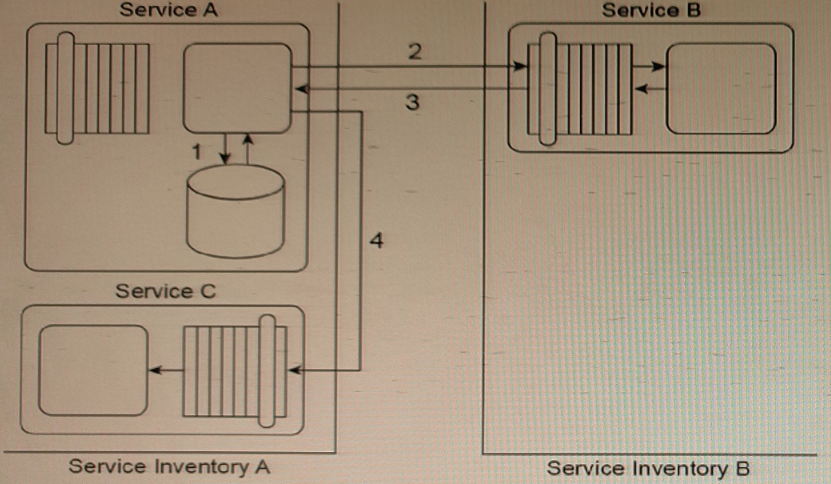
Service A is a task service that sends Service B a message (2) requesting that Service B return data back to Service A in a response message (3). Depending on the response received, Service A may be required to send a message to Service C (4) for which it requires no response.
Before it contacts Service B, Service A must first retrieve a list of code values from its own database (1) and then place this data into its own memory. If it turns out that it must send a message to Service C, then Service A must combine the data it receives from Service B with the data from the code value list in order to create the message it sends to Service C. If Service A is not required to invoke Service C, it can complete its task by discarding the code values.
Service A and Service C reside in Service Inventory
The problem is that Service A and Service B are using different technologies and cannot communicate. Therefore, an intermediate processing layer can be established that can transform messages from one data format to another at runtime. This can be achieved using the Data Format Transformation pattern.
Additionally, Service C frequently reaches its usage thresholds and is not always available, so an Asynchronous Queuing pattern can be applied to establish an intermediate queue between Service A and Service C. This queue will store the messages sent by Service A to Service C and retransmit them until they are successfully delivered. This approach improves the reliability of the system.
Moreover, the Redundant Implementation pattern can be applied to Service C to ensure its availability and scalability, and the Service Autonomy principle can be applied to make Service C independent of other services.
Refer to Exhibit.
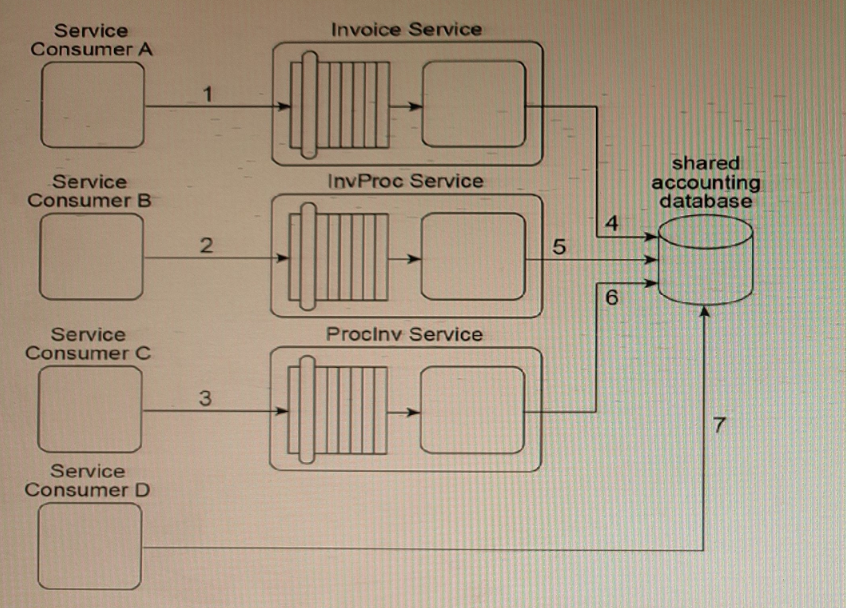
Our service inventory contains the following three services that provide Invoice-related data access capabilities: Invoice, InvProc and Proclnv. These services were created at different times by different project teams and were not required to comply with any design standards. Therefore, each of these services has a different data model for representing invoice data.
Currently, each of these three services has a different service consumer: Service Consumer A accesses the Invoice service (1), Service Consumer B (2) accesses the InvProc service, and Service Consumer C (3) accesses the Proclnv service. Each service consumer invokes a data access capability of an invoice-related service, requiring that service to interact with the shared accounting database that is used by all invoice-related services (4, 5, 6).
Additionally, Service Consumer D was designed to access invoice data from the shared accounting database directly (7). (Within the context of this architecture, Service Consumer D is labeled as a service consumer because it is accessing a resource that is related to the illustrated service architectures.)
Assuming that the Invoice service, InvProc service and Proclnv service are part of the same service inventory, what steps would be required to fully apply the Official Endpoint pattern?
he Legacy Wrapper pattern can be applied so that Component B is separated into a separate utility service that wraps the shared database. The Legacy Wrapper pattern can be applied again so that Component C is separated into a separate utility service that acts as a wrapper for the legacy system API. The Legacy Wrapper pattern can be applied once more to Component D so that it is separated into another utility service that provides standardized access to the file folder. The Service Facade pattern can be applied so that three facade components are added: one between Component A and each of the new wrapper utility services. This way, the facade components can compensate for any change in behavior that may occur as a result of the separation. The Service Composability principle can be further applied to Service A and the three new wrapper utility services so that all four services are optimized for participation in the new service composition. This will help make up for any performance loss that may result from splitting the three components into separate services.
By applying the Legacy Wrapper pattern to separate Components B, C, and D into three different utility services, the shared resources within the IT enterprise (Database A, the legacy system, and the file folders) can be properly encapsulated and managed by dedicated services. The Service Facade pattern can then be used to create a facade component between Component A and each of the new wrapper utility services, allowing them to interact seamlessly without affecting Service Consumer A's behavior.
Finally, the Service Composability principle can be applied to ensure that Service A and the three new wrapper utility services are optimized for participation in the new service composition. This will help to mitigate any performance loss that may result from splitting the three components into separate services.
Refer to Exhibit.
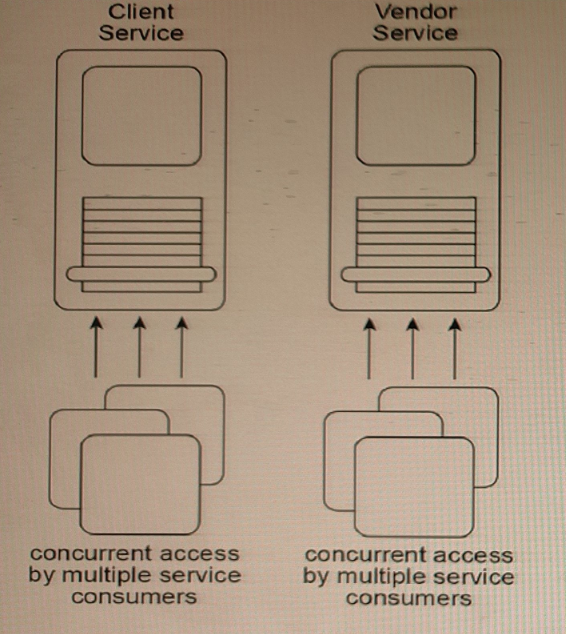
The Client and Vendor services are agnostic services that are both currently part of multiple service compositions. As a result, these services are sometimes subjected to concurrent access by multiple service consumers.
The Client service primarily provides data access logic to a client database but also coordinates with other services to determine a clients credit rating. The Vendor service provides some data access logic but can also generate various dynamic reports based on specialized business requirements.
After reviewing historical statistics about the runtime activity of the two services, it is discovered that the Client service is serving an ever-increasing number of service consumers. It is regularly timing out, which in turn increases its call rate as service consumers retry their requests. The Vendor service occasionally has difficulty meeting its service-level agreement (SLA) and when this occurs, penalties are assessed.
Recently, the custodian of the Client service was notified that the Client service will be made available to new service consumers external to its service inventory. The Client service will be providing free credit rating scores to any service consumer that connects to the service via the Internet. The Vendor service will remain internal to the service inventory and will not be exposed to external access.
Which of the following statements describes a solution that addresses these issues and requirements?
This solution addresses the specific requirements and issues identified in the scenario. The Official Endpoint pattern can be applied to the Client service to establish a managed endpoint for consumption by service consumers external to the service inventory, which will allow for controlled and managed access to the service. The Concurrent Contracts pattern can be applied to the Vendor service, which will enable it to connect with alternative Client service implementation if the first attempt to connect fails, thereby increasing its availability and reducing the possibility of penalties being assessed due to not meeting its SLA.
Refer to Exhibit.
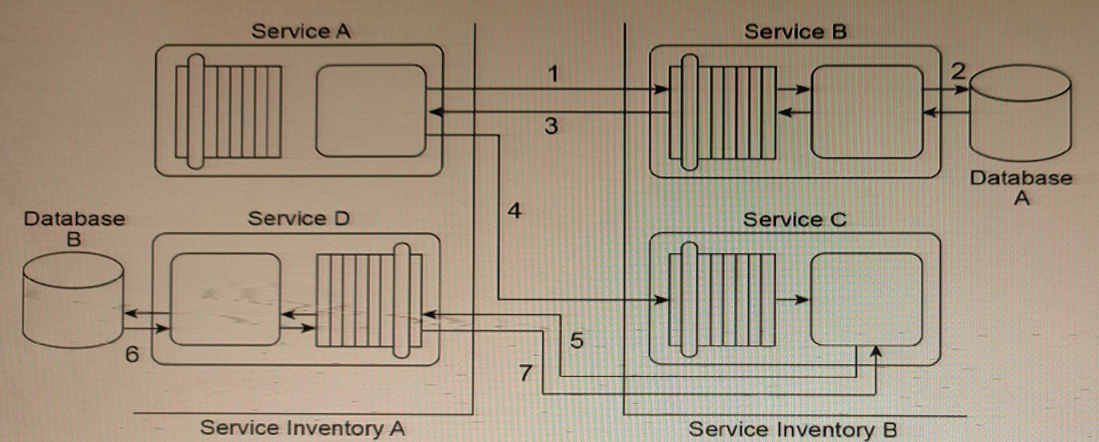
Service A sends a message to Service B (1). After Service B writes the message contents to Database A (2), it issues a response message back to Service A (3). Service A then sends a message to Service C (4). Upon receiving this message, Service C sends a message to Service D (5), which then writes the message contents to Database B (6) and issues a response message back to Service C (7).
Service A and Service D are located in Service Inventory
This solution addresses the two main challenges in the service composition architecture: the different XML schema used by services in Service Inventory A and Service Inventory B, and the incompatible data formats of the two databases.
By applying the Data Model Transformation pattern, data model transformation logic can be inserted to map the invoice-related data between the different XML schemas used by the services in Service Inventory A and Service Inventory B. This can be done at the appropriate points in the message flow: between Service A and Service B, between Service A and Service C, between Service C and Service D, and between the Service D logic and Database B.
By applying the Data Format Transformation pattern, data format transformation logic can be inserted to convert the XML-formatted data used by the services to the CSV format required by Database A, and to convert the proprietary XML schema used by Database B to the XML schema used by the services. This can be done between the Service B logic and Database A.
The Protocol Bridging pattern is not necessary in this case because all services are already communicating using the same protocol (presumably HTTP or a similar protocol).
Refer to Exhibit.
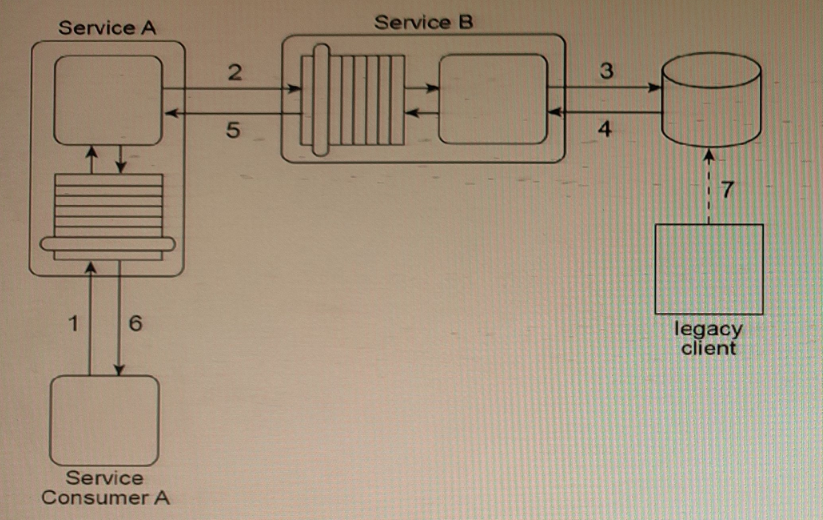
Service A is an entity service that provides a Get capability which returns a data value that is frequently changed.
Service Consumer A invokes Service A in order to request this data value (1). For Service A to carry out this request, it must invoke Service B (2), a utility service that interacts (3, 4) with the database in which the data value is stored. Regardless of whether the data value changed, Service B returns the latest value to Service A (5), and Service A returns the latest value to Service Consumer A (6).
The data value is changed when the legacy client program updates the database (7). When this change will occur is not predictable. Note also that Service A and Service B are not always available at the same time.
Any time the data value changes, Service Consumer A needs to receive It as soon as possible. Therefore, Service Consumer A initiates the message exchange shown In the figure several times a day. When it receives the same data value as before, the response from Service A Is ignored. When Service A provides an updated data value, Service Consumer A can process it to carry out its task.
The current service composition architecture is using up too many resources due to the repeated invocation of Service A by Service Consumer A and the resulting message exchanges that occur with each invocation.
What steps can be taken to solve this problem?
This solution is the most appropriate one among the options presented. By using the Event-Driven Messaging pattern, Service A can be notified of changes to the data value without having to be invoked repeatedly by Service Consumer A, which reduces the resources required for message exchange. Asynchronous Queuing ensures that the event notification message is not lost due to the unavailability of Service A or Service B. This approach improves the efficiency of the service composition architecture.
Get access to all 17 verified questions with detailed answers.
Unlock All S90.08B Questions