300-610 Exam Questions & Answers
Designing Cisco Data Center Infrastructure • Cisco
100% money-back guarantee
About 300-610 Exam
The Cisco 300-610 Designing Cisco Data Center Infrastructure certification exam is a crucial credential for IT professionals seeking to validate their expertise in designing robust and scalable data center solutions. This advanced-level exam covers essential topics including data center design principles, network architecture, storage solutions, security implementation, and virtualization technologies. Candidates must demonstrate proficiency in designing fault-tolerant systems, optimizing performance, and implementing best practices for modern data center environments. The 300-610 exam is ideal for network engineers, solutions architects, and data center professionals who want to advance their careers and prove their ability to design enterprise-grade infrastructure solutions on the Cisco platform.
To successfully pass the 300-610 exam, candidates benefit significantly from utilizing updated exam dumps and comprehensive practice tests that mirror the actual certification assessment. These resources provide insight into question formats, difficulty levels, and content domains, allowing learners to identify knowledge gaps and focus their study efforts strategically. Practice tests simulate real exam conditions, building confidence and time-management skills essential for success. Combined with official Cisco learning materials and hands-on lab experience, quality dumps and practice exams accelerate preparation timelines and increase first-attempt pass rates, making them invaluable tools for ambitious IT professionals pursuing this prestigious data center design certification.
Exam Topics & Objectives
4-Week Study Plan for 300-610
Week 1: Network Design Fundamentals
- Study OSI Layer 3-7 design principles for data center networks
- Review Cisco Nexus switching architecture and line rate throughput
- Learn spine-leaf topology design with equal-cost multipath (ECMP)
- Analyze vPC (Virtual PortChannel) implementation and redundancy
- Complete practice questions on network scalability and bandwidth provisioning
- Design a sample 3-tier network topology with failover scenarios
- Review Cisco ACI fabric design concepts and policy model
Week 2: Compute Design and Storage Network Foundations
- Study server virtualization platforms (VMware vSphere, Hyper-V, KVM)
- Learn Cisco UCS architecture, blade servers, and rack servers
- Review fabric interconnect design and B-series vs C-series considerations
- Analyze service profiles and template-based configuration
- Begin storage network fundamentals: NAS vs SAN architectures
- Study Fibre Channel design principles and zoning strategies
- Review iSCSI implementation in data center environments
- Complete practice scenarios on server-storage connectivity
Week 3: Advanced Storage and Automation Design
- Study Fibre Channel over Ethernet (FCoE) and converged networks
- Learn storage area network (SAN) performance optimization techniques
- Analyze multi-site storage replication and disaster recovery design
- Review storage tiering and cache design considerations
- Study Infrastructure as Code (IaC) principles and tools
- Learn Ansible for network and infrastructure automation
- Review Python scripting for data center automation tasks
- Study Cisco Intersight and management API integration
- Complete hands-on labs for automation workflows
Week 4: Integration, Design Scenarios, and Exam Preparation
- Design end-to-end data center solution integrating all four domains
- Practice multi-site data center design with redundancy and failover
- Review design trade-offs: cost vs performance vs scalability
- Study real-world case studies and design patterns
- Complete full-length practice exams and review weak areas
- Practice time management and exam question techniques
- Review all domain summary sheets and key design principles
- Conduct final review of Cisco best practices and design guidelines
Sample 300-610 Questions
Practice with real exam-style questions. Reveal answers to verify your knowledge.
A network architect needs secure access to the organization's perimeter routers and firewalls. The administrator must access network devices from a remote location that is reachable from the WAN cloud Which action meets these requirements?
An engineer must design a disaster recovery solution for a Cisco ACI Multi-Site network. One requirement is that the applications must have seamless IP addressing across sites. The solution must also be highly resilient and support Layer 2 adjacency. Which design meets these requirements?
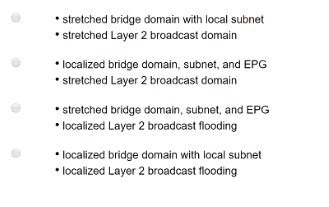
Refer to the exhibit.
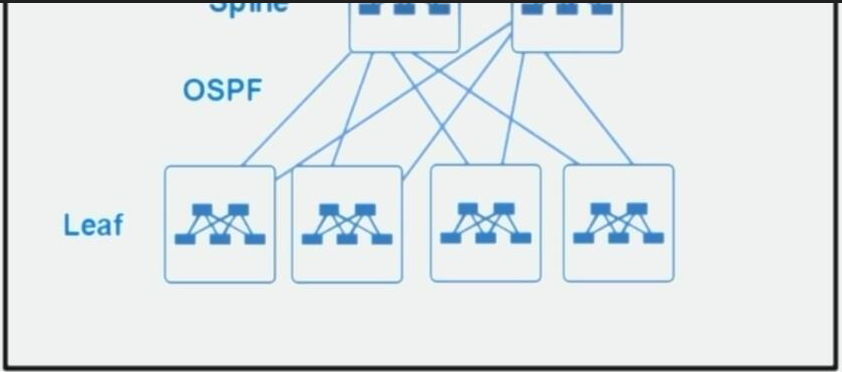
Fiber links are provisioned directly between the spine and leaf switches in the given LAN topology A/30 prefix has been configured over each fiber link to provide underlay connectivity for a VXLAN network. The network-engineering team must update the network configuration to provide the shortest possible convergence time if a fiber link is cut. Which action must the team take to meet the requirement?
Refer to the exhibit.
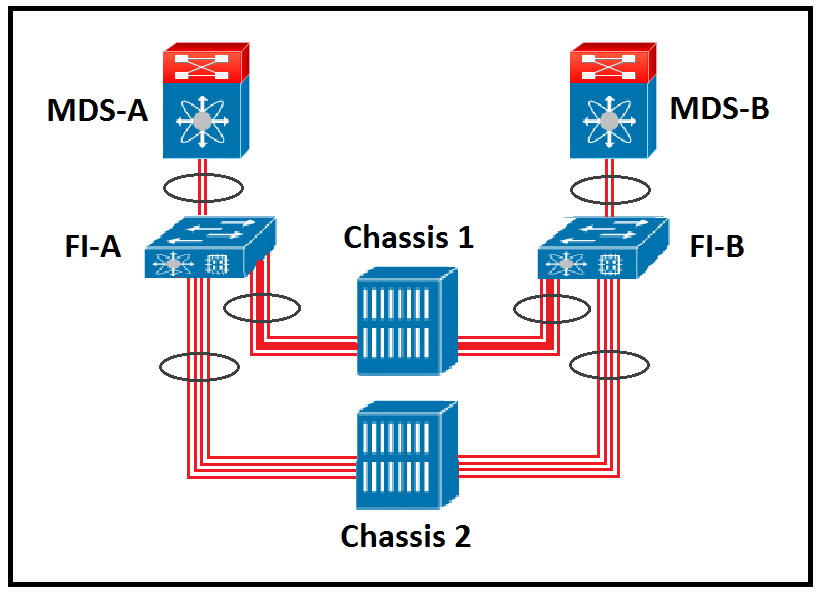
An engineer must assign multiple Fibre Channel IDs to a single port channel. Which two features must be enabled this goal? (Choose two.)
A customer attaches an additional storage appliance to an existing Cisco UCS domain, which contains 50 virtualization hosts that require fabric failover connectivity on fabric interconnect B. The interfaces are bound to a separate pin group to segregate traffic with a CoS value of 0 Which Cisco UCS Manager feature meets these requirements?
Get access to all 277 verified questions with detailed answers.
Unlock All 300-610 Questions