Databricks-Certified-Professional-Data-Engineer Exam Questions & Answers
Databricks Certified Data Engineer Professional • Databricks
100% money-back guarantee
Sample Databricks-Certified-Professional-Data-Engineer Questions
Practice with real exam-style questions, each with the verified correct answer and explanation.
A data engineer is using Lakeflow Spark Declarative Pipelines Expectations to track the data quality of incoming sensor data. Periodically, sensors send bad readings that are out of range, and the team is currently flagging those rows with a warning and writing them to the silver table along with the good data. They have been given a new requirement: the bad rows need to be quarantined in a separate quarantine table and no longer included in the silver table.
This is the existing code for the silver table:
@dlt.table
@dlt.expect("valid_sensor_reading", "reading < 120")
def silver_sensor_readings():
return spark.readStream.table("bronze_sensor_readings")
Which code will satisfy the requirements?
Databricks documents that expect retains invalid records in the target dataset, while expect_or_drop drops invalid records before writing to the target. Therefore, the silver table must use expect_or_drop so bad records are excluded from silver. (Databricks Documentation)
Databricks also documents a quarantine pattern in which invalid records are separated for downstream processing, but the fully documented pattern uses an intermediate quarantine dataset with an is_quarantined flag and then derives valid and invalid paths from it. None of the listed options exactly matches the official quarantine pattern. As written, option B is the closest intended answer because it at least creates a separate quarantine table and removes invalid rows from silver, but strictly speaking, the documented quarantine implementation is more explicit than any option shown here. (Databricks Documentation)
Which statement regarding stream-static joins and static Delta tables is correct?
This is the correct answer because stream-static joins are supported by Structured Streaming when one of the tables is a static Delta table. A static Delta table is a Delta table that is not updated by any concurrent writes, such as appends or merges, during the execution of a streaming query. In this case, each microbatch of a stream-static join will use the most recent version of the static Delta table as of each microbatch, which means it will reflect any changes made to the static Delta table before the start of each microbatch. Verified Reference: [Databricks Certified Data Engineer Professional], under ''Structured Streaming'' section; Databricks Documentation, under ''Stream and static joins'' section.
An external object storage container has been mounted to the location /mnt/finance_eda_bucket.
The following logic was executed to create a database for the finance team:

After the database was successfully created and permissions configured, a member of the finance team runs the following code:
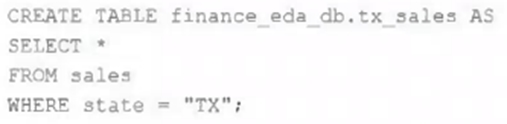
If all users on the finance team are members of the finance group, which statement describes how the tx_sales table will be created?
https://docs.databricks.com/en/lakehouse/data-objects.html
A data engineer needs to install the PyYAML Python package within an air-gapped Databricks environment. The workspace has no direct internet access to PyPI. The engineer has downloaded the .whl file locally and wants it available automatically on all new clusters.
Which approach should the data engineer use?
For secure, air-gapped Databricks deployments, the recommended practice is to host dependency files such as .whl packages in Unity Catalog Volumes --- a managed storage layer governed by Unity Catalog.
Once stored in a volume, these files can be safely referenced from cluster-scoped init scripts, which automatically execute installation commands (e.g., pip install /Volumes/catalog/schema/path/PyYAML.whl) during cluster startup.
This ensures consistent environment setup across clusters and compliance with data governance rules.
User directories (A) lack enterprise security controls; private repositories (C) are not viable in air-gapped setups; and Git repos (D) do not trigger package installation. Therefore, B is the correct and officially approved method.
A data team is implementing an append-only Delta Lake pipeline that needs to handle both batch and streaming data. They want to ensure that schema changes in the source data can be automatically incorporated without breaking the pipeline. Which configuration should the team use when writing data to the Delta table?
Databricks documents mergeSchema as the write option used to enable schema evolution when appending data to Delta tables. This allows new columns in the source to be automatically merged into the target schema rather than causing the write to fail. (Databricks Documentation)
overwriteSchema is used with overwrite operations, not append-style schema evolution. validateSchema and ignoreChanges are not the correct configuration for this requirement. Because the pipeline is append-only and must tolerate source schema changes automatically, mergeSchema = true is the documented choice. (Databricks Documentation)
Get access to all 215 verified questions with detailed answers.
Unlock All Databricks-Certified-Professional-Data-Engineer Questions