Databricks-Machine-Learning-Associate Exam Questions & Answers
Databricks Certified Machine Learning Associate Exam • Databricks
100% money-back guarantee
Sample Databricks-Machine-Learning-Associate Questions
Practice with real exam-style questions, each with the verified correct answer and explanation.
A data scientist is using the following code block to tune hyperparameters for a machine learning model:
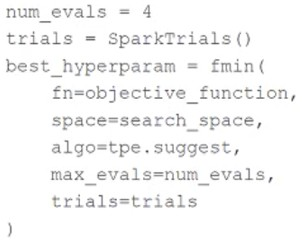
Which change can they make the above code block to improve the likelihood of a more accurate model?
To improve the likelihood of a more accurate model, the data scientist can increase num_evals to 100. Increasing the number of evaluations allows the hyperparameter tuning process to explore a larger search space and evaluate more combinations of hyperparameters, which increases the chance of finding a more optimal set of hyperparameters for the model.
Databricks documentation on hyperparameter tuning: Hyperparameter Tuning
Which of the following hyperparameter optimization methods automatically makes informed selections of hyperparameter values based on previous trials for each iterative model evaluation?
Tree of Parzen Estimators (TPE) is a sequential model-based optimization algorithm that selects hyperparameter values based on the outcomes of previous trials. It models the probability density of good and bad hyperparameter values and makes informed decisions about which hyperparameters to try next.
This approach contrasts with methods like random search and grid search, which do not use information from previous trials to guide the search process.
Hyperopt and TPE
A data scientist uses 3-fold cross-validation when optimizing model hyperparameters for a regression problem. The following root-mean-squared-error values are calculated on each of the validation folds:
* 10.0
* 12.0
* 17.0
Which of the following values represents the overall cross-validation root-mean-squared error?
To calculate the overall cross-validation root-mean-squared error (RMSE), you average the RMSE values obtained from each validation fold. Given the RMSE values of 10.0, 12.0, and 17.0 for the three folds, the overall cross-validation RMSE is calculated as the average of these three values:
OverallCVRMSE=10.0+12.0+17.03=39.03=13.0OverallCVRMSE=310.0+12.0+17.0=339.0=13.0
Thus, the correct answer is 13.0, which accurately represents the average RMSE across all folds. Reference:
Cross-validation in Regression (Understanding Cross-Validation Metrics).
The implementation of linear regression in Spark ML first attempts to solve the linear regression problem using matrix decomposition, but this method does not scale well to large datasets with a large number of variables.
Which of the following approaches does Spark ML use to distribute the training of a linear regression model for large data?
For large datasets with many variables, Spark ML distributes the training of a linear regression model using iterative optimization methods. Specifically, Spark ML employs algorithms such as Gradient Descent or L-BFGS (Limited-memory Broyden--Fletcher--Goldfarb--Shanno) to iteratively minimize the loss function. These iterative methods are suitable for distributed computing environments and can handle large-scale data efficiently by partitioning the data across nodes in a cluster and performing parallel updates. Reference:
Spark MLlib Documentation (Linear Regression with Iterative Optimization).
A data scientist has developed a linear regression model using Spark ML and computed the predictions in a Spark DataFrame preds_df with the following schema:
prediction DOUBLE
actual DOUBLE
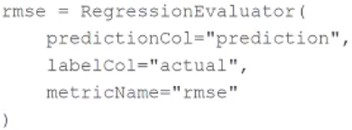
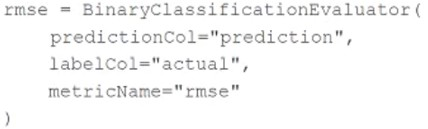
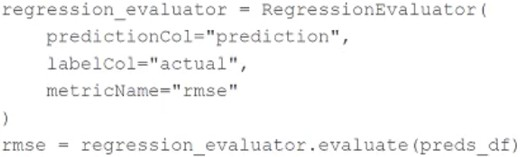
Which of the following code blocks can be used to compute the root mean-squared-error of the model according to the data in preds_df and assign it to the rmse variable?
A)
B)
C)
D)
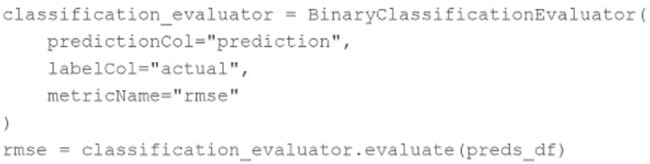
To compute the root mean-squared-error (RMSE) of a linear regression model using Spark ML, the RegressionEvaluator class is used. The RegressionEvaluator is specifically designed for regression tasks and can calculate various metrics, including RMSE, based on the columns containing predictions and actual values.
The correct code block to compute RMSE from the preds_df DataFrame is:
regression_evaluator = RegressionEvaluator( predictionCol='prediction', labelCol='actual', metricName='rmse' ) rmse = regression_evaluator.evaluate(preds_df)
This code creates an instance of RegressionEvaluator, specifying the prediction and label columns, as well as the metric to be computed ('rmse'). It then evaluates the predictions in preds_df and assigns the resulting RMSE value to the rmse variable.
Options A and B incorrectly use BinaryClassificationEvaluator, which is not suitable for regression tasks. Option D also incorrectly uses BinaryClassificationEvaluator.
Get access to all 74 verified questions with detailed answers.
Unlock All Databricks-Machine-Learning-Associate Questions