Limited-Time Offer: Enjoy 50% Savings! - Ends In 0d 00h 00m 00s Coupon code: 50OFF
Free Exam Questions

Databricks-Machine-Learning-Professional Exam Questions & Answers

Databricks Certified Machine Learning Professional  •  Databricks

60 Questions 120 min Updated Jul 2026 99% Pass Rate
Get Full Access

100% money-back guarantee

About Databricks-Machine-Learning-Professional Exam

The Databricks Certified Machine Learning Professional (DCMP) certification is a comprehensive credential designed to validate expertise in machine learning workflows on the Databricks platform. This advanced certification exam evaluates candidates' proficiency in key areas including feature engineering, model development, model evaluation, and production deployment using Databricks' unified analytics platform. The certification covers essential topics such as MLflow for model tracking, Delta Lake for data management, Apache Spark for distributed computing, and best practices for building scalable machine learning solutions. This certification is ideal for data scientists, machine learning engineers, and analytics professionals seeking to demonstrate their ability to build and deploy machine learning models in enterprise environments.

Candidates preparing for the Databricks Machine Learning Professional exam should prioritize hands-on practice with updated exam dumps and comprehensive practice tests. These resources provide valuable insights into the actual exam format, question types, and performance requirements, allowing candidates to identify knowledge gaps and strengthen weak areas before test day. Quality practice tests simulate real exam conditions and help develop time management skills essential for success. By utilizing current study materials, candidates can confidently validate their machine learning expertise, enhance their career prospects, and position themselves as skilled professionals capable of implementing advanced ML solutions on the Databricks platform.

Exam Topics & Objectives

Experimentation
30%
Model Lifecycle Management
30%
Model Deployment
25%
Solution and Data Monitoring
15%

4-Week Study Plan for Databricks-Machine-Learning-Professional

Week 1: Experimentation Fundamentals & Tracking

  • Study MLflow Tracking API components: experiments, runs, parameters, metrics, and artifacts
  • Practice logging parameters and metrics in notebook experiments using mlflow.log_param() and mlflow.log_metric()
  • Explore MLflow UI for comparing multiple experiment runs and analyzing results
  • Learn autologging capabilities for Scikit-learn, XGBoost, and Spark MLlib models
  • Study hyperparameter tuning with MLflow and Hyperopt integration
  • Practice creating and managing custom metrics for model evaluation
  • Review best practices for experiment organization and naming conventions
  • Complete hands-on labs: logging 3+ different model experiments with parameter comparison

Week 2: Model Lifecycle Management & Registry

  • Deep dive into MLflow Model Registry: concepts, stages (None, Staging, Production, Archived)
  • Practice registering models from experiment runs into the Model Registry
  • Study model versioning and transition workflows between stages
  • Learn how to add descriptions, tags, and aliases to registered models
  • Explore model lineage tracking and reproducibility features
  • Study Delta Lake integration with model lifecycle for data versioning
  • Practice implementing approval workflows and stage transitions
  • Review model packaging and environment management (conda, Docker)
  • Complete labs: register 3+ models, transition stages, add metadata and tags

Week 3: Model Deployment & Serving

  • Study MLflow Models format and model flavors (sklearn, spark, xgboost, pyfunc)
  • Learn batch prediction patterns using Spark with registered models
  • Practice deploying models to Databricks Model Serving endpoints
  • Study REST API endpoint creation and model invocation
  • Review scaling configurations and compute resource management for serving
  • Learn inference with Pandas UDF for distributed batch predictions
  • Study A/B testing setup for model comparison in production
  • Practice monitoring model endpoints and handling predictions at scale
  • Complete labs: deploy 2+ models to serving endpoints, test REST APIs, batch inference

Week 4: Solution Architecture & Data Monitoring

  • Study data drift detection concepts and implementation approaches
  • Learn model drift metrics and performance degradation monitoring
  • Practice implementing custom monitoring jobs using Databricks Workflows
  • Review Delta Lake schema monitoring and data quality checks
  • Study medallion architecture (bronze, silver, gold) for ML pipelines
  • Learn feature store concepts and monitoring feature quality
  • Practice setting up alerts and notifications for model degradation
  • Review end-to-end ML solution design patterns on Databricks
  • Study governance, security, and reproducibility best practices
  • Complete practice exam questions (50+) covering all four certification topics
  • Review exam format, time management, and weak areas identified in practice tests

Sample Databricks-Machine-Learning-Professional Questions

Practice with real exam-style questions. Reveal answers to verify your knowledge.

Q1 MultipleChoice

A data scientist has developed a model model and computed the RMSE of the model on the test set. They have assigned this value to the variable rmse. They now want to manually store the RMSE value with the MLflow run.

They write the following incomplete code block:

Which of the following lines of code can be used to fill in the blank so the code block can successfully complete the task?

Q2 MultipleChoice

A machine learning engineer wants to deploy a model for real-time serving using MLflow Model Serving. For the model, the machine learning engineer currently has one model version in each of the stages in the MLflow Model Registry. The engineer wants to know which model versions can be queried once Model Serving is enabled for the model.

Which of the following lists all of the MLflow Model Registry stages whose model versions are automatically deployed with Model Serving?

Q3 MultipleChoice

A machine learning engineer wants to view all of the active MLflow Model Registry Webhooks for a specific model.

They are using the following code block:
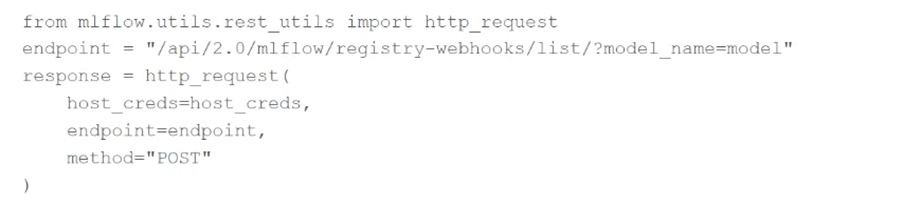
Which of the following changes does the machine learning engineer need to make to this code block so it will successfully accomplish the task?

Q4 MultipleChoice

Which of the following MLflow Model Registry use cases requires the use of an HTTP Webhook?

Q5 MultipleChoice

Which of the following is an advantage of using the python_function(pyfunc) model flavor over the built-in library-specific model flavors?

Get access to all 60 verified questions with detailed answers.

Unlock All Databricks-Machine-Learning-Professional Questions

Frequently Asked Questions

The exam covers ML fundamentals, data preparation, model training and evaluation, hyperparameter tuning, and production ML workflows on Databricks. It also includes questions on MLflow for model management, distributed machine learning, and best practices for building scalable ML solutions.

The exam is typically 120 minutes long, during which candidates must answer multiple-choice and hands-on questions. This timeframe allows sufficient time to demonstrate practical knowledge of ML concepts and Databricks platform capabilities.

Candidates should have foundational knowledge of machine learning concepts, Python programming experience, and familiarity with the Databricks platform. It's recommended to have practical experience with ML workflows and understanding of Apache Spark for distributed computing.

The exam combines both multiple-choice questions and hands-on practical components where you must write and execute code. This blend ensures candidates can both understand ML theory and apply their knowledge using Databricks tools and libraries.

Databricks provides official documentation, training courses, sample questions, and a learning path on their website. Additionally, candidates can leverage community resources, practice labs, and review materials focused on MLflow, distributed ML, and the Databricks runtime environment.
Exam Details
  • Exam CodeDatabricks-Machine-Learning-Professional
  • VendorDatabricks
  • Total Questions60
  • Duration120 min
  • LanguageEnglish
  • Last UpdatedJul 22, 2026
4.9/5

Pass Databricks-Machine-Learning-Professional First Time

Get all 60 exam questions with verified answers and 90-day free updates.

Buy Now & Pass
  • PDF + Practice Test Bundle
  • 90-Day Free Updates
  • 100% Money-Back Guarantee
  • Instant Download
  • 24/7 Customer Support
99% Pass Rate Trusted by 50,000+ IT professionals