CDCS Exam Questions & Answers
EXIN EPI Certified Data Centre Specialist • Exin
100% money-back guarantee
Sample CDCS Questions
Practice with real exam-style questions, each with the verified correct answer and explanation.
What should be implemented when an Inergen-based fire suppression system is installed in the computer room?
Inert gas systems (Inergen, Argonite, Nitrogen) extinguish fires by reducing oxygen concentration through massive gas discharge. This rapid release causes a significant pressure rise inside the room. To avoid structural damage to walls, ceilings, or raised floors, pressure relief vents (pressure release valves) must be installed.
A (drainage) applies to water suppression.
B (tank location) is logistical but not mandatory; remote storage with piping is acceptable.
D (water leak detection) is unrelated to inert gas suppression.
Therefore, the critical safety requirement is pressure relief.
Three data centers are benchmarked on facilities energy efficiency.
Data center A has achieved a PUE of 2.45.
Data center B has achieved a PUE of 1.20.
Data center C has achieved a PUE of 1.90.
Which of the data centers is operating at the highest facility efficiency?
A Power Usage Effectiveness (PUE) of 1.20 (achieved by Data Center B) indicates the highest facility efficiency among the three data centers. A lower PUE value signifies better energy efficiency, as it means that a greater proportion of the total energy consumed is used directly for IT equipment rather than for cooling, lighting, or other facility needs.
Detailed Explanation:
PUE is calculated as the ratio of total facility energy to IT equipment energy. A PUE close to 1.0 suggests that almost all the energy is dedicated to computing processes, with minimal overhead. With PUE values of 2.45, 1.20, and 1.90, Data Center B (1.20) operates most efficiently by devoting a higher percentage of its total energy to IT equipment.
EPI Data Center Specialist Reference:
The EPI curriculum emphasizes PUE as a key metric for data center efficiency, with lower values representing better performance. Achieving a PUE near 1.0 aligns with industry best practices for energy-efficient data center design and operation.
Does hot/cold aisle containment impact PUE?
Hot and cold aisle containment prevents mixing of supply and return air, which improves cooling efficiency. By maintaining higher return-air temperatures, cooling units operate more efficiently, often allowing higher chilled water setpoints. This reduces overall cooling power consumption, directly improving PUE (Power Usage Effectiveness).
Containment is recognized by ASHRAE and Green Grid as one of the simplest and most cost-effective methods for lowering PUE. Options A, C, and D are false because containment benefits apply regardless of cooling source or IT virtualization.
A computer room is fitted with a hypoxic-based fire suppression system. On what principle does it work?
Hypoxic air systems continuously reduce the oxygen concentration in the protected area to below the level required for combustion (typically 15--16%), while still remaining safe for human occupancy (>14%). By lowering oxygen concentration, ignition and flame propagation are prevented.
This is different from halocarbon or inert-gas clean agents, which flood the room only upon detection of fire. Hypoxic systems are preventive, creating a permanent fire-retardant environment.
They do not remove heat (A), fuel (C), or use water (D). Their key mechanism is oxygen displacement.
From the options indicated, what is the correct starting point for the raised floor installation?
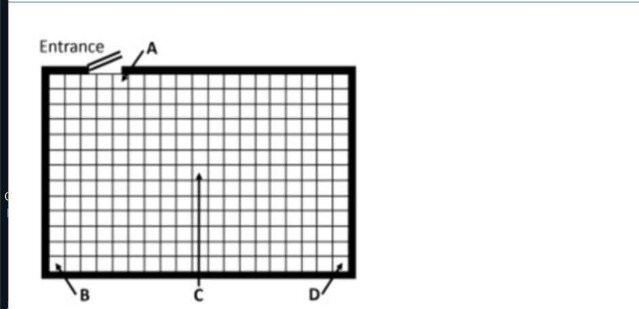
When installing a raised floor, the best starting point is typically from the farthest corner away from the entrance, in this case, Point B. This method allows for the floor installation to progress towards the entrance, ensuring that workers can avoid walking over the newly installed tiles, thus minimizing the risk of damage and maintaining cleanliness during installation.
Detailed Explanation:
Starting at the farthest corner (Point B) and working towards the entrance (Point A) is a standard practice in raised floor installation. This approach ensures that installers do not walk over freshly laid tiles, which could lead to shifting or misalignment. Additionally, it allows for more controlled placement and alignment, as well as convenient egress when installation is complete.
EPI Data Center Specialist Reference:
EPI guidelines for raised floor installation emphasize beginning at the farthest point from the entrance and working back towards it, which aligns with industry best practices for efficiency and quality assurance. This method reduces potential damage and supports precise alignment across the floor area.
Get access to all 120 verified questions with detailed answers.
Unlock All CDCS Questions