Associate-Data-Practitioner Exam Questions & Answers
Google Cloud Associate Data Practitioner • Google
100% money-back guarantee
Sample Associate-Data-Practitioner Questions
Practice with real exam-style questions, each with the verified correct answer and explanation.
You need to create a new data pipeline. You want a serverless solution that meets the following requirements:
* Data is streamed from Pub/Sub and is processed in real-time.
* Data is transformed before being stored.
* Data is stored in a location that will allow it to be analyzed with SQL using Looker.
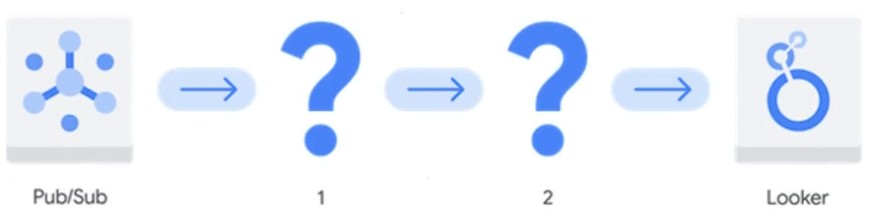
Which Google Cloud services should you recommend for the pipeline?
To build a serverless data pipeline that processes data in real-time from Pub/Sub, transforms it, and stores it for SQL-based analysis using Looker, the best solution is to use Dataflow and BigQuery. Dataflow is a fully managed service for real-time data processing and transformation, while BigQuery is a serverless data warehouse that supports SQL-based querying and integrates seamlessly with Looker for data analysis and visualization. This combination meets the requirements for real-time streaming, transformation, and efficient storage for analytical queries.
Your organization has several datasets in BigQuery. The datasets need to be shared with your external partners so that they can run SQL queries without needing to copy the data to their own projects. You have organized each partner's data in its own BigQuery dataset. Each partner should be able to access only their dat
a. You want to share the data while following Google-recommended practices. What should you do?
Using Analytics Hub to create a listing on a private data exchange for each partner dataset is the Google-recommended practice for securely sharing BigQuery data with external partners. Analytics Hub allows you to manage data sharing at scale, enabling partners to query datasets directly without needing to copy the data into their own projects. By creating separate listings for each partner dataset and allowing only the respective partner to subscribe, you ensure that partners can access only their specific data, adhering to the principle of least privilege. This approach is secure, efficient, and designed for scenarios involving external data sharing.
Your organization is building a new application on Google Cloud. Several data files will need to be stored in Cloud Storage. Your organization has approved only two specific cloud regions where these data files can reside. You need to determine a Cloud Storage bucket strategy that includes automated high availability. What should you do?
Comprehensive and Detailed In-Depth
The strategy requires storage in two specific regions with automated high availability (HA). Cloud Storage location options dictate the solution:
Option A: A dual-region bucket (e.g., us-west1 and us-east1) replicates data synchronously across two user-specified regions, ensuring HA without manual intervention. It's fully automated and meets the requirement.
Option B: Two single-region buckets with gcloud storage replication is manual, not automated, and lacks real-time HA (requires scripting and monitoring).
Option C: Multi-region buckets (e.g., us) span multiple regions within a geography but don't let you specify exactly two regions, potentially violating the restriction.
Option D: Two single-region buckets with Storage Transfer Service automate replication but aren't synchronous (batch-based), reducing HA compared to dual-region's real-time sync. Why A is Best: Dual-region buckets provide geo-redundancy across two exact regions (e.g., nam4 for us-central1/us-east1), ensuring data is always available with no manual setup. For example, gsutil mb -l nam4 gs://my-bucket creates this setup, aligning with Google's HA recommendations. Extract from Google Documentation: From 'Cloud Storage Bucket Locations' (https://cloud.google.com/storage/docs/locations): 'Dual-region buckets provide high availability by synchronously replicating data across two specific regions you choose, ensuring automated redundancy and accessibility within your approved locations.' Reference: Google Cloud Documentation - 'Cloud Storage Dual-Region' (https://cloud.google.com/storage/docs/locations#dual-region).
Why A is Best: Dual-region buckets provide geo-redundancy across two exact regions (e.g., nam4 for us-central1/us-east1), ensuring data is always available with no manual setup. For example, gsutil mb -l nam4 gs://my-bucket creates this setup, aligning with Google's HA recommendations.
Extract from Google Documentation: From 'Cloud Storage Bucket Locations' (https://cloud.google.com/storage/docs/locations): 'Dual-region buckets provide high availability by synchronously replicating data across two specific regions you choose, ensuring automated redundancy and accessibility within your approved locations.'
Option D: Two single-region buckets with Storage Transfer Service automate replication but aren't synchronous (batch-based), reducing HA compared to dual-region's real-time sync. Why A is Best: Dual-region buckets provide geo-redundancy across two exact regions (e.g., nam4 for us-central1/us-east1), ensuring data is always available with no manual setup. For example, gsutil mb -l nam4 gs://my-bucket creates this setup, aligning with Google's HA recommendations. Extract from Google Documentation: From 'Cloud Storage Bucket Locations' (https://cloud.google.com/storage/docs/locations): 'Dual-region buckets provide high availability by synchronously replicating data across two specific regions you choose, ensuring automated redundancy and accessibility within your approved locations.' Reference: Google Cloud Documentation - 'Cloud Storage Dual-Region' (https://cloud.google.com/storage/docs/locations#dual-region).
You are working on a data pipeline that will validate and clean incoming data before loading it into BigQuery for real-time analysis. You want to ensure that the data validation and cleaning is performed efficiently and can handle high volumes of dat
a. What should you do?
Using Dataflow to create a streaming pipeline that includes validation and transformation steps is the most efficient and scalable approach for real-time analysis. Dataflow is optimized for high-volume data processing and allows you to apply validation and cleaning logic as the data flows through the pipeline. This ensures that only clean, validated data is loaded into BigQuery, supporting real-time analysis while handling high data volumes effectively.
You have a Cloud SQL for PostgreSQL database that stores sensitive historical financial dat
a. You need to ensure that the data is uncorrupted and recoverable in the event that the primary region is destroyed. The data is valuable, so you need to prioritize recovery point objective (RPO) over recovery time objective (RTO). You want to recommend a solution that minimizes latency for primary read and write operations. What should you do?
Comprehensive and Detailed in Depth
Why D is correct:Synchronous replication ensures that data is written to both the primary and secondary instances at the same time, minimizing data loss (RPO).
Regional availability (HA) within different zones provides redundancy within the same region, minimizing latency.
Why other options are incorrect:A: Asynchronous replication has a potential for data loss.
B: Multiregion backups are for disaster recovery, not minimizing latency.
C: Hourly backups do not provide the lowest possible RPO.
Cloud SQL high availability: https://cloud.google.com/sql/docs/postgres/high-availability
Cloud SQL backups: https://cloud.google.com/sql/docs/postgres/backup-restore
Get access to all 106 verified questions with detailed answers.
Unlock All Associate-Data-Practitioner Questions