Professional-Cloud-Developer Exam Questions & Answers
Professional Cloud Developer • Google
100% money-back guarantee
About Professional-Cloud-Developer Exam
The Professional Cloud Developer certification from Google Cloud is a prestigious credential designed for software developers and engineers who want to demonstrate their expertise in building, testing, and deploying cloud applications on Google Cloud Platform. This advanced certification validates your ability to design cloud-native applications, manage APIs, implement security best practices, and optimize application performance. Key topics covered include application development using Google Cloud services, data management, asynchronous messaging, integration with Google Cloud APIs, and deploying applications with CI/CD pipelines. The exam is ideal for experienced developers seeking to advance their careers and prove their proficiency in cloud development on GCP.
To successfully pass the Professional Cloud Developer exam, candidates should leverage updated exam dumps and comprehensive practice tests that mirror the actual certification assessment. These resources help you identify knowledge gaps, understand exam question formats, and build confidence before the real test. Practice tests simulate real-world scenarios you'll encounter in your role as a cloud developer, while exam dumps provide valuable insights into commonly tested topics and answer explanations. By combining hands-on experience with GCP services, official Google Cloud documentation, and quality practice materials, you can effectively prepare for this challenging certification and advance your cloud development career with a recognized Google Cloud credential.
Exam Topics & Objectives
4-Week Study Plan for Professional-Cloud-Developer
Week 1: Cloud Architecture & Scalability Foundations
- Study GCP compute options: App Engine, Cloud Run, GKE, and Compute Engine
- Learn horizontal and vertical scaling patterns for cloud-native applications
- Review load balancing strategies and traffic distribution
- Understand autoscaling policies and metrics in GCP
- Study database scaling: Cloud Spanner, Firestore, and Cloud SQL replication
- Practice designing fault-tolerant architectures with multiple availability zones
- Complete hands-on lab: Configure autoscaling for a web application
Week 2: Application Development, Testing & Deployment Pipelines
- Master Cloud Source Repositories and version control integration
- Study Cloud Build for CI/CD pipeline creation and configuration
- Learn unit testing, integration testing, and load testing strategies
- Review container image creation and vulnerability scanning
- Understand deployment strategies: blue-green, canary, and rolling deployments
- Study Cloud Deploy for automated application release management
- Practice writing and executing test suites in Cloud Build
- Complete hands-on lab: Create a CI/CD pipeline with automated testing
Week 3: Google Cloud Services Integration & Messaging
- Study asynchronous messaging: Pub/Sub topics, subscriptions, and message ordering
- Learn event-driven architecture patterns on Google Cloud
- Review Cloud Tasks for task queue management and scheduling
- Understand API Gateway for API management and authentication
- Study BigQuery integration for analytics and data processing
- Learn Cloud Storage integration for file uploads and media handling
- Review service-to-service communication and service accounts
- Complete hands-on lab: Build event-driven application with Pub/Sub and Cloud Functions
Week 4: Performance Monitoring, Operations & Exam Prep
- Master Cloud Logging for centralized log management and analysis
- Study Cloud Monitoring for metrics collection and dashboards
- Learn Cloud Trace for distributed tracing and performance analysis
- Review Cloud Profiler for identifying performance bottlenecks
- Study Error Reporting for error tracking and alerting
- Understand SLOs, SLIs, and SLAs in GCP context
- Review security best practices: IAM, VPC, and secrets management
- Complete practice exams and review weak areas from all four sections
- Perform final hands-on lab: Deploy, monitor, and troubleshoot a complete application
Sample Professional-Cloud-Developer Questions
Practice with real exam-style questions. Reveal answers to verify your knowledge.
You are developing a new application that has the following design requirements:
Creation and changes to the application infrastructure are versioned and auditable.
The application and deployment infrastructure uses Google-managed services as much as possible.
The application runs on a serverless compute platform.
How should you design the application's architecture?
You are designing a schema for a table that will be moved from MySQL to Cloud Bigtable. The MySQL table is as follows:
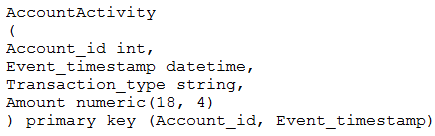
How should you design a row key for Cloud Bigtable for this table?
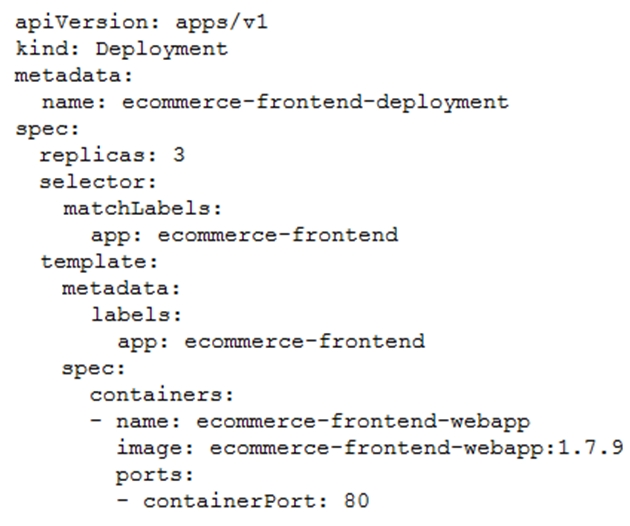
Your application is deployed in a Google Kubernetes Engine (GKE) cluster. When a new version of your application is released, your CI/CD tool updates the spec.template.spec.containers[0].image value to reference the Docker image of your new application version. When the Deployment object applies the change, you want to deploy at least 1 replica of the new version and maintain the previous replicas until the new replica is healthy.
Which change should you make to the GKE Deployment object shown below?
You are writing from a Go application to a Cloud Spanner database. You want to optimize your application's performance using Google-recommended best practices. What should you do?
Your company has deployed a new API to a Compute Engine instance. During testing, the API is not behaving as expected. You want to monitor the application over 12 hours to diagnose the problem within the application code without redeploying the application. Which tool should you use?
Get access to all 265 verified questions with detailed answers.
Unlock All Professional-Cloud-Developer Questions