HPE7-A11 Exam Questions & Answers
HPE Network Campus Access Professional Architect • HP
Sample HPE7-A11 Questions
Practice with real exam-style questions, each with the verified correct answer and explanation.
You are creating a wireless intrusion detection and prevention strategy (WIDS/WIPS) for a client's enterprise network with HPE Aruba Networking and AOS-10. As part of the design, you intend to deploy dedicated Air Monitors (AMs).
Which two statements are consistent with HPE Aruba Networking best practices for deploying AMs in an AOS-10 environment?
Choose two.
HPE Aruba Networking WIDS/WIPS provides detection, classification, and protection mechanisms for unauthorized wireless devices and potentially malicious wireless activity.
Infrastructure threat detection supports multiple detection levels, including Low, Medium, and High. Beginning with conservative detection settings allows administrators to establish an operational baseline before enabling additional signatures that may generate excessive alerts.
HPE documentation identifies infrastructure signatures such as AP spoofing, Windows bridging, broadcast deauthentication, and broadcast disassociation within the Low detection category.
Option B reflects the recommended staged approach to increasing detection sensitivity after validating environmental behavior and potential false positives.
Option C is correct because wireless deauthentication containment can disrupt client connectivity and may create legal or regulatory concerns. HPE specifically recommends involving security and legal stakeholders before enabling containment mechanisms.
Option A is incorrect because the proposed four-to-five-AM density per 10,000 square feet is not a general HPE WIDS deployment rule. AM placement must follow RF coverage and security-monitoring objectives.
Option D incorrectly characterizes hybrid monitoring and its claimed public-safety-band scanning behavior.
Option E is incorrect because HPE advises caution with 40 MHz intolerance-related detection and generally recommends disabling unnecessary alert signatures.
The final design should distinguish passive detection from active containment and document the approval required for disruptive security controls.
Official HPE Reference: HPE Aruba Networking Wireless & Branch Technical Documentation --- WIDS/WIPS Infrastructure Event Detection, Protection and Containment Guidelines.
A large multinational financial institution has engaged you to design a new full-stack wired and wireless network for its new 6-story regional office building. The bottom two floors of the facility will be retail space for a large banking branch. The upper floors will be carpeted corporate office space, with each floor measuring approximately 100,000 sq ft (9290 sq m). All data centers are offsite and are out of scope for this project. The customer is underserved by its existing L2-based network infrastructure and wants to apply modern best practices in the new design. The network must be fully resilient and fault-tolerant, with dynamic segmentation at the edge.
The retail space will provide public guest Wi-Fi access. Retail associates will use corporate tablets for customer service, and the retail floors will contain a mix of wired and wireless devices. Corporate users will primarily connect wirelessly, but several wired clients, printers, and hard VoIP phones will also be used.
The customer also plans to renovate the corporate office space to take advantage of 'smart office' technology. These enhancements will enable blue-dot wayfinding, presence analytics, and other location-based services.
The client has decided to manage two wiring closets as one stack totaling 10 switches, with a minimum transport speed of 25Gbps over OM4 MM fiber. They also want to minimize stacking-cabling cost.
Which switch series would most economically meet these requirements?
The HPE Aruba Networking CX 6300F Switch Series is the most economical listed platform that satisfies both the required ten-member stacking configuration and the minimum 25 Gbps stacking transport requirement.
The CX 6300 family supports Virtual Switching Framework (VSF), enabling multiple physical switches to operate as one logical switching system.
HPE Aruba Networking documents support for up to ten VSF members in a CX 6300 stack. This is particularly important because the customer intends to consolidate two wiring closets into a single manageable switching system.
The CX 6300 platform also supports high-speed VSF links, including compatible 25 Gbps connectivity, subject to the selected interfaces and supported transceivers.
Option A is insufficient because the CX 6200 family supports a maximum of eight VSF members, below the customer's ten-switch requirement.
Option C represents a modular switching platform supporting VSX rather than the specified ten-member VSF architecture, introducing unnecessary cost and deployment complexity.
Option D does not support the required VSF configuration.
The final design should use supported OM4 optical transceivers, validate individual link lengths, and employ a resilient VSF ring topology where practical.
This provides management simplification, redundancy, and suitable inter-switch transport capacity while avoiding a more expensive modular chassis solution.
Official HPE Reference: HPE Aruba Networking AOS-CX Virtual Switching Guide --- 6300 VSF Member Limits, Topology and Link Speeds; Campus Switching Reference Architectures.
The client's current network has occasional voice dropouts during phone calls between office locations. It has been determined that no packet loss is occurring, and QoS is the likely cause.
Which phenomenon is the client currently experiencing issues with?
Original exhibit --- Question 36
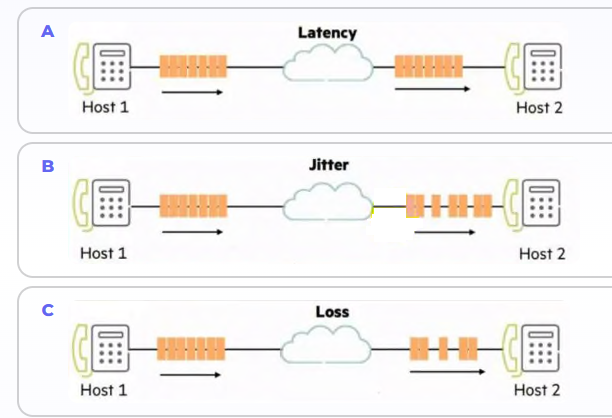
Jitter represents the variation in packet transmission delay over time and is particularly detrimental to real-time communications such as Voice over IP.
Voice applications generate a continuous stream of packets that must arrive at reasonably consistent intervals for smooth playback.
When packets experience variable queuing delays, they may arrive irregularly, creating interruptions in the reconstructed audio stream.
Even when no packets are lost during transmission, excessive jitter can produce audible dropouts if packets arrive too late to be used by the receiving jitter buffer.
The scenario identifies intermittent voice dropouts, an absence of measured packet loss, and a suspected QoS problem. These conditions strongly indicate excessive jitter.
Option A represents latency, which measures packet transmission delay. High latency produces conversational delays and may cause users to interrupt one another, but does not necessarily produce intermittent audio gaps.
Option C represents packet loss, where transmitted packets fail to reach the destination. The scenario explicitly excludes that condition.
QoS mechanisms such as appropriate DSCP classification, traffic prioritization, queue management, and congestion avoidance help reduce jitter.
The architect should examine WAN interface utilization, queue statistics, DSCP preservation, and end-to-end voice performance before recommending configuration changes.
Official HPE Reference Topics: HPE Aruba Networking AOS-CX Quality of Service Guide --- Traffic Classification and Scheduling; Unified Communications and Collaboration --- Voice Performance Monitoring.
Before starting the design for HPE Aruba Networking Cloud Authentication at a distributed enterprise, you must collect information about the customer's current identity infrastructure and endpoint capabilities. The customer has indicated interest in a cloud-native authentication solution, but details about its identity infrastructure or endpoint capabilities still need to be gathered.
As the network architect, you must proceed with initial planning by recording reasonable assumptions about the existing environment and its readiness to support cloud-native authentication.
Which assumptions are appropriate to include at this point to guide the design process?
Choose two.
HPE Aruba Networking Cloud Authentication provides cloud-native network access control using identity integration, certificate-based authentication, and centralized authorization policies.
Option A is an appropriate planning assumption because EAP-TLS is the principal authentication mechanism for managed enterprise endpoints, while MAC authentication can accommodate selected legacy or headless devices that cannot perform 802.1X.
MAC authentication should be restricted to appropriate device categories because MAC addresses can be spoofed and do not provide the same identity assurance as certificate-based authentication.
Option C is correct because EAP-TLS requires compatible client supplicants, valid certificates, and an appropriate certificate trust infrastructure.
The architect must establish whether corporate devices support EAP-TLS and can receive certificates and wireless profiles through an onboarding or endpoint-management workflow.
Option B is incorrect as written because Microsoft IntuneID and CloudScape Workspace are not the documented identity-provider names. HPE supports Microsoft Entra ID, Google Workspace, and Okta Workforce Identity Cloud in its cloud-native identity integrations.
Option D introduces an unsupported authentication-method assumption.
Option E incorrectly makes ClearPass Device Insight integration a prerequisite for cloud authentication.
These assumptions must subsequently be validated through identity-platform discovery, endpoint testing, and authentication proof-of-concept activities.
Official HPE Reference: HPE Aruba Networking Central NAC --- Identity Providers, Authentication and Authorization; Migrating from Cloud Authentication to Central NAC.
The current IT staff is accustomed to working with legacy OS-S (ProCurve) equipment. They are concerned that the differing command syntax will prevent them from handling OS-CX switches.
Which two methods can make their transition easier? (Select two.)
Choose two.
Migrating from legacy HPE Aruba Networking OS-Switch platforms to AOS-CX requires administrators to become familiar with different command structures, configuration models, and operational workflows.
Option B is appropriate because a cross-platform CLI reference guide enables engineers to compare commands used by AOS-CX, OS-Switch, Comware, and Cisco IOS.
This assists with translating familiar configuration and troubleshooting procedures into the equivalent AOS-CX commands.
For example, differences in VLAN configuration, interface management, link aggregation, routing, and diagnostic commands can be addressed through structured command comparisons.
Option D is correct because AOS-CX supports user-defined command aliases.
Aliases allow administrators to create shortcuts for frequently executed commands, reducing typing requirements and simplifying repetitive operational tasks.
HPE's AOS-CX CLI documentation explicitly supports the alias command and allows multiple commands and parameters to be incorporated into an alias definition.
Option A does not identify a specific command-transition mechanism.
Option C, CLI Bank, is also a legitimate HPE Aruba Networking command-reference resource. It provides command documentation for AOS-CX and other Aruba platforms, making it useful for training and troubleshooting.
However, for the intended two-answer selection, the cross-platform reference guide and CLI aliases are the more direct transition aids.
Official HPE Reference: HPE Aruba Networking AOS-CX Command-Line Interface Guide --- Alias Commands; HPE Aruba Networking CLI Bank.
Verification note: Option C is also a valid learning resource. The distinction between B and C depends on whether the question is testing direct command translation or general command-reference access.
Get access to all 94 verified questions with detailed answers in our HPE7-A11 exam dumps.
Unlock All HPE7-A11 Questions