H12-891_V1.0 Exam Questions & Answers
HCIE-Datacom V1.0 • Huawei
100% money-back guarantee
Sample H12-891_V1.0 Questions
Practice with real exam-style questions, each with the verified correct answer and explanation.
Which of the following statements is correct about the differences between NSR and NSF?
Comprehensive and Detailed In-Depth
NSR (Non-Stop Routing) and NSF (Non-Stop Forwarding) are high-availability mechanisms used to maintain network stability during routing process failures:
NSR (Non-Stop Routing):
Operates within the local router only.
Keeps routing information synchronized between the active and standby processes.
Does not require collaboration from neighboring routers.
NSF (Non-Stop Forwarding):
Requires collaboration from neighboring routers that support graceful restart.
The router undergoing failover relies on its neighbors to maintain forwarding tables while control plane recovery takes place.
Neighboring routers must support GR (Graceful Restart) for NSF to function correctly.
Therefore, the correct answer is B because NSF requires neighboring router collaboration, while NSR does not.
Huawei HCIE Datacom Official Certification Guide
Huawei High-Availability Configuration and Maintenance Guide
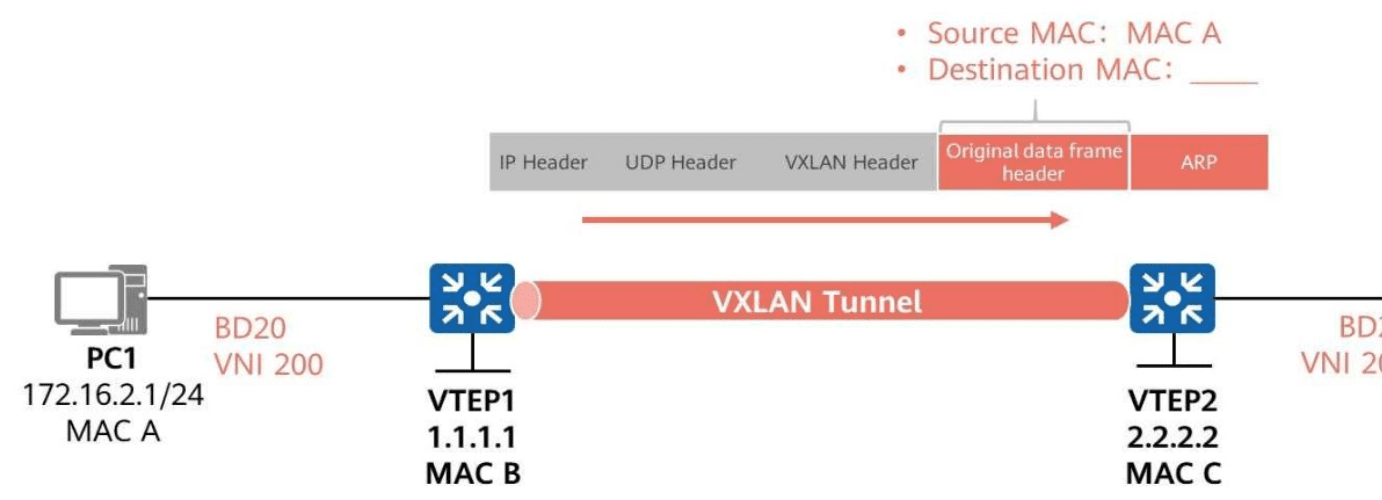
As shown in the figure, ARP broadcast suppression is enabled on VTEP1 in BD 20 (VNI 200).
VTEP1 learns ARP information about PC2 through BGP EVPN routes.
When VTEP1 forwards the ARP request for PC1's MAC address to VTEP2,
What is the destination MAC address of the inner data frame?
Understanding VXLAN and ARP Suppression in BGP EVPN
VXLAN (Virtual Extensible LAN) is used to extend Layer 2 networks over Layer 3 infrastructure.
VXLAN uses VTEPs (VXLAN Tunnel Endpoints) to encapsulate and forward Layer 2 traffic.
BGP EVPN (Ethernet VPN) is used for MAC/IP address learning and distribution across VXLAN networks.
How ARP Request Forwarding Works in This Scenario?
1 ARP Broadcast Suppression Enabled (VXLAN Optimized Forwarding)
Since ARP broadcast suppression is enabled on VTEP1, the ARP request is not flooded.
Instead, VTEP1 checks its EVPN learned database to find PC2's MAC address (MAC C).
2 VTEP1 Encapsulates the ARP Request
VTEP1 encapsulates the ARP request in a VXLAN packet and sends it to VTEP2.
The original ARP frame inside the VXLAN tunnel still has:
Source MAC: MAC A (PC1's MAC)
Destination MAC: MAC C (PC2's MAC, learned via EVPN)
3 VXLAN Outer Headers
The outer VXLAN header uses:
Source IP: 1.1.1.1 (VTEP1)
Destination IP: 2.2.2.2 (VTEP2)
VNI (VXLAN Network Identifier): 200 (BD 20)
4 VTEP2 Receives and Forwards the ARP Request
VTEP2 decapsulates the VXLAN packet and forwards the original ARP request to PC2 (MAC C).
This ensures that only the intended receiver (PC2) gets the ARP request, preventing unnecessary broadcast flooding.
Why the Answer is MAC C?
B. MAC C is Correct
The destination MAC of the inner data frame is PC2's MAC (MAC C).
This is because VTEP1 forwards the ARP request directly to VTEP2, which then forwards it to PC2.
Why Other Answers Are Incorrect?
A. MAC B (Incorrect)
MAC B is VTEP1's MAC address, which is used in the outer VXLAN header, not in the inner Ethernet frame.
C. MAC A (Incorrect)
MAC A is the source MAC of the ARP request (PC1), not the destination.
D. MAC D (Incorrect)
MAC D is not mentioned in the topology, so it is irrelevant.
Reference: Huawei HCIE Datacom -- VXLAN BGP EVPN and ARP Suppression
In 6PE networking, the shared explicit null label function can be enabled on routers to reduce the number of required MPLS labels. With this function, a router assigns a label with the value (enter only digits) to all 6PE routes.
0In 6PE (IPv6 over MPLS for Provider Edge), the shared explicit null label value is 0. When this function is enabled, the PE router assigns label 0 (IPv4 Explicit Null) to all IPv6 routes, reducing the label space consumption. This is known as label 0 reuse for IPv6 forwarding over MPLS.Exact Extract - HCIE-Datacom IPv6/MPLS Integration Section:''To optimize label usage in 6PE deployments, shared explicit null label (label 0) can be assigned to all 6PE routes.''
Huawei HCIE-Datacom Guide -- IPv6 over MPLS (6PE and 6VPE)
Huawei Training Manual -- MPLS IPv6 Label Assignment
A network administrator runs the display telemetry destination command on a device to check information about a destination group that sampled data is sent to. The command output is as follows. Which of the following statements is incorrect?
[~CE-telemetry-sensor-group-Sensor1]display telemetry destination
Dest-name Dest-addr Dest-port State Vpn-name Protocol
Dest1 192.168.56.1 20000 RESOLVED - GRPC
Understanding the Telemetry Output:
Dest-addr: 192.168.56.1 The destination IP address is 192.168.56.1.
Dest-name: Dest1 The destination group name is Dest1.
Protocol: gRPC Data push uses the gRPC protocol.
Vpn-name: - (empty) No VPN encapsulation is used.
Incorrect Answer
C. 'VPN encapsulation is used for data push' Incorrect!
The Vpn-name field is empty, indicating that VPN encapsulation is NOT enabled for telemetry data transport.
Reference from Huawei HCIE-Datacom Documentation:
Huawei Telemetry Configuration Guide -- Destination and Data Push Methods
HCIE-Datacom Study Material -- gRPC and Telemetry Data Streaming
IS-IS supports multi-instance and multi-process. Which of the following statements are correct about IS-IS multi-instance and multi-process?
IS-IS Multi-Process:
Huawei devices support running multiple IS-IS processes simultaneously.
These processes are completely independent of one another: different LSDBs, interfaces, routing tables, etc.
Each process can be associated with a separate VPN instance, and a single VPN instance can be served by multiple IS-IS processes.
IS-IS Multi-Instance:
One IS-IS process can run multiple instances, typically used for multi-VPN scenarios.
However, Huawei's current implementation prefers one VPN per process for clarity and control.
Based on Huawei's design:
A is incorrect --- an IS-IS process can serve multiple VPNs in other vendors, but Huawei typically uses one process per VPN for clean separation.
B is correct --- a VPN instance can be associated with multiple IS-IS processes.
C is incorrect in Huawei implementation context.
D is correct --- IS-IS processes are independent.
Correct answers: B, D
Get access to all 322 verified questions with detailed answers.
Unlock All H12-891_V1.0 Questions