CBAP Exam Questions & Answers
Certified Business Analysis Professional • IIBA
100% money-back guarantee
Sample CBAP Questions
Practice with real exam-style questions, each with the verified correct answer and explanation.
A company that specialized in manufacturing vending machines for books has been in business for 10 years. As the e-book and online retailing grow, the company perceived that a change is required to respond to the new emerging market forces. However, the change should focus on reusability as much as possible to reduce expenses. After analyzing the current state with the business subject matter experts, the business analyst
(BA) proposed investing in a new business line of vending machines that sell pay per use mobile device phone fast charging stations.
Due to the urgency of this change, the BA was asked to finalize requirements elicitation in the shortest possible time.
The BA was able to complete requirements elicitation activities in a short period of time. Which type of elicitation approach did the BA use?
A collaborative approach is a type of elicitation approach that involves working with multiple stakeholders simultaneously to elicit, analyze, and validate requirements. A collaborative approach can help to complete requirements elicitation activities in a short period of time, as it can:
Reduce the number of individual meetings and interviews that need to be conducted
Increase the quality and quantity of information that can be gathered from different perspectives and sources
Enhance the communication and understanding among the stakeholders and the BA
Promote the consensus and agreement on the requirements and the solution scope
Identify and resolve any conflicts, issues, or gaps in the requirements
Some examples of collaborative elicitation techniques are:
Requirements workshops: A structured and facilitated session that brings together a group of stakeholders to elicit, analyze, and prioritize requirements
Brainstorming: A technique that generates a large number of ideas or solutions from a group of stakeholders in a creative and spontaneous manner
Focus groups: A technique that collects the opinions, preferences, and feedback of a group of stakeholders on a specific topic or issue
Prototyping: A technique that creates a simplified or partial version of the solution to elicit, demonstrate, and validate requirements
The other options are not correct because they are not types of elicitation approaches, but rather techniques that can be used within an elicitation approach. An experiment is a technique that tests a hypothesis or an assumption by observing the results of a controlled or simulated scenario. An estimation is a technique that approximates the size, cost, duration, or effort of a project or a solution. A research is a technique that collects and analyzes information from existing sources, such as documents, reports, databases, etc.
[BABOK Guide v3], Section 4.2: Conduct Elicitation, p. 100-101
Types of Elicitation Techniques for the Business Analyst, Blog Post, September 2018
Elicitation Techniques Used by Business Analysts -- Tips and Guidance, Blog Post, July 2023
The business analyst (BA) has been tasked with assessing and recommending the best solution that fits an organization's need for a new third-party sales tool.
What technique would be used for identifying suitable options?
A major manufacturer of popular beverages has appointed a local distributor to serve a specific territory. The demand for the beverages has a pronounced seasonal pattern. The distributor performs well overall, but is repeatedly unable to keep up with fulfilling many customer orders during peak demand periods. The distributor's current delivery capability is stretched to deliver 60 tons of merchandise per day whereas the season's peak demand periods need a daily delivery capability of up to 100 tons.
The distributor is under pressure to fully meet the year-round market demand in order to stay in business. The distributor's management wants to identify and consider more cost-effective options as resorting to adding more trucks and drivers would not be economically feasible.
A business analyst (BA) has spent several days observing and measuring the warehouse activities to understand the situation and to gain insights into possible solutions. The delivery workflow is a four-step process: (1) picking the orders and assembling them on trays, (2) bringing the trays to the loading bay, (3) loading the orders into trucks, and (4) delivering the orders to customers. As the following table illustrates, overall performance depends is dependent on five major resources: (1) the workers who pick the orders and load them into trucks, (2) the tallyers who check the orders, (3) the drivers, (4) the trucks, and (5) eight loading bays (LBs).
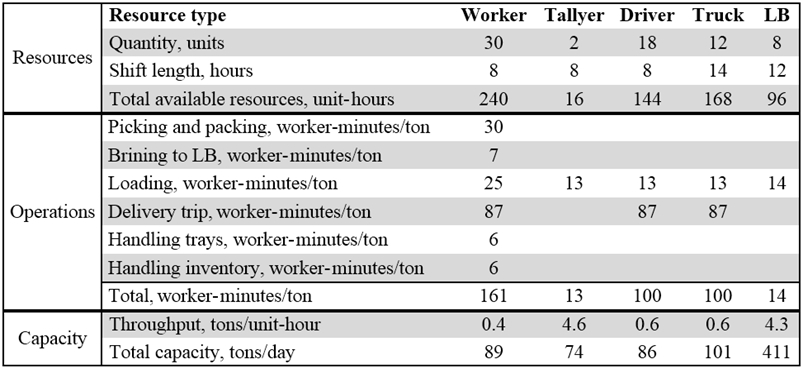
Preparing a customer order for loading takes about one hour. Upon the BA's observation, only 30% of trips have their orders available for loading when a truck arrives. This causes a waste of both the truck's and the driver's time.
What should the BA recommend to eliminate such waste?
The BA should recommend implementing a system that coordinates order processing activities in advance with all trips. This approach aims to ensure that orders are ready for loading when the trucks arrive, eliminating the waste of both the truck's and driver's time. By aligning order preparation with delivery schedules, the distributor can optimize resource utilization and improve efficiency.Reference: I need to search for specific references from Business Analysis Professional (CBAP) Learning documents or resources to provide an exact source.
You have identified several problems that you need to track as the business analysis duties progress. You want to make certain that the identified activities are resolved.
What document elicitation technique can help in this scenario?
Problem tracking is a document elicitation technique that can help in this scenario. Problem tracking is the process of identifying, documenting, and resolving issues that arise during the business analysis process. Problem tracking helps to ensure the quality and validity of the requirements and the solutions. Problem tracking also provides an opportunity for stakeholders to rank the importance of issues affecting them. Problem tracking can be done using various tools, such as spreadsheets, databases, or software applications. Problem tracking can help the business analyst to monitor the status of the issues, communicate the progress and outcomes to the stakeholders, and improve the business analysis performance and practices. The other options are not document elicitation techniques, but rather information elicitation techniques. Brainstorming is a technique that involves generating new ideas and finding solutions for a specific problem. Observation is a technique that involves watching how people perform their tasks or interact with a system. Interviews are a technique that involves asking questions and documenting the responses from a single person or a group of people.Reference:
Problem/Issue Tracking Technique --- Business Analyst Learnings, paragraph 1
Elicitation Methods | SpringerLink, paragraph 1
Understanding the Document Analysis Technique - Business Analyst Learnings, paragraph 1
What is the time difference in days between the shortest and longest implementation?
This question is based on a case study that compares four scenarios for implementing a new system for a bank. The case study provides the following information about the duration of each scenario:
Scenario 1: 6 months
Scenario 2: 9 months
Scenario 3: 10 months
Scenario 4: 7 months
Get access to all 497 verified questions with detailed answers.
Unlock All CBAP Questions