Project-Management Exam Questions & Answers
ARE 5.0 Project Management (PjM) Exam • NCARB
100% money-back guarantee
Sample Project-Management Questions
Practice with real exam-style questions, each with the verified correct answer and explanation.
A geotechnical report for a public project reveals a previously unknown condition and indicates that there is rock directly beneath the existing grade. The proposed building will now require a shallow foundation. The chosen location was the result of a three-year process evaluating multiple potential sites.
Which actions should the architect take next as a result of the geotechnical report results? Check the three that apply.
The architect should take technical and managerial steps to respond to the new geotechnical data:
A . Identifying the type of rock informs excavation methods and potential foundation redesign.
B . The cost estimate must be updated because excavation in rock is significantly more expensive.
D . Schedule impacts are also probable due to extended excavation time.
C is incorrect because the site was already selected after a lengthy evaluation process. E may not apply unless the architect is being asked to provide significant redesign. F is not typically the architect's responsibility at this stage.
NCARB ARE 5.0 Handbook -- Geotechnical coordination and cost implications
AIA B101 -- Architect's Basic Services related to site analysis
CSI MasterFormat -- Division 31 (Earthwork), 03 (Concrete Foundations)
What is the primary purpose of a construction schedule?
A construction schedule outlines the timing and sequence of construction activities and resource allocation. It helps manage workflow, coordinate trades, minimize conflicts, and track progress. It is a tool for project control and communication among all parties. While budgets and code compliance are important, the schedule's main function is organizing the sequence and timing of work. This fundamental principle is emphasized in the ARE 5.0 PjM division's construction phase and project management practices.
A key Project Manager leaves an architectural firm halfway through a project. Several days of lost productivity pass while the new Project Manager determines the customized organization that the previous Project Manager used. The new Project Manager recommends implementing new office policies to create standards and quality control methods for the entire office.
Which methods should be implemented? Check the four that apply.
Comprehensive Detailed Explanation:
Best practices in quality management include:
A . Reviewing existing methods to identify inefficiencies
B . Standardizing workflow to prevent variability and loss of knowledge
D . Measuring performance to track productivity and outcomes
E . Continuous improvement ensures the office adapts and grows
C is incorrect as customization contradicts standardization and is the root of the issue. F is a drastic step not warranted by the situation.
NCARB ARE 5.0 PjM Handbook -- Quality management and office standards
Ballast ARE 5 Review Manual -- Project Management tools and quality assurance
AIA Best Practices -- Office workflow documentation and training
Refer to the exhibit.
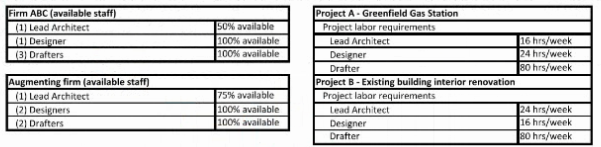
Design Firm ABC is awarded two projects, but they do not have enough staff to support the execution of both projects due to unexpected staffing issues. ABC is deciding if they need to hire staff from an outside firm to execute the projects.
Which one of the following sets of staff members would adequately support ABC's staffing needs?
Comprehensive Detailed Explanation:
From the schedule:
Total lead architect hours needed = 16 + 24 = 40 hrs/week
Firm ABC only has 50% of 1 Lead Architect = 20 hrs/week Needs 20 hrs more
Total drafter hours needed = 80 + 80 = 160 hrs/week
Firm ABC has 3 Drafters at 100% = 3 40 = 120 hrs/week Needs 40 hrs more
Thus, the firm needs 1 Lead Architect (for 20 hrs) and 1 Drafter (for 40 hrs) from the augmenting firm to meet the requirement.
NCARB ARE 5.0 PjM Handbook -- Staffing plans and workload balancing
The construction documents for a new multi-tenant office building are 90% complete. The owner requests that the bid documents include the rough-in of security camera locations and access control points for the building.
Which changes should the architect consider? Check the three that apply.
Comprehensive Detailed Explanation:
Since the documents are nearly complete, integrating new scope such as security systems can affect both the schedule and the fee. The architect should adjust the delivery timeline to accommodate new coordination, drawings, or revisions (A). Additional services require revising the design agreement (C). If a security consultant or electrical engineer is involved, their scope must also be amended (D).
Option E (building permit application) is premature unless security is a life safety requirement. Option F (revising CM services) is outside the architect's direct responsibility.
NCARB ARE 5.0 Handbook -- Contract modifications and consultant coordination
AIA B101 -- Additional Services
AIA C401 -- Consultant Agreement
Get access to all 79 verified questions with detailed answers.
Unlock All Project-Management Questions