NetSec-Analyst Exam Questions & Answers
Palo Alto Networks Network Security Analyst • Palo Alto Networks
100% money-back guarantee
Sample NetSec-Analyst Questions
Practice with real exam-style questions, each with the verified correct answer and explanation.
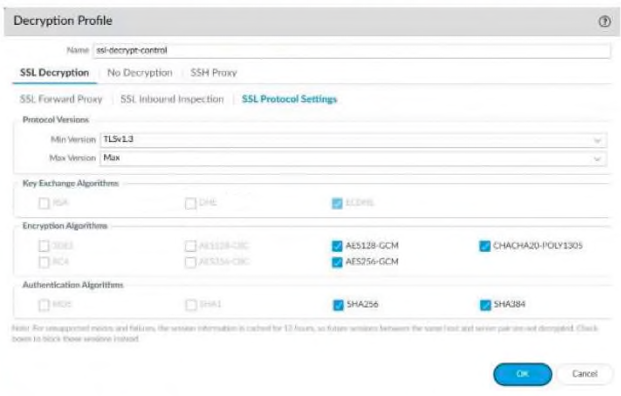
Based on the image below, what is a risk associated with this configuration?
Comprehensive and Detailed 150 to 250 words of Explanation From Palo Alto Networks Network Security Analyst Knowledge:
In the provided image, the Decryption Profile is configured with a Min Version of TLSv1.3. While this represents a high security posture, it introduces a significant operational risk: compatibility issues with legacy applications or clients.
Many older operating systems, web browsers, and legacy internal applications do not support TLS 1.3. If a client or server attempts to negotiate a connection using an older, unsupported protocol version (such as TLS 1.2 or 1.1), the firewall will drop the connection because it falls below the configured minimum threshold. A Network Security Analyst must balance the need for modern encryption with the functional requirements of the network.
Option C is incorrect because disabling weak algorithms like 3DES and RC4 actually improves the security posture. Option D is incorrect because the firewall is fully capable of decrypting traffic using Perfect Forward Secrecy (PFS) if the appropriate certificates are installed. Option B is a general concern for all decryption but is not a specific risk of the versioning shown. Therefore, the most immediate risk of setting the minimum version to TLS 1.3 is the potential disruption of services for any user or system still relying on the widely-used TLS 1.2 protocol or older.
A user reports that a specific business application is dropping connection every few minutes. The analyst wants to see if the firewall's session table is reaching its limit for that specific user. Which tool should the analyst use?
Comprehensive and Detailed 150 to 250 words of Explanation From Palo Alto Networks Network Security Analyst Knowledge:
The Session Browser (found under the Monitor tab) provides a real-time view of every active session currently being processed by the firewall's data plane. Unlike the Traffic Log, which shows completed or denied sessions, the Session Browser allows an analyst to inspect 'live' traffic.
By filtering the Session Browser by the user's source IP, the analyst can see exactly how many sessions are open, the state of those sessions (e.g., active, discard, or closing), and the time-to-live (TTL) for each session. If an application is frequently dropping, the analyst can check if the session is timing out prematurely or if the host is reaching a session limit set by a DoS Protection profile. This granular, real-time visibility is essential for troubleshooting complex application performance issues that do not necessarily appear as a 'deny' in the standard log files.
A company wants to ensure that all internal users are prevented from uploading sensitive documents to a specific personal cloud storage site. Which Security profile is specifically designed to inspect the content of file transfers for specific data patterns?
Comprehensive and Detailed 150 to 250 words of Explanation From Palo Alto Networks Network Security Analyst Knowledge:
While a File Blocking Profile (Option A) can block files based on their type (e.g., preventing any .docx upload), it does not look at the information within the file. The Data Filtering Profile is the tool designed for Data Loss Prevention (DLP).
An analyst uses Data Filtering to scan file uploads and downloads for specific sensitive patterns, such as credit card numbers, Social Security numbers, or custom regex patterns (like internal project IDs). By attaching this profile to a security rule that allows access to the cloud storage application, the firewall can permit the use of the app while specifically blocking any session that contains unauthorized data. This provides a granular layer of security that protects intellectual property and ensures regulatory compliance without completely disabling the business applications users need to perform their jobs.
Which feature allows the firewall to automatically identify and categorize IoT (Internet of Things) devices based on their unique network behavior?
Comprehensive and Detailed 150 to 250 words of Explanation From Palo Alto Networks Network Security Analyst Knowledge:
While App-ID identifies the software, Device-ID is a newer Palo Alto Networks technology (often paired with the IoT Security subscription) that identifies the physical device type (e.g., a Siemens PLC, a Philips MRI machine, or an Amazon Echo).
Device-ID uses machine learning to analyze the traffic patterns, MAC addresses, and protocols unique to IoT devices. Once identified, the analyst can write security policies based on the 'Device-ID' rather than IP addresses. For example, an analyst can create a rule that says 'All Infusion Pumps are only allowed to talk to the Medical Management Server.' This provides much higher granularity and security for IoT environments, where devices often have weak internal security and fixed, hard-to-manage identities.
An analyst is troubleshooting a policy that is not matching traffic as expected. After reviewing the logs, the analyst sees that the traffic is matching a rule with a lower priority. Which feature allows the analyst to compare two rules side-by-side to identify the conflict?
Comprehensive and Detailed 150 to 250 words of Explanation From Palo Alto Networks Network Security Analyst Knowledge:
The Rule Comparison tool (often found in Panorama or SCM) allows an analyst to select two specific security policies and see a highlighted, side-by-side view of their differences. This is an essential troubleshooting objective when dealing with large, complex rulebases where 'shadowing' might occur.
By comparing the rules, the analyst can quickly see if one rule has a more broad source address or a different service object that is capturing traffic before it reaches the intended, more granular rule. Palo Alto Networks firewalls evaluate rules from the top down; therefore, understanding exactly where two rules diverge helps the analyst reorganize the policy set to ensure the most specific rules are at the top. This ensures the 'Positive Enforcement Model' is maintained and that traffic is subjected to the intended security profiles and logging requirements.
Get access to all 74 verified questions with detailed answers.
Unlock All NetSec-Analyst Questions