SD-WAN-Engineer Exam Questions & Answers
Palo Alto Networks SD-WAN Engineer • Palo Alto Networks
100% money-back guarantee
Sample SD-WAN-Engineer Questions
Practice with real exam-style questions, each with the verified correct answer and explanation.
The UI triggers incident DEVICESW_CONCURRENT_FLOWLIMIT_EXCEEDED for a branch site. Based in the image below, which tool can be used to identify the host?
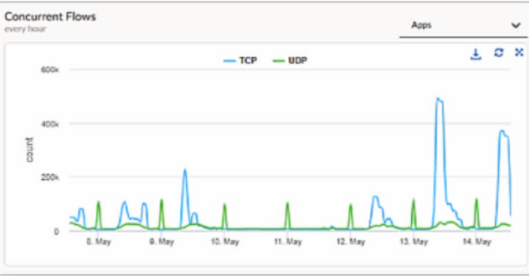
When a Prisma SD-WAN ION device triggers the DEVICESW_CONCURRENT_FLOWLIMIT_EXCEEDED incident, it indicates that the number of active sessions has reached the hardware or software-defined capacity limit of that specific appliance. In the provided graph, we can see a massive spike in concurrent TCP flows on May 13th, reaching nearly 500k, which is a clear indicator of anomalous behavior---likely a 'top talker' host, a malware outbreak, or a misconfigured application generating excessive connections.
To identify the specific host responsible for this surge, administrators should navigate to Monitor Activity Flows. This interface, commonly known as the Flow Browser, provides the most granular visibility into real-time and historical session data within the Prisma SD-WAN fabric. Unlike 'Transaction Stats,' which provide high-level summaries, or 'New Flows,' which only show the rate of session initiation, the Flows view allows an engineer to filter and sort the active session table by metadata such as Source IP, Destination IP, Application, and Site.
By utilizing the Flow Browser, an administrator can quickly group flows by 'Source IP' to pinpoint exactly which internal host is consuming the most flow table entries. This is the standard 'Day 2' operational workflow for troubleshooting performance and capacity incidents. While running a tcpdump (Option A) is a valid diagnostic for packet-level analysis, it is inefficient for identifying a single host among hundreds of thousands of flows and can further tax the device's CPU during a high-load event. The Monitor Activity Flows tool is designed specifically for this type of scale, providing the necessary visibility to remediate the flow limit exhaustion and restore normal network operations.
In the Prisma SD-WAN portal, an administrator is viewing the "Media" analytics for a branch site to troubleshoot complaints about poor voice quality.
When calculating the Mean Opinion Score (MOS) for voice traffic, which two metrics does the system prioritize active monitoring for, even when no user voice traffic is present on the link? (Choose two.)
Comprehensive and Detailed Explanation
Prisma SD-WAN calculates the Mean Opinion Score (MOS) to provide a standardized metric (1-5) for voice quality. To ensure the system always knows the 'voice readiness' of a path---even before a call starts---it uses Active Probes (synthetic UDP packets).
While latency is measured, the MOS calculation algorithm is most heavily penalized by Packet Loss (D) and Jitter (B).
Packet Loss: Even a small amount of loss (e.g., >1%) dramatically reduces voice clarity, causing dropouts.
Jitter: High variance in packet arrival time (jitter) causes the 'robotic' voice effect and buffer underruns.
The system continuously measures these specific metrics on all WAN links using synthetic probes. If the packet loss or jitter exceeds the threshold defined in the 'Path Quality Profile' (e.g., Voice Profile), the path is marked as non-compliant, and the MOS score drops, triggering a policy action to move the flow. Throughput (C) is less critical for voice as calls consume very little bandwidth (e.g., 64-100 Kbps), making congestion (loss/jitter) the primary enemy, not raw speed.
When deploying a branch gateway, secure fabric VPN tunnels are automatically established between which two site types? (Choose two.)
In the Prisma SD-WAN (Instant-On Network) architecture, the 'Secure Fabric' is a key feature that simplifies VPN orchestration through automation. When an ION device is deployed at a site and associated with a specific role, the Prisma SD-WAN Controller automatically manages the establishment of encrypted VPN tunnels without requiring manual IPsec configuration.
The most fundamental tunnel type is Branch gateway to data center (Option B). By default, the system follows a hub-and-spoke model where every branch ION device automatically attempts to build secure tunnels to all available Data Center clusters within its domain. This ensures that branch locations have immediate, redundant connectivity to centralized corporate resources and applications as soon as they are brought online.
Additionally, Prisma SD-WAN supports automated Branch gateway to branch gateway connectivity (Option C). Unlike traditional architectures that backhaul all traffic through a central hub, the Prisma SD-WAN fabric can dynamically establish 'spoke-to-spoke' tunnels between branch gateways to facilitate direct communication. This is particularly useful for latency-sensitive applications like Voice over IP (VoIP) or video conferencing. While this can be configured as a 'full mesh' where all sites build tunnels to all other sites, the controller intelligently manages these connections based on the defined site roles and domain configurations to optimize resource usage and performance. Options A and D are incorrect because the fabric orchestration logic is primarily focused on the functional roles of the gateways (Branch vs. Data Center) rather than 'domains' in the context of tunnel initiation.
A network administrator notices that a branch ION device is experiencing high CPU utilization due to a suspected TCP SYN Flood attack originating from a compromised host on the local LAN.
Which specific security feature should be configured and applied to the "LAN" zone to mitigate this Denial of Service (DoS) attack?
Comprehensive and Detailed Explanation
To defend against volumetric attacks such as TCP SYN Floods, UDP Floods, or ICMP Floods, Prisma SD-WAN (like PAN-OS) utilizes Zone Protection Profiles.
Function: A Zone Protection Profile is a specific security object designed to screen traffic for protocol anomalies and flood behaviors before it is processed by the complex firewall policy engine. It sets thresholds (e.g., 'Max 1000 SYNs/sec'). If the traffic rate exceeds this threshold, the system triggers an action (Alarm, Drop, or SYN Cookies) to protect the device's resources.
Application: Unlike a standard ZBFW Rule (A) which filters based on Source/Destination/App-ID (which might still allow the initial handshake packets that cause the flood), a Zone Protection Profile is applied to the Zone object itself (in this case, the LAN Zone). This ensures that the flood is mitigated at the ingress stage, preventing the ION's session table and CPU from being exhausted by the attack.
Based on the HA topology image below, which two statements describe the end-state when power is removed from the ION 1200-S labeled ''Active'', assuming that the ION labeled ''Standby'' becomes the active ION? (Choose two.)
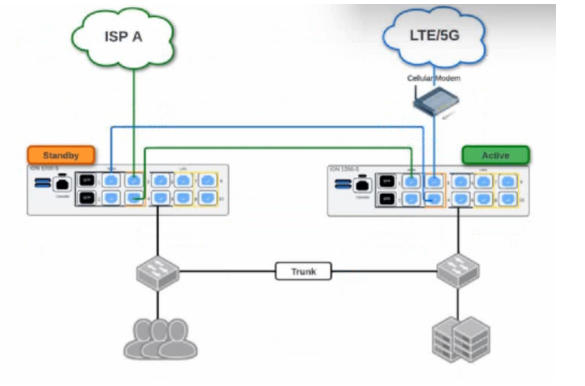
Prisma SD-WAN High Availability (HA) for branch ION devices, particularly the Gen-2 ION 1200-S, is designed to provide '100% WAN Capacity' preservation during a hardware or power failure. This is achieved through the use of Bypass Pairs (Fail-to-Wire). In the provided topology, the ISP A and LTE/5G circuits are cross-connected using the bypass ports (typically ports 3 and 4 on the ION 1200-S).
When the 'Active' ION device loses power, the internal physical relays in its bypass ports transition to a closed state, effectively creating a physical bridge between the ports. In this scenario, the LTE/5G signal---which enters the Active ION's port 4---is mechanically bridged to port 3, allowing it to pass through to port 4 of the Standby ION. Simultaneously, ISP A is already connected to the Standby ION. Consequently, once the Standby device completes its transition to the 'Active' state, it has physical access to both WAN circuits, validating Statement A.
Regarding the LAN transition, Prisma SD-WAN does not use standard VRRP for ION-to-ION HA; instead, it uses a proprietary Control Plane HA mechanism. When the failover occurs, the newly active ION takes over the IP addresses of all configured Switch Virtual Interfaces (SVIs) and LAN interfaces. To ensure the downstream Layer 2 infrastructure (like the LAN switches shown in the diagram) updates its MAC address tables to point to the new physical hardware for those IPs, the newly active ION immediately broadcasts a Gratuitous ARP (GARP). This ensures that LAN traffic is correctly steered to the new device without a significant timeout, validating Statement C.
Get access to all 86 verified questions with detailed answers.
Unlock All SD-WAN-Engineer Questions