200-901 Exam Questions & Answers
Automating Networks Using Cisco Platforms • Cisco
100% money-back guarantee
Sample 200-901 Questions
Practice with real exam-style questions, each with the verified correct answer and explanation.
A company is adopting DevOps as part of an internal transformation, and is reviewing the success of the first deployments. Developers and engineers are working together to resolve any resulting issues. However, this new way of working has increased overhead, and the team is finding it difficult to complete releases in time.
Which area of the CALMS framework must the company target for improvement?
The CALMS framework is used to assess and guide DevOps transformations. It stands for Culture, Automation, Lean, Measurement, and Sharing. Each element represents a critical area for improvement in DevOps practices.
Collaboration: Emphasizes teamwork and breaking down silos.
Lean: Focuses on eliminating waste, optimizing processes, and ensuring efficiency.
Sharing: Encourages transparency and knowledge sharing among teams.
Measurement: Involves monitoring and analyzing performance metrics to drive improvement.
Given that the team is struggling to complete releases on time due to increased overhead, targeting the Lean aspect can help streamline processes, reduce waste, and improve efficiency, ultimately helping them to meet their release deadlines.
Cisco DevNet DevOps Essentials: CALMS Framework
Refer to the exhibit.
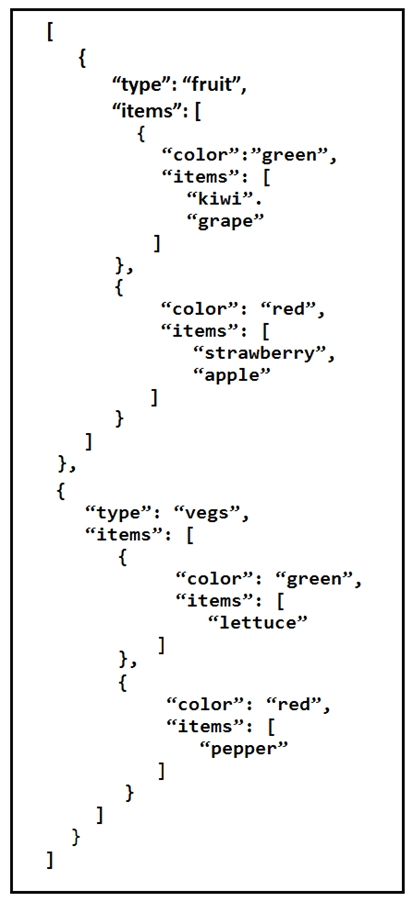
A REST API retune this JSON output for a GET HTTP request, Which has assigned to a variable called ''vegetables'' Using python, which output is the result of this command?

Understand the JSON Structure: The JSON data given in the exhibit consists of an array of objects. Each object has a type and an items key. The items key contains an array of objects, each with a color and another items key, which is an array of strings representing items of that color.
Analyze the Python Code: The Python code provided is:
print(filter(lambda l: l['type'] == 'fruit', vegetables)[0]['items'][0]['items'][0])
Break Down the Code:
filter(lambda l: l['type'] == 'fruit', vegetables): This line filters the JSON array vegetables to include only objects where the type is 'fruit'.
filter(...)[0]: After filtering, this selects the first object in the filtered list, which is the fruit object.
['items'][0]: This accesses the first item in the items array of the fruit object. In this case, it refers to the object where color is 'green'.
['items'][0]: This accesses the first item in the items array of the green object, which is 'kiwi'.
Evaluate the Code:
The first object of type fruit in the JSON is found.
The first item in the items array for fruit with the color green is selected.
The first item in this nested items array is 'kiwi'.
Therefore, the output of the given Python command is 'Kiwi'.
Python documentation on filter: Python Docs - Filter
JSON structure understanding from DevNet Associate study materials on API interactions and data parsing.
A developer is writing an application that a REST API and the application requires a valid from the API which element of the response is used in the conditional check?
When a developer is writing an application that interacts with a REST API, the status code of the response is a critical element used in conditional checks. The status code provides information about the success or failure of the request. Common status codes include:
200: OK (The request was successful).
201: Created (The resource was successfully created).
400: Bad Request (The server could not understand the request due to invalid syntax).
401: Unauthorized (Authentication is required and has failed or has not been provided).
404: Not Found (The requested resource could not be found).
By checking the status code, the application can determine if the request was successful and handle errors appropriately.
What is a function of the default gateway in a network?
A default gateway is a router or network device that serves as an access point to another network, often the internet, when no other route is specified for a given data packet. In other words, it is used to forward traffic from the local subnet to different subnets, including external networks. When a host needs to communicate with a device on a different subnet, it sends the traffic to the default gateway, which then routes the traffic accordingly.
Cisco DevNet Associate Certification Guide
Cisco Networking Essentials, Chapter on Routing and Switching Basics
Which HTTP status means that the origin server knows the method that is received in the request line, but the target resource does not support the method?
Get access to all 481 verified questions with detailed answers.
Unlock All 200-901 Questions