300-410 Exam Questions & Answers
Implementing Cisco Enterprise Advanced Routing and Services • Cisco
100% money-back guarantee
About 300-410 Exam
The 300-410 ENARSI (Implementing Cisco Enterprise Advanced Routing and Services) certification exam is a crucial credential for network professionals seeking to validate their expertise in enterprise-level routing and network services. This advanced-level exam tests candidates' knowledge of complex routing protocols including BGP, OSPF, and EIGRP, along with services deployment such as VPN technologies, QoS implementation, and infrastructure security. The 300-410 exam covers critical topics including Layer 3 technologies, VPN implementations, infrastructure services, and security protocols that are essential for managing modern enterprise networks. IT professionals, network engineers, and system administrators pursuing their CCNP Enterprise certification must demonstrate proficiency in these advanced networking concepts to succeed in today's competitive job market.
Preparing for the 300-410 exam requires comprehensive study materials and hands-on practice. Updated exam dumps and practice tests provide candidates with realistic exam simulations, helping them identify knowledge gaps and build confidence before test day. These resources offer detailed explanations of complex routing scenarios, service implementations, and troubleshooting techniques that mirror actual exam questions. By utilizing current practice tests and verified study materials, candidates can effectively master the exam's challenging topics and increase their chances of passing on the first attempt. Investing in quality preparation resources ensures that aspiring CCNP Enterprise professionals are thoroughly equipped to handle enterprise-grade networking challenges and advance their careers in information technology.
Exam Topics & Objectives
4-Week Study Plan for 300-410
Week 1: Layer 3 Technologies Foundation
- Study OSPF fundamentals: areas, LSA types, DR/BDR election, and convergence mechanisms
- Review EIGRP: metric calculation, successor/feasible successor concepts, hello/dead timers
- Practice configuring multi-area OSPF topologies with different area types (backbone, standard, stub, totally stubby, NSSA)
- Lab: Configure EIGRP with unequal cost load balancing using variance command
- Study BGP basics: ASN, iBGP vs eBGP, message types, neighbor relationships
- Review redistribution between routing protocols and administrative distance considerations
- Practice troubleshooting routing protocol adjacencies and neighbor relationships
Week 2: Advanced Layer 3 & VPN Technologies
- Study BGP route filtering: prefix lists, distribute lists, route maps, and community attributes
- Practice BGP path selection and best path algorithm manipulation
- Lab: Configure BGP confederation and route reflectors for scalability
- Study IPsec fundamentals: tunnel modes, encryption algorithms, authentication methods
- Review IKEv1 and IKEv2 phases and negotiation processes
- Configure site-to-site IPsec VPNs with encryption and authentication
- Study remote access VPN concepts: SSL/TLS VPN, client-based VPN
- Practice IPsec troubleshooting: debug commands, crypto ACLs, transform sets
Week 3: Infrastructure Security & Services
- Study access control lists (ACLs): standard, extended, named ACLs, and placement strategies
- Configure object groups and dynamic ACLs for enterprise security
- Review Cisco AAA (Authentication, Authorization, Accounting): RADIUS, TACACS+, local databases
- Lab: Configure AAA for device management access with TACACS+ server
- Study DHCP: scope configuration, relay agents, snooping, and starvation attacks
- Practice DNS security and DNSSEC implementation
- Review NTP: authentication, hierarchical deployment, accuracy considerations
- Configure syslog implementation for centralized logging
Week 4: Advanced Infrastructure & Comprehensive Review
- Study QoS mechanisms: classification, marking, queuing, policing, shaping
- Practice configuring MQC (Modular QoS CLI) for traffic prioritization
- Lab: Implement end-to-end QoS policy across multiple router interfaces
- Review multicast: PIM sparse/dense modes, RP selection, multicast routing protocols
- Configure IGMP and multicast traffic flow
- Study High Availability: HSRP, VRRP, GLBP operation and configuration
- Practice failover scenarios and tracking object implementation
- Review exam objectives across all four domains
- Complete full-length practice exams covering Layer 3, VPN, Security, and Services topics
- Identify weak areas and targeted review of specific technologies
Sample 300-410 Questions
Practice with real exam-style questions. Reveal answers to verify your knowledge.
A network administrator successfully established a DMVPN tunnel with one hub and two spokes using EIGRP. One of the requirements was to enable spoke-to-spoke tunnels through the hub router using EIGRP. Which configuration command must the engineer configure to meet the requirement?
Which statement about MPLS LDP router ID is true?
Refer to the exhibit.
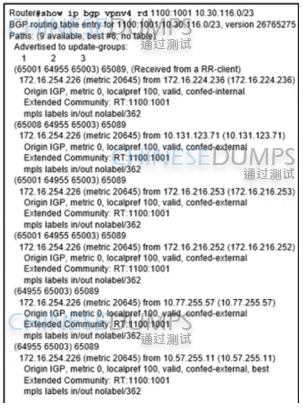
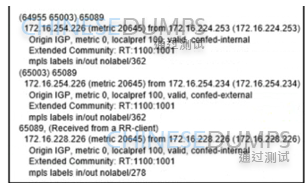
Refer to the exhibit. An engineer configured BGP and wants to select the path from 10.77.255.57 as the best path instead of current best path. Which action resolves the issue?
Refer to the exhibit.
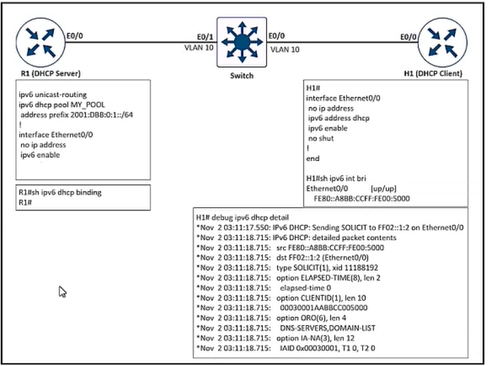
After the network administrator rebuilds the IPv6 DHCP server, clients are not getting the IPv6 address lease. Which action resolves the issue?
Refer to the exhibit.
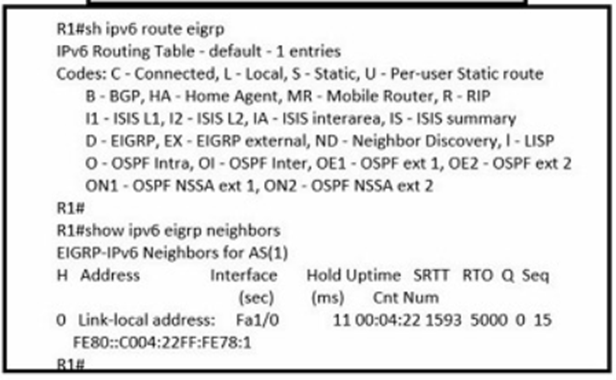
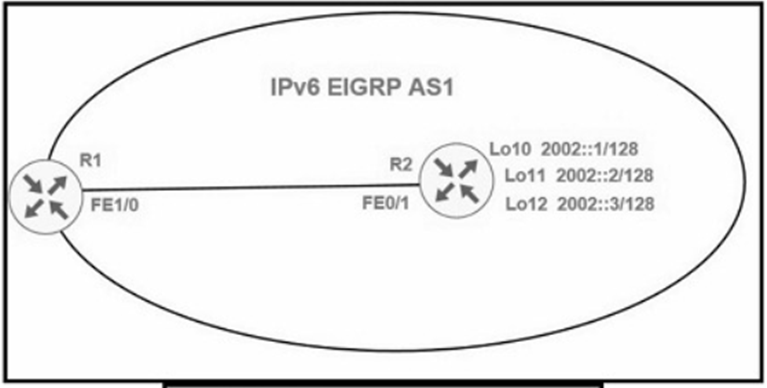
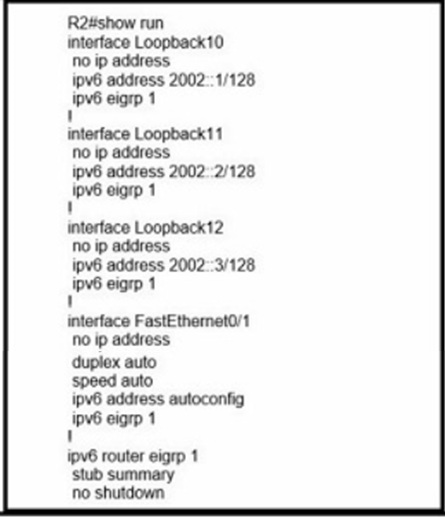
R1 cannot receive the R2 Interfaces with individual prefixes. What must be reconfigured to advertise R2 Interfaces to R1?
Get access to all 640 verified questions with detailed answers.
Unlock All 300-410 Questions