300-440 Exam Questions & Answers
Designing and Implementing Secure Cloud Connectivity • Cisco
100% money-back guarantee
Sample 300-440 Questions
Practice with real exam-style questions, each with the verified correct answer and explanation.
Which feature is unique to Cisco SD-WAN IPsec tunnels compared to native IPsec VPN tunnels?
What is the role of service providers to establish private connectivity between on-premises networks and Google Cloud resources?
The role of service providers to establish private connectivity between on-premises networks and Google Cloud resources is to facilitate direct, dedicated network connections through Google Cloud Interconnect. Google Cloud Interconnect is a service that allows customers to connect their on-premises networks to Google Cloud through a service provider partner. This provides low latency, high bandwidth, and secure connectivity to Google Cloud services, such as Google Compute Engine, Google Cloud Storage, and Google BigQuery. Google Cloud Interconnect also supports hybrid cloud scenarios, such as extending on-premises networks to Google Cloud regions, or connecting multiple Google Cloud regions together. Google Cloud Interconnect offers two types of connections: Dedicated Interconnect and Partner Interconnect. Dedicated Interconnect provides physical connections between the customer's network and Google's network at a Google Cloud Interconnect location. Partner Interconnect provides virtual connections between the customer's network and Google's network through a supported service provider partner. Both types of connections use VLAN attachments to establish private connectivity to Google Cloud Virtual Private Cloud (VPC) networks.Reference:
Designing and Implementing Cloud Connectivity (ENCC) v1.0
[Google Cloud Interconnect Overview]
[Google Cloud Interconnect Documentation]
Refer to the exhibits.
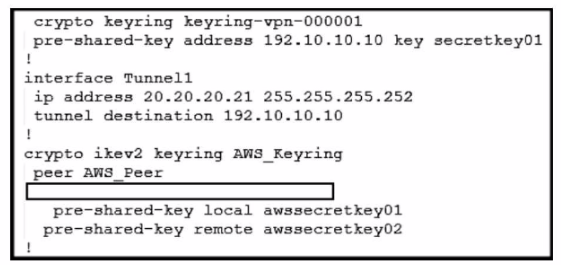
Refer to the exhibit. An engineer needs to configure a site-to-site IPsec VPN connection between an on-premises Cisco IOS XE router and Amazon Web Services (AWS). Which configuration command must be placed in the blank in the code to complete the tunnel configuration?
Configure IOS-XE Site-to-Site VPN Connection to Amazon Web Services - Cisco Community
[Security for VPNs with IPsec Configuration Guide, Cisco IOS XE Release 3S - Config
A company with multiple branch offices wants a suitable connectivity model to meet these network architecture requirements:
* high availability
* quality of service (QoS)
* multihoming
* specific routing needs
Which connectivity model meets these requirements?
A fully meshed topology with SD-WAN technology using dynamic routing and prioritized traffic for QoS meets the network architecture requirements of the company. A fully meshed topology provides high availability by eliminating single points of failure and allowing multiple paths between branch offices. SD-WAN technology enables multihoming by supporting multiple transport options, such as MPLS, internet, LTE, etc. SD-WAN also provides QoS by applying policies to prioritize traffic based on application, user, or network conditions. Dynamic routing allows the SD-WAN solution to adapt to changing network conditions and optimize the path selection for each traffic type. A fully meshed topology with SD-WAN technology can also support specific routing needs, such as segment routing, policy-based routing, or application-aware routing.Reference:
Designing and Implementing Cloud Connectivity (ENCC) v1.0
[Cisco SD-WAN Design Guide]
[Cisco SD-WAN Configuration Guide]
A company has multiple branch offices across different geographic locations and a centralized data center. The company plans to migrate Its critical business applications to the public cloud infrastructure that is hosted in Microsoft Azure. The company requires high availability, redundancy, and low latency for its business applications. Which connectivity model meets these requirements?
The connectivity model that meets the requirements of high availability, redundancy, and low latency for the company's business applications isExpressRoute with private peering using SDCI.
By using ExpressRoute with private peering and SDCI, the company can achieve the following benefits:
Get access to all 38 verified questions with detailed answers.
Unlock All 300-440 Questions