300-510 Exam Questions & Answers
Implementing Cisco Service Provider Advanced Routing Solutions • Cisco
100% money-back guarantee
About 300-510 Exam
The Cisco 300-510 (Implementing Cisco Service Provider Advanced Routing Solutions) certification exam validates expertise in designing and implementing advanced routing solutions for service provider networks. This challenging exam covers critical topics including BGP configuration, multiprotocol routing, segment routing, VPN technologies, and service provider architecture fundamentals. Candidates must demonstrate proficiency in managing complex network environments, troubleshooting routing issues, and optimizing network performance across large-scale service provider deployments. The 300-510 exam is ideal for network engineers, routing specialists, and IT professionals seeking to advance their careers in service provider networking and infrastructure management.
Preparing for the 300-510 exam requires comprehensive study resources and hands-on practice. Updated exam dumps and practice tests provide candidates with realistic exam scenarios, enabling them to identify knowledge gaps and build confidence before attempting the certification. These resources offer detailed explanations for each question, helping learners understand complex routing concepts and best practices used in production environments. By utilizing quality practice tests alongside official Cisco learning materials, candidates can significantly improve their chances of passing the exam on the first attempt and obtaining this prestigious certification that recognizes advanced routing expertise in service provider networks.
Exam Topics & Objectives
4-Week Study Plan for 300-510
Week 1: Unicast Routing Fundamentals
- Review OSI model and routing protocols overview (RIP, EIGRP, OSPF, BGP)
- Study OSPF areas, LSA types, and SPF algorithm in depth
- Configure and verify OSPF in multiple areas with different area types (backbone, standard, stub, NSSA)
- Lab: Implement OSPF with area filtering and summarization techniques
- Review EIGRP named mode configuration and advanced features
- Study metric calculation, K-values, and EIGRP convergence behavior
- Lab: Configure EIGRP with stub routing and load balancing across unequal paths
- Complete practice questions on OSPF and EIGRP from exam bank
Week 2: Advanced Unicast Routing & Multicast Routing
- Study BGP fundamentals: AS numbers, peer relationships, and message types
- Configure BGP for both eBGP and iBGP scenarios with route reflectors and confederations
- Lab: Implement BGP with various topologies including route reflector clusters
- Review Multicast Routing Protocol (PIM) modes: Dense Mode, Sparse Mode, and Sparse-Dense Mode
- Study RP (Rendezvous Point) selection, election methods, and multicast tree creation
- Configure PIM-SM with static RP and Auto-RP in lab environment
- Lab: Build multicast network with IGMP, PIM-SM, and verify multicast forwarding
- Study MSDP and its role in inter-domain multicast
- Complete labs on RPF (Reverse Path Forwarding) checks and multicast troubleshooting
Week 3: Routing Policy, Manipulation & MPLS Fundamentals
- Study prefix lists, route maps, and access control lists for route filtering
- Configure route redistribution between OSPF, EIGRP, and BGP protocols
- Lab: Implement complex route redistribution with metric manipulation and filtering
- Study BGP attributes: weight, local preference, AS-path, MED, and communities
- Configure prefix-based and path-based route manipulation using route maps
- Lab: Manipulate BGP routing decisions using various attributes and conditions
- Review MPLS fundamentals: labels, label switching paths (LSPs), and control plane protocols
- Study LDP (Label Distribution Protocol) and RSVP-TE for LSP creation
- Configure MPLS on service provider topology with label propagation verification
Week 4: MPLS Advanced Topics, Segment Routing & Final Review
- Study MPLS VPN (L3VPN): VRF concepts, route targets, and route distinguishers
- Configure MPLS L3VPN with multiple customer sites and overlapping address spaces
- Lab: Implement full MPLS VPN topology with BGP signaling and traffic verification
- Review Segment Routing (SR) architecture, segment types, and SID allocation
- Study SR-MPLS and SR-IPv6 operation and difference from traditional MPLS
- Configure Segment Routing on topology with IS-IS or OSPF as IGP
- Lab: Implement SR-MPLS with traffic engineering and SID-based path selection
- Study Segment Routing Traffic Engineering (SR-TE) and its benefits
- Review Traffic Engineering, Fast Reroute (FRR), and MPLS Graceful Restart
- Complete all four domains with comprehensive practice exams and timed mock tests
- Review weak areas and perform final verification labs
Sample 300-510 Questions
Practice with real exam-style questions. Reveal answers to verify your knowledge.
Guidelines
This is a lab item in which tasks will be performed on virtual devices.
Refer to the Tasks tab to view the tasks for this lab item.
Refer to the Topology tab to access the device console(s) and perform the tasks.
Console access is available for all required devices by clicking the device icon or using the tab(s) above the console window.
All necessary preconfigurations have been applied.
Do not change the enable password or hostname for any device.
Save your configurations to NVRAM before moving to the next item.
Click Next at the bottom of the screen to submit this lab and move to the next question.
When Next is clicked, the lab doses and cannot be reopened.
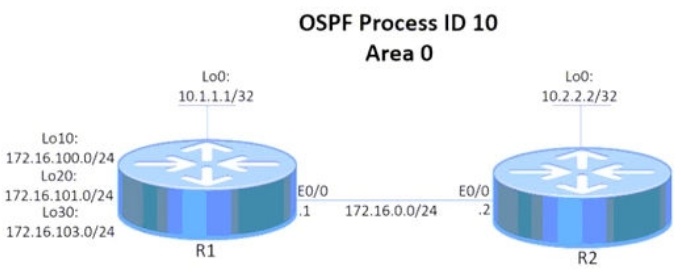
Topology
Tasks
Configure and verify an OSPF neighbor adjacency between R1 and R2 in OSPF area 0 according to the topology to achieve these goals:
1. R1 pings the Loopback0 interface of R2. Use interface-level configuration to complete this task.
2. R2 pings the Loopback0 interface of R1. Use interface-level configuration to complete this task.
3. R2 receives a single summary route 172.16.100.0/22 for networks 172.16.100.0/24, 172.16.101.0/24, and 172.16.103.0/24.
Refer to the exhibit.
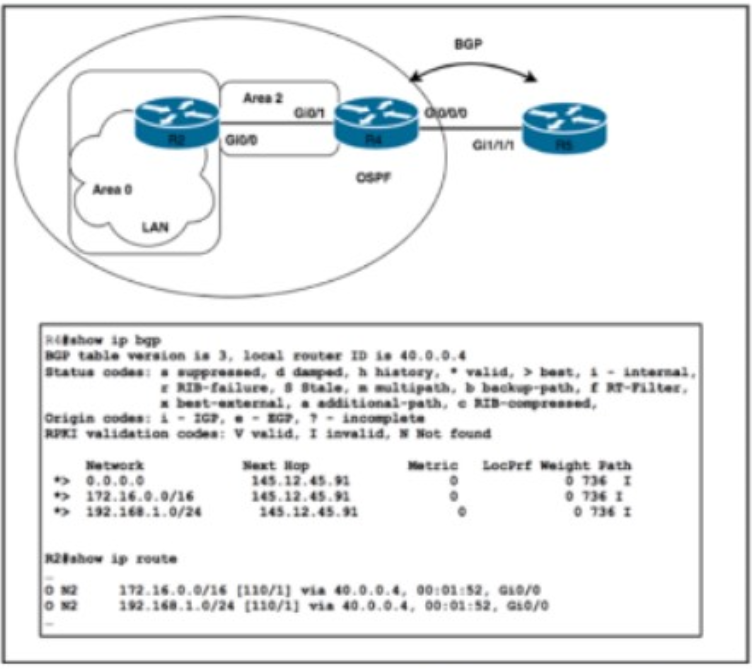
OSPF is an interior routing protocol on the network. R2 Is In the backbone area, and R4 is In a totally NSSA are
a. R5 announces only the 0.0.0.0/0 route to R4 via BGP. R4 is configured with redistribute bgp 736 metric-type 2. After the most recent maintenance window. R2 no longer has the default route via R4. Which action must the network engineer take to correct the reachability problem?
Which attribute is used to instruct the router that packets must be processed by an ASA that is associated with the segment?
What is the difference between RPL and route map actions?
Refer to the exhibit.
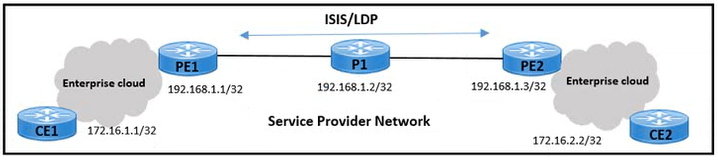
Refer to the exhibit. An engineer working for a private telecommunication company with an employee id 4115 46 881 is enabling a segment routing solution with these requirements.
A service provider is using the default range for prefix SID.
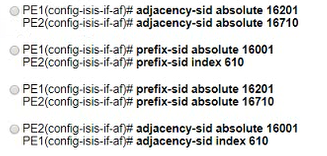
PE1 must allocate the first SID from the default range for the loopback address
PE1 and PE2 loopback SID allocation should have a minimum difference of 500.
Which configuration must be implemented to meet the requirements?
Get access to all 269 verified questions with detailed answers.
Unlock All 300-510 Questions
