300-815 Exam Questions & Answers
Implementing Cisco Advanced Call Control and Mobility Services • Cisco
100% money-back guarantee
About 300-815 Exam
The Cisco 300-815 certification exam, also known as Implementing Cisco Advanced Call Control and Mobility Services, is a critical credential for IT professionals seeking to demonstrate expertise in enterprise voice and mobility solutions. This advanced certification validates your ability to implement, configure, and troubleshoot Cisco Unified Communications Manager, mobility services, and advanced call control features. The exam covers essential topics including device mobility, Cisco Unified Communications Manager clustering, call routing, media resources, and integration with Cisco collaboration platforms. IT professionals, network engineers, and voice specialists pursuing CCNP Collaboration certification should consider taking this exam to advance their careers and enhance their technical proficiency in modern communication systems.
Preparing for the 300-815 exam requires comprehensive study materials, and updated exam dumps and practice tests play a vital role in candidate success. These resources provide real-world scenarios and hands-on experience that mirror the actual examination format, helping candidates identify knowledge gaps and build confidence before test day. Quality practice tests simulate the exam environment, allowing candidates to manage their time effectively and refine their problem-solving strategies. Combined with official Cisco documentation and training courses, updated exam dumps and practice tests ensure candidates are fully prepared to pass the 300-815 certification and gain practical skills needed for implementing advanced call control solutions in enterprise environments.
Exam Topics & Objectives
4-Week Study Plan for 300-815
Week 1: Signaling Protocols & Foundations
- Study SIP (Session Initiation Protocol) fundamentals including message structure, methods (INVITE, BYE, REGISTER), and response codes
- Review H.323 protocol components: gatekeeper, gateway, MCU, and terminal roles
- Learn SCCP (Skinny Client Control Protocol) architecture and device registration process
- Understand MGCP (Media Gateway Control Protocol) call flows and endpoint management
- Analyze media protocols: RTP, RTCP, and codec selection (G.711, G.729, G.722)
- Study VoIP quality metrics including jitter, latency, and packet loss thresholds
- Complete practice questions on signaling and media protocols (aim for 80%+)
Week 2: CME, SRST, and CUBE Fundamentals
- Configure Cisco Unified Communications Manager Express (CME) on routers
- Study SRST (Survivable Remote Site Telephony) deployment scenarios and fallback mechanisms
- Learn CME dial plan configuration and ephone/ephone-dn objects
- Understand Cisco Unified Border Element (CUBE) role as SIP-to-SIP gateway
- Study CUBE security features: protocol normalization, topology hiding, and attack mitigation
- Configure basic CUBE SIP normalization and signaling flows
- Lab: Set up CME dial plan with 10 extensions and SRST fallback
- Lab: Configure CUBE for basic SIP call routing between endpoints
Week 3: Call Control, Dial Planning & Advanced Features
- Master call routing patterns, wildcards, and priority matching in Cisco Unified CM
- Study translation patterns, calling search spaces (CSS), and partition configuration
- Learn number plan implementation: internal extensions, external routes, and least-cost routing
- Configure call admission control (CAC) mechanisms and bandwidth management
- Study Cisco Unified CM call features: call forwarding, call transfer, conference, and call hold
- Understand DTMF relay methods: inband, out-of-band (RFC 2833), and SIP INFO
- Configure intercom, line group, and hunt group features
- Lab: Design complete dial plan with CSS, partitions, and multiple route patterns
- Lab: Configure call forwarding, transfer, and feature access codes (FACs)
Week 4: Mobility, Advanced CUBE, and Exam Preparation
- Study Cisco Unified CM mobility features: remote office phones, IP phone wireless, and mobile connect
- Configure Cisco Jabber deployment with Unified CM integration
- Learn device mobility and location-based calling restrictions
- Study advanced CUBE features: emergency calling, SBC functions, and multi-tenant deployments
- Configure CUBE interworking between SIP and H.323 domains
- Master CUBE media manipulation and codec negotiation strategies
- Review call control features in CUBE: call routing policies, SIP header manipulation
- Complete three full-length practice exams (aim for 85%+ on each)
- Review weak areas identified in practice tests
- Study exam blueprint and validate coverage of all six domains
- Perform final lab review covering all major configuration scenarios
Sample 300-815 Questions
Practice with real exam-style questions. Reveal answers to verify your knowledge.
A new Cisco UCM deployment is configured, and now the customer requires a set of 10 DNSs to park the calls starting with 8. The users must use the softkey to park the call. Which configuration must be performed to achieve this requirement?
A)
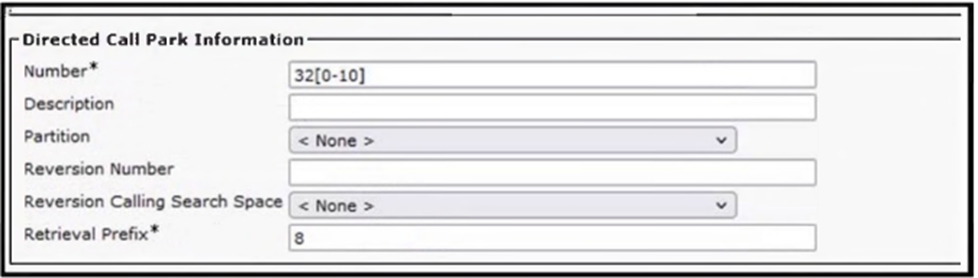
B)
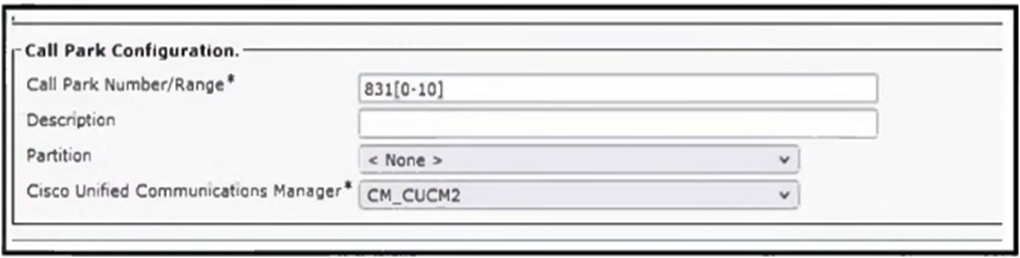
C)
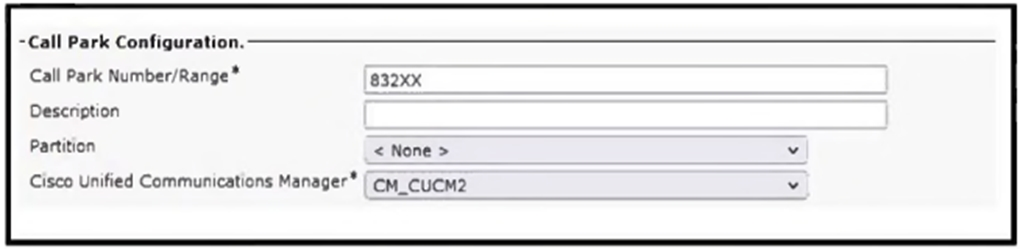
D)
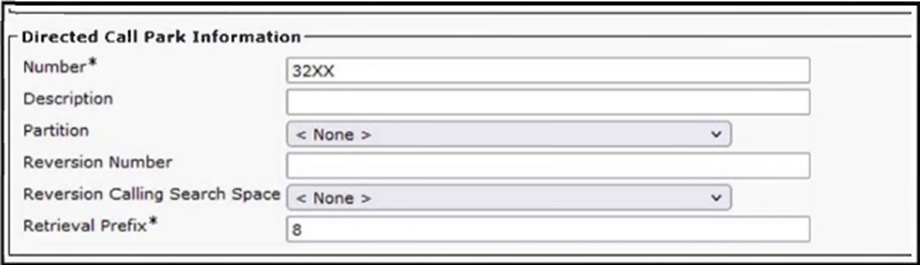
What are two configureation features of the Client matter code setting in the route pattern configuration? (Choose two.)
A Cisco UCM-based solution uses URI-based calling for Cisco Jabber clients. The solution has several clusters in different locations. The solution being configured must have a secure method o* exchanging addresses between the clusters. Which action ensures that a configuration complies with the requirements?
Refer to the exhibit.
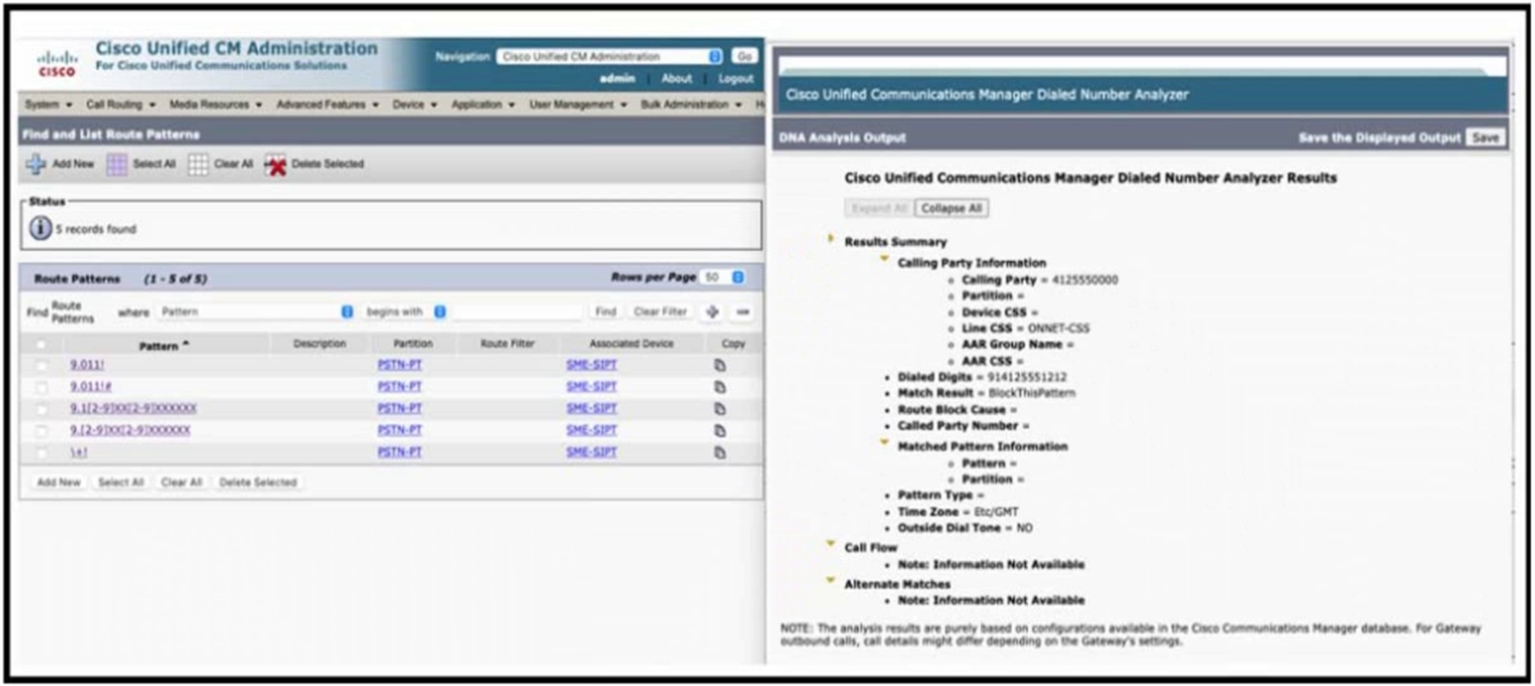
Refer to the exhibit. A collaboration engineer is troubleshooting an issue where a user of a Cisco UCM IP phone reports failed calls when trying to dial out to the PSTN. Which action resolves the issue?
Refer to the exhibit.
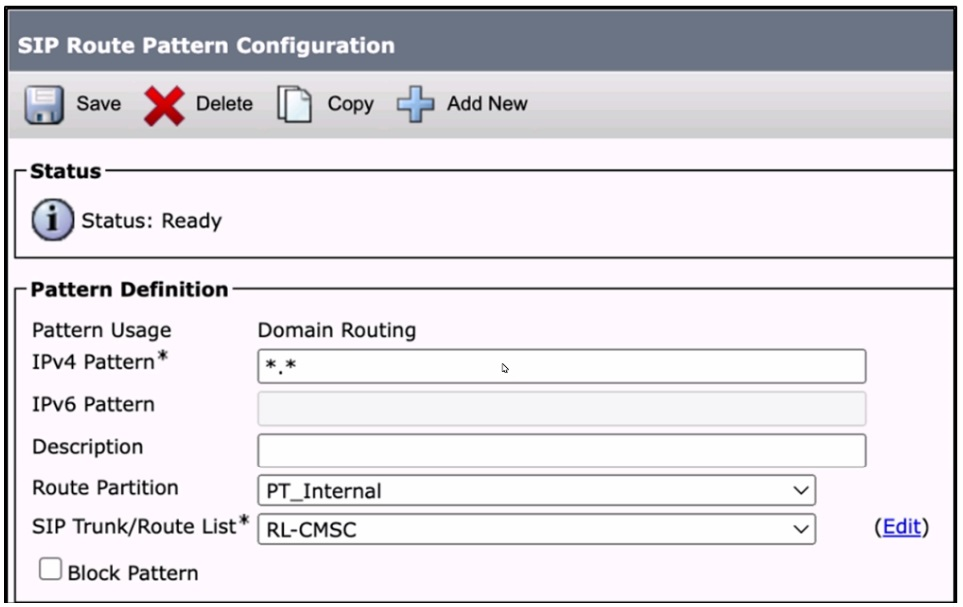
A collaboration engineer investigates an issue where the user calls that match the local Jabber domain are routed back to Cisco UCM. Which action resolves this problem?
Get access to all 242 verified questions with detailed answers.
Unlock All 300-815 Questions