350-101 Exam Questions & Answers
Implementing and Operating Cisco Wireless Core Technologies • Cisco
100% money-back guarantee
Sample 350-101 Questions
Practice with real exam-style questions, each with the verified correct answer and explanation.
A network administrator at a retail company recently deployed a Cisco Catalyst 9800 WLC. The NOC was unaware of wireless issues until it received reports from users. The network administrator must configure Cisco Catalyst Center to enable effective client issue alerts via email to prevent this happening again. Which action must the network administrator take in Cisco Catalyst Center to meet the requirements?
Cisco Catalyst Center uses its Event Notifications framework to alert operations teams when Assurance detects client, device, or wireless issues. The correct workflow is not a simple email-address entry under Issue Settings; it is an event subscription that binds selected issue events to a notification channel such as EMAIL. Cisco's Catalyst Assurance documentation states that, when a specific Assurance issue is triggered and its status changes, Assurance can generate REST or email notifications, and the workflow opens the Platform > Developer Toolkit > Event Notifications window from Manage Subscription. The same guide confirms that EMAIL is one of the supported notification channels and that the EMAIL notification details include sender, recipient, and subject fields. Cisco's Platform User Guide also defines Event Notifications as the place to ''view and subscribe to specific events'' and gives the GUI path as Platform > Developer Toolkit > Event Notifications. Therefore, option B is correct. SMTP/email destination configuration may be a prerequisite, but the required alerting action is creating the event notification subscription. Reference topics: Catalyst Center Assurance, Event Notifications, Wireless Monitoring and Management.
An onsite engineer is working to connect devices to the wireless network using central switching in a corporate environment. Security protocols and network-specific settings must be configured as per enterprise policy. After the initial wireless settings are applied on an iOS tablet, the engineer must ensure that VLAN ID 10 is assigned on the client device to complete a successful enterprise Wi-Fi connection. Which action meets this requirement?
In a centrally switched deployment, the WLAN traffic is tunneled via CAPWAP from the AP to the WLC, where VLAN assignment occurs. To ensure that client devices are placed into the correct VLAN (in this case, VLAN 10), the WLAN policy profile must define the VLAN mapping. This allows the WLC to tag client traffic appropriately when forwarding to the upstream switch. Option C is correct because it configures the WLAN profile (policy profile) with VLAN 10, ensuring all clients associating with the WLAN are mapped to the proper VLAN automatically. Option A is incorrect because VLAN tagging is managed centrally on the WLC, and access ports at the AP are typically trunked or transparent in central switching mode. Option B is invalid; manually configuring VLAN on client devices is not feasible or scalable in enterprise deployments and does not integrate with CAPWAP central switching. Option D is also incorrect; relying on MAC-based redirection introduces complexity and is not standard practice for VLAN assignment in centrally switched networks. Cisco Wireless Core Technologies recommend using policy profiles to centrally enforce VLANs, simplifying management, ensuring security compliance, and supporting consistent enterprise Wi-Fi connectivity. Reference topics: Client Connectivity Configuration --- VLAN assignment, WLAN policy profiles, centrally switched deployments, Cisco Catalyst 9800 WLC.
Which hierarchy in a YANG data modeling approach describes a relationship in the context of NETCONF device configuration?
YANG represents network configuration and operational state as a hierarchical data model. In Cisco model-driven programmability, YANG is used with NETCONF to model configuration and state data so that client applications can programmatically retrieve, edit, and manage device configuration. Cisco states that YANG is used with NETCONF for automated and programmable network operations, and that YANG primarily models the configuration and state data used by NETCONF operations.
The correct hierarchy is the tree and leaf-based structure. Cisco's YANG model structure description defines it as a hierarchical framework that organizes data into a tree with top-level nodes and nested child nodes, and groups related data through containers, lists, and leaves. In this model, containers and lists create structure, while leaf nodes hold actual values such as interface names, VLAN IDs, descriptions, IP addresses, or policy parameters. Option B describes a relationship inside the hierarchy, but it is not the full YANG modeling hierarchy. Options A and C are not valid YANG/NETCONF structural models. Reference topics: Automation and AI --- model-driven programmability, NETCONF, YANG data models, configuration/state data, and Cisco IOS XE programmability.
Exhibit:
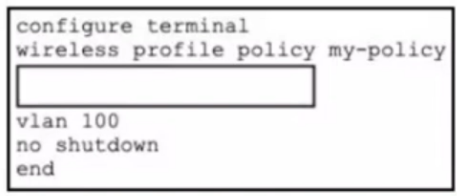
Refer to the exhibit. An enterprise is deploying Cisco Catalyst 9800 WLCs and is using Catalyst Center as the management platform to oversee wireless access policies. To meet the organization's compliance requirements, all wireless endpoints must be evaluated with security posture validation before gaining access. Which set of CLI commands must be added to the box in the code to complete the configuration?
The correct configuration is aaa-override followed by nac under the existing Catalyst 9800 wireless policy profile. The exhibit already places the administrator in policy-profile configuration mode with wireless profile policy my-policy, so the missing commands must be policy-profile subcommands, not another profile declaration. Cisco's Catalyst 9800 configuration examples show the exact sequence: enter wireless profile policy
aaa-override permits authorization attributes returned by AAA or Cisco ISE, such as VLAN, ACL, QoS, redirect ACL, or posture-related access controls, to override the locally defined policy. Cisco's documentation explicitly states that AAA override applies policies coming from AAA or ISE servers, while nac enables Network Access Control in the policy profile. This is the required behavior when endpoints must be posture-validated before normal network access is granted. Cisco also notes that NAC State is enabled in the policy profile and can only be enabled when AAA override is enabled.
Option A is invalid because nac-policy is not the correct CLI keyword. Options B and D omit NAC. Reference topic: Client Connectivity Configuration --- Catalyst 9800 policy profiles, AAA override, NAC State, posture enforcement, and ISE-based access control.
An engineer is migrating to a new Cisco Catalyst CW9800-H1 WLC to modernize the wireless infrastructure and enable advanced monitoring capabilities. The organization operates more than 150 access points and uses Cisco Catalyst Center for centralized network management and assurance. As part of the deployment, the engineer must enable wireless service assurance and wireless telemetry to monitor client connectivity, roaming behavior, and performance metrics across the wireless network. Which configuration must be applied in Cisco Catalyst Center when onboarding the WLC?
When onboarding a Cisco Catalyst CW9800-H1 WLC into Cisco Catalyst Center for enterprise-scale wireless monitoring, proper credential configuration and service enablement are critical. Device controllability ensures that the Catalyst Center can communicate with and manage the WLC and its associated access points, while wireless assurance provides telemetry data for client connectivity, roaming, and performance metrics. The recommended approach is to enable CLI, SNMP, and NETCONF credentials during discovery to allow full management access. Enabling device controllability globally allows the Catalyst Center to push configurations and query device status without restriction. Assigning the WLC to a site with wireless assurance enabled activates telemetry data collection, ensuring detailed visibility into client behavior and network health. Options A and B misalign telemetry and controllability settings, which can result in incomplete monitoring. Option C enables wireless assurance globally but does not globally enable device controllability, limiting operational control. Cisco best practices dictate that for large-scale deployments with hundreds of APs, global device controllability paired with site-level wireless assurance guarantees consistent, non-disruptive monitoring and enables full utilization of advanced features. Reference topics: Wireless Monitoring and Management --- WLC onboarding, Catalyst Center telemetry, device controllability, wireless assurance, large-scale AP management.
Get access to all 103 verified questions with detailed answers.
Unlock All 350-101 Questions