350-501 Exam Questions & Answers
Implementing and Operating Cisco Service Provider Network Core Technologies • Cisco
100% money-back guarantee
Sample 350-501 Questions
Practice with real exam-style questions, each with the verified correct answer and explanation.
A network operator working for a telecommunication company with an employee Id: 4065 96080 it trying to implement BFD configuration on an existing network of Cisco devices Which task must the engineer perform to enable BFD on the interfaces?
Refer to the exhibit.
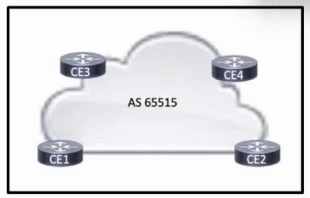
Refer to the exhibit. The enterprise is running BGP between sites to provide connectivity to users across the company's geographic regions. A network engineer must update the configuration so that the operations team can confirm that BGP prefixes that are received on each router originated from the correct autonomous system.
Which configuration must the engineer apply?
An engineer is implementing MPLS to monitor within the MPLS domain. Which must the engineer perform to prevent packets from being forwarded beyond the service provider domain when the LSP is down?
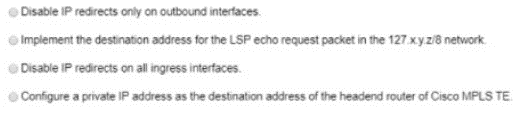
To prevent packets from being forwarded beyond the service provider domain when the Label Switched Path (LSP) is down, the engineer must configure a private IP address as the destination address of the headend router of Cisco MPLS Traffic Engineering (TE). This ensures that if the LSP fails, the packets will not be routable over the public internet, thus containing them within the service provider's network.
What is the characteristic of the Tl-LFA?
TI-LFA, or Topology Independent Loop-Free Alternate, is a fast-reroute mechanism that provides protection against link or node failures in a network. It guarantees a loop-free alternate path for all areas configured in OSPF, ensuring traffic can be quickly rerouted in case of a failure. This characteristic is crucial for maintaining network stability and avoiding traffic loops, which can lead to packet loss and network congestion.
Refer to the exihibit.

Refer to the exhbit. ISP A has a BGP peering with ISP C with the maximum-prefix 150 configuration on R1. After a recent security breach on the ISP A network, a network engineer has been asked to enable a lightweight security mechanism to protect the R1 CPU and BGP membership from spoofing attacks. Which solution must ISP A implement?
The Time to Live (TTL) security mechanism is a lightweight security feature that can protect against CPU and memory resource exhaustion due to a denial-of-service (DoS) attack. It works by setting a limit on the number of hops (TTL value) that BGP packets can traverse. By configuringneighbor 10.163.83.55 ttl-security hops 2, ISP A ensures that BGP packets received from ISP C must have a TTL value of at least 254 when they reach R1, as BGP packets decrement the TTL by 1 with each hop. This effectively prevents spoofing attacks from outside the directly connected network because any packets spoofed from further away would have a TTL that drops below the threshold before reaching R1.
Get access to all 547 verified questions with detailed answers.
Unlock All 350-501 Questions