800-150 Exam Questions & Answers
Supporting Cisco Devices for Field Technicians • Cisco
100% money-back guarantee
Sample 800-150 Questions
Practice with real exam-style questions, each with the verified correct answer and explanation.
Which two components are accessed by removing the chassis cover on Cisco Catalyst 8000 Series Edge platforms? (Choose two.)
On Cisco Catalyst 8000 Series Edge platforms, removing the chassis cover provides access to internal components such as DIMMs (Dual In-line Memory Modules) and SSDs (Solid-State Drives). These components are located internally and require the removal of the chassis cover for maintenance or replacement.
DIMMs are used for system memory and are essential for the router's operation.
SSDs provide storage for system software and configurations.
Other components like Network Interface Modules (NIMs) and transceivers are typically accessible externally and do not require chassis cover removal.
Which type of license is locally managed and does not require external tools for management?
Right-To-Use (RTU) licenses are locally managed licenses that allow users to activate specific features on Cisco devices without the need for external tools or connectivity to Cisco's licensing infrastructure. These licenses operate on an honor-based system, where the user agrees to comply with the licensing terms without mandatory enforcement mechanisms.
In contrast:
Hybrid licenses combine aspects of traditional and smart licensing models.
PAK (Product Authorization Key) licenses require registration and activation through Cisco's licensing portal.
Smart licenses necessitate communication with Cisco's Smart Licensing servers for activation and management.
Which protocol should be analyzed when troubleshooting call quality between IP phones?
When addressing call quality issues between IP phones, the Real-time Transport Protocol (RTP) is the primary protocol to analyze. RTP is responsible for the actual transmission of voice data during a call, and its performance directly impacts call quality.
Key factors affecting RTP and, consequently, call quality include:
Packet Loss: Missing packets can lead to audio gaps.
Jitter: Variations in packet arrival times can cause choppy audio.
Latency: Delays in packet delivery can result in noticeable lag.
Analyzing RTP streams allows technicians to identify these issues and implement appropriate Quality of Service (QoS) measures to mitigate them.
In contrast:
SIP (Session Initiation Protocol): Handles call setup, modification, and teardown but not the media stream.
SCCP (Skinny Client Control Protocol): A Cisco proprietary protocol for signaling, not media transport.
Why is it important to verify the update status after the initial upgrade process when upgrading firmware on a Cisco UCS C-Series server using the Host Upgrade Utility?
After upgrading the firmware on a Cisco UCS C-Series server using the Host Upgrade Utility (HUU), it is critical to verify the update status to ensure that all targeted components (such as BIOS, CIMC, and RAID controller firmware) have been successfully updated.
Firmware upgrades often involve multiple subsystems, and partial or failed updates can result in inconsistencies or even device instability. Verifying the update status allows the technician to identify any missed components and perform corrective actions if necessary.
Options like generating compliance reports, third-party application checks, or license activations are not the primary reasons for this verification step in the HUU process.
Refer to the exhibit.
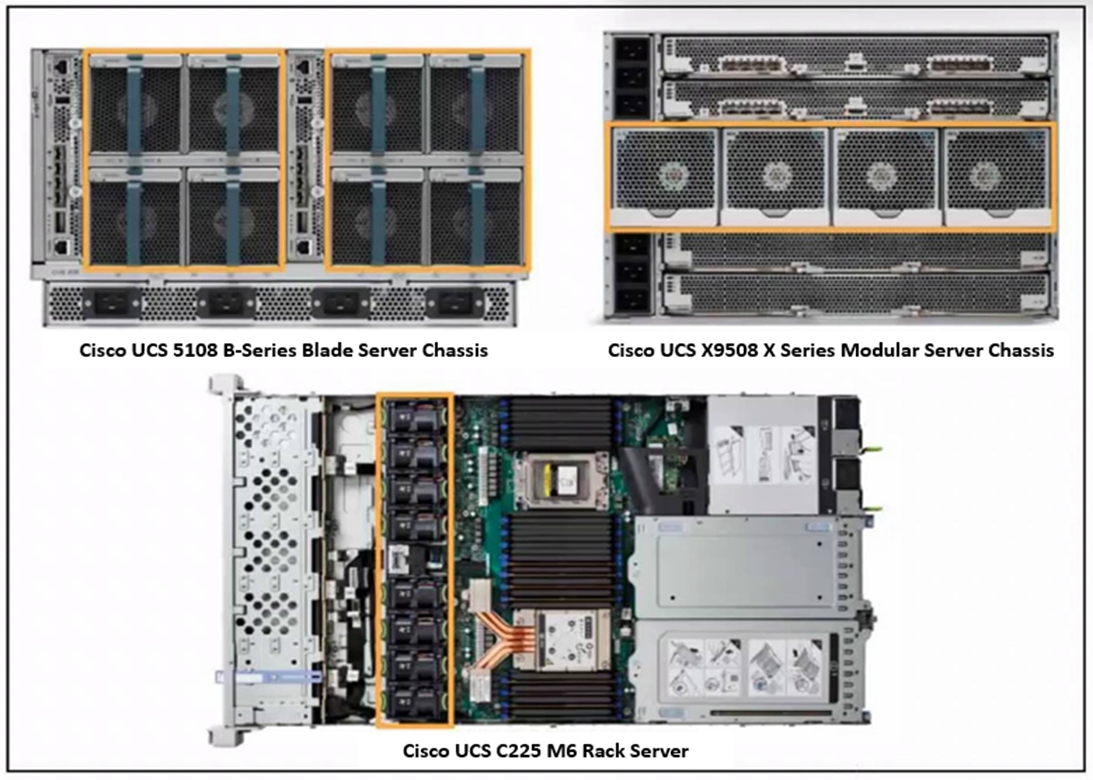
Refer to the exhibit. Which replaceable components are highlighted on the three different series of Cisco UCS servers?
The highlighted components in all three Cisco UCS server models (5108 B-Series Blade Server Chassis, X9508 X Series Modular Server Chassis, and C225 M6 Rack Server) are fan modules, which are field-replaceable units responsible for cooling the system.
The highlighted components in the images correspond to cooling fans --- these are essential for maintaining optimal thermal conditions within each Cisco UCS server type. Here's a breakdown of what's visible in each:
Cisco UCS 5108 B-Series Blade Server Chassis: The highlighted vertical rectangular components are fan modules, which provide high-efficiency airflow for the densely packed blades.
Cisco UCS X9508 X-Series Modular Server Chassis: The front-facing fan trays are clearly marked, used to cool the modular nodes and shared infrastructure.
Cisco UCS C225 M6 Rack Server: The highlighted components on the side of the motherboard are also fan modules, directly responsible for cooling the CPU, memory, and other internal components.
These fans are field-replaceable units (FRUs) and are routinely accessed by technicians during preventive maintenance or fault replacement.
Get access to all 100 verified questions with detailed answers.
Unlock All 800-150 Questions