H12-351_V1.0 Exam Questions & Answers
HCIE-WLAN (Written) V1.0 • Huawei
100% money-back guarantee
About H12-351_V1.0 Exam
The HCIE-WLAN (Written) V1.0 certification, identified as H12-351_V1.0, is Huawei's premier qualification for networking professionals seeking expertise in wireless local area network design, deployment, and management. This comprehensive exam validates advanced knowledge across critical topics including WLAN architecture, RF fundamentals, security protocols, QoS implementation, roaming mechanisms, and troubleshooting methodologies. The certification is designed for experienced network engineers, wireless specialists, and IT professionals who want to demonstrate mastery of enterprise-level WLAN solutions and Huawei's proprietary technologies.
Candidates preparing for the H12-351_V1.0 exam benefit significantly from utilizing updated exam dumps and practice tests that mirror the actual certification assessment. These study materials provide realistic exam scenarios, detailed explanations for complex WLAN concepts, and help identify knowledge gaps before the official test. By engaging with comprehensive practice tests covering all exam domains—including network planning, device configuration, performance optimization, and security hardening—candidates can build confidence, improve time management skills, and substantially increase their likelihood of achieving a passing score on their first attempt.
Exam Topics & Objectives
4-Week Study Plan for H12-351_V1.0
Week 1: Foundational Technologies and Core Concepts
- Study WLAN Networking Technology (7%): Review 802.11a/b/g/n/ac/ax standards, frequency bands (2.4GHz, 5GHz, 6GHz), channel planning, and data rates
- Study WLAN Radio Resource Management (7%): Learn power control, channel assignment algorithms, dynamic frequency selection (DFS), and transmit power management
- Study WLAN Roaming (5%): Understand fast roaming mechanisms (802.11r, 802.11k), roaming optimization, and handover procedures
- Study WLAN Reliability (6%): Learn redundancy design, fault tolerance, load balancing, and reliability metrics
- Complete practice questions on networking fundamentals and radio concepts
- Review Huawei WLAN product documentation for AP models and controllers
Week 2: Security, Access Control, and Multicast Management
- Study WLAN Security and Defense (6%): Cover authentication methods (802.1X, PSK), encryption (WEP, WPA, WPA2, WPA3), TKIP, AES, and rogue AP detection
- Study WLAN Network Admission Control (7%): Learn NAC policies, device identification, access profiles, and compliance enforcement
- Study WLAN Multicast and mDNS (3%): Understand multicast management, mDNS/Bonjour handling, and multicast optimization
- Study WLAN Security Defense mechanisms: Learn intrusion prevention, encryption standards, and security audit procedures
- Practice scenario-based questions on NAC and security policy implementation
- Review Huawei CloudCampus security architecture and NAC policies
Week 3: Advanced Technologies and Specialized Solutions
- Study CloudCampus Solution (7%): Learn cloud-based WLAN management, centralized control, and campus network integration
- Study WLAN and IoT Convergence (5%): Understand IoT device connectivity, coexistence challenges, and QoS for IoT traffic
- Study Constructing an IPv6 WLAN (5%): Learn IPv6 deployment on WLAN, DHCPv6, address allocation, and IPv6 security
- Study WLAN Wireless Location Technology (3%): Understand location-based services, positioning accuracy, and indoor localization methods
- Study Large-scale WLAN Networking Practice (7%): Review enterprise deployment strategies, scalability considerations, and multi-AP coordination
- Work through case studies on large-scale WLAN implementations
Week 4: Operations, Optimization, and Exam Preparation
- Study WLAN Troubleshooting (7%): Learn diagnostic tools, log analysis, common issues, interference detection, and performance troubleshooting
- Study Intelligent WLAN O&M (5%): Understand intelligent management platforms, AI-driven optimization, predictive analytics, and automated operations
- Study Enterprise WLAN Optimization Design (6%): Learn capacity planning, coverage optimization, site surveys, and performance tuning strategies
- Complete full-length practice exams covering all 15 topics with emphasis on high-percentage domains
- Review weak areas and re-study relevant sections
- Practice Huawei-specific command syntax and configuration examples
- Take final mock exam and review all incorrect answers
- Create summary notes on complex concepts for final review before exam day
Sample H12-351_V1.0 Questions
Practice with real exam-style questions. Reveal answers to verify your knowledge.
Which of the following statements about the access layer design are true when Huawei's CloudCampus Solution is applied to small and midsize campus networks? (Select All that Apply)
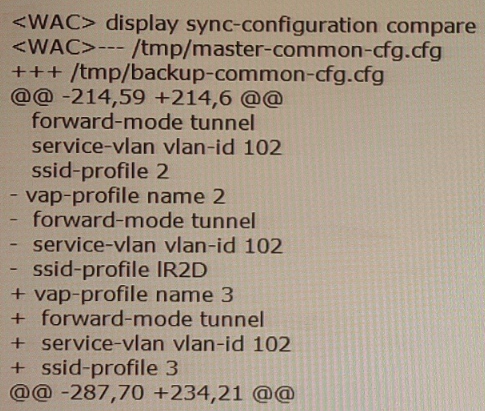
The display sync-configuration compare command is executed on the backup WAC in HSB to check wireless configuration synchronization. Based on the command output, which of the following statements are true? (Select All that apply)
Which of the following types of non-Wi-R devices can be identified by Huawei APs? (Select All that Apply)
When a STA roams from API to AP2 at Layer 2, AP2 notifies its neighbors of from this STA is encapsulated in a tunnel and sent to API for forwarding.
Master NCE-Campuslnsight can comprehensively record and analyze Interference. Which of the following parameters are recorded? (Select All that Apply)
Get access to all 60 verified questions with detailed answers.
Unlock All H12-351_V1.0 Questions