H12-831_V1.0 Exam Questions & Answers
HCIP-Datacom-Advanced Routing & Switching Technology V1.0 • Huawei
100% money-back guarantee
Sample H12-831_V1.0 Questions
Practice with real exam-style questions, each with the verified correct answer and explanation.
On a BGP/MPLS IP VPN network, VPNv4 routes carry the export RT. Which of the following attributes is used by MP-BGP to carry the export RT?
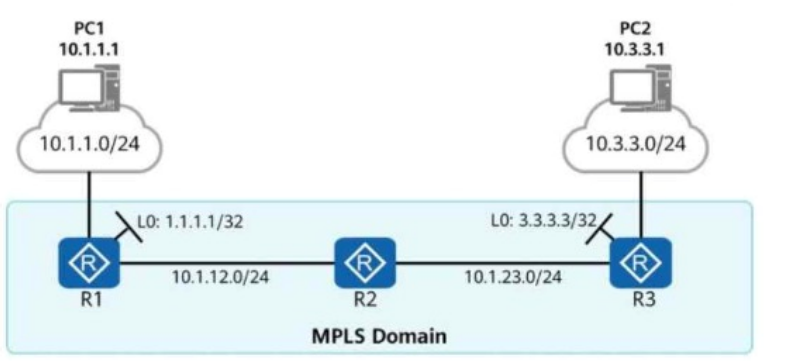
On the network shown in the figure, an administrator first completes the routing configuration and then enables MPLS and LDP on R1, R2, and R3 and their interconnected interfaces. In this manner, traffic from PC1 to PC2 can be forwarded based on MPLS. Which of the following routing configurations can implement this function?
Options:
A.
nginx
CopyEdit
R1
ospf 1
area 0
network 1.1.1.1 0.0.0.0
network 10.1.12.0 0.0.0.255
network 10.1.1.0 0.0.0.255
R2
ospf 1
area 0
network 2.2.2.2 0.0.0.0
network 10.1.12.0 0.0.0.255
network 10.1.23.0 0.0.0.255
R3
ospf 1
area 0
network 3.3.3.3 0.0.0.0
network 10.1.23.0 0.0.0.255
network 10.3.3.0 0.0.0.255
B.
nginx
CopyEdit
R1
bgp 65000
router-id 1.1.1.1
peer 3.3.3.3 as-number 65000
peer 3.3.3.3 connect-interface LoopBack 0
network 10.1.1.0 24
R3
bgp 65000
router-id 3.3.3.3
peer 1.1.1.1 as-number 65000
peer 1.1.1.1 connect-interface LoopBack 0
network 10.3.3.0 24
C.
nginx
CopyEdit
R2
ospf 1
area 0
network 2.2.2.2 0.0.0.0
network 10.1.12.0 0.0.0.255
network 10.1.23.0 0.0.0.255
R3
ospf 1
area 0
network 3.3.3.3 0.0.0.0
network 10.1.23.0 0.0.0.255
bgp 65000
router-id 3.3.3.3
peer 1.1.1.1 as-number 65000
peer 1.1.1.1 connect-interface LoopBack 0
network 10.3.3.0 24
ip ip-prefix 1 index 10 permit 10.1.1.0 24
route recursive-lookup tunnel ip-prefix 1
D.
nginx
CopyEdit
R1
ospf 1
area 0
network 1.1.1.1 0.0.0.0
network 10.1.12.0 0.0.0.255
R2
ospf 1
area 0
network 2.2.2.2 0.0.0.0
network 10.1.12.0 0.0.0.255
network 10.1.23.0 0.0.0.255
R3
ospf 1
area 0
network 3.3.3.3 0.0.0.0
network 10.1.23.0 0.0.0.255
Comprehensive and Detailed In-Depth
This question is based on MPLS (Multiprotocol Label Switching) and its interaction with routing protocols. The goal is to ensure PC1 (10.1.1.1) can communicate with PC2 (10.3.3.1) over MPLS. Let's analyze each option carefully.
1 Understanding MPLS Routing Requirements
To forward traffic using MPLS and LDP, we need:
An IGP (Interior Gateway Protocol) like OSPF or IS-IS to advertise network reachability.
Loopback interfaces advertised in OSPF to establish LDP neighbor relationships.
Consistent MPLS LDP enablement on all links in the MPLS domain.
End-to-end IP reachability between loopbacks (since LDP uses the loopback for label distribution).
2 Option A (Correct Answer) Analysis
This configuration enables OSPF on all routers (R1, R2, and R3) across the MPLS domain:
All networks are advertised in OSPF area 0, ensuring IP reachability. Loopback interfaces (1.1.1.1, 2.2.2.2, 3.3.3.3) are included, which is required for MPLS LDP peer establishment. PC1's network (10.1.1.0/24) and PC2's network (10.3.3.0/24) are properly advertised, ensuring end-to-end connectivity. R1, R2, and R3 have OSPF neighbor relationships, meaning LDP can use OSPF routes for label switching.
Conclusion: Option A meets all MPLS forwarding requirements and is the correct answer.
3 Why Other Options Are Incorrect
Option B (Incorrect)
Uses BGP instead of OSPF, which is not optimal for MPLS forwarding in a simple MPLS domain.
LDP requires an IGP like OSPF or IS-IS to work efficiently.
BGP alone does not establish LDP label bindings between R1, R2, and R3.
Option C (Incorrect)
Mixes OSPF and BGP, causing routing inconsistency.
Uses ip ip-prefix and recursive lookup, which is unnecessary in a standard MPLS domain.
BGP does not distribute labels dynamically like an IGP with LDP.
Option D (Incorrect)
R1 does not advertise the 10.1.1.0/24 network, meaning PC1's network is not reachable.
R3 does not advertise the 10.3.3.0/24 network, meaning PC2's network is not reachable.
Missing essential routing entries for full end-to-end reachability.
HCIP-Datacom Advanced Routing & Switching Technology Huawei Official MPLS and LDP Configuration Guide Huawei Enterprise Networking Documentation
A network device has established an OSPF neighbor relationship with another device. The figure shows the configuration of GE0/0/0 on the network device.
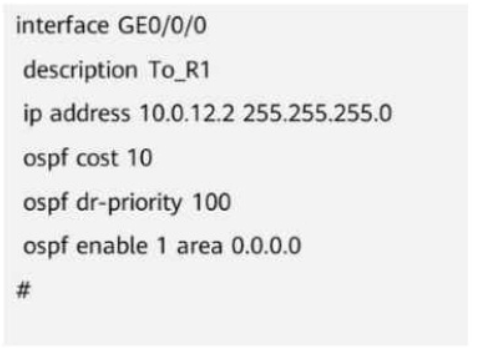
Which of the following commands would NOT affect the OSPF neighbor status of the interface?
Comprehensive and Detailed In-Depth
To determine the correct answer, we need to analyze how each command impacts OSPF neighbor relationships.
1. Understanding OSPF Neighbor Formation
OSPF routers form neighbor relationships when they meet the following conditions:
They are in the same subnet (IP addresses and subnet masks must match).
They are in the same OSPF area.
They use the same network type (e.g., Broadcast, Point-to-Point).
Authentication (if configured) must match.
Hello and Dead timers must match.
2. Analyzing Each Answer Option
A. 'undo ip address 10.0.12.2 24' Affects OSPF Neighbor Status
Removing the IP address will prevent the interface from sending and receiving OSPF Hello packets.
Without an IP address, OSPF cannot establish neighbor relationships.
Effect: Breaks OSPF neighbor status.
B. 'undo description' Does NOT Affect OSPF Neighbor Status
The interface description is just a label for administrators and has no impact on OSPF functionality.
It does not affect neighbor relationships, routing, or communication.
Effect: No impact on OSPF neighbors.
C. 'undo ospf cost' Affects OSPF Neighbor Status Indirectly
OSPF cost determines the path selection but does NOT break the neighbor relationship.
However, if the cost change leads to routing table recalculations, it might cause temporary convergence issues.
Effect: Does not directly break neighbor status, but affects route selection.
D. 'undo ospf dr-priority' Affects OSPF Neighbor Status (Possibly Causes DR Re-Election)
OSPF DR/BDR election uses priority values.
If changed, a new election might occur, leading to a temporary loss of neighbor relationships.
Effect: Might cause OSPF neighbor reset (temporary impact on adjacency).
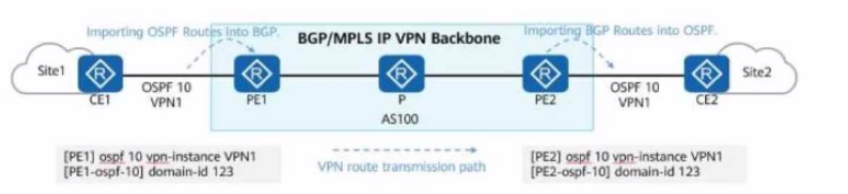
Service routes of an enterprise are transmitted on the network. Some configurations of PE1 and PE2 are shown in the figure. Which of the following LSAs may CE2 receive?
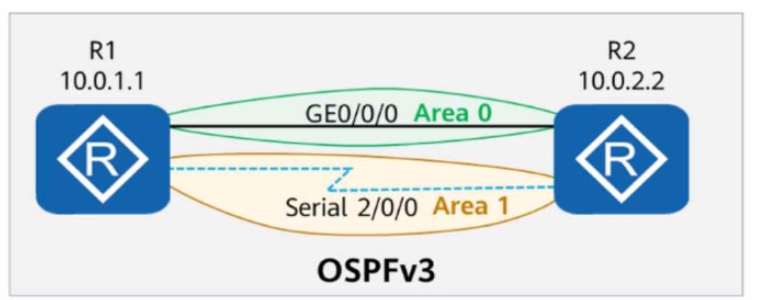
On the OSPFv3 network shown in the figure, area 1 is a stub are
a. Which of the following statements are true?
Get access to all 156 verified questions with detailed answers.
Unlock All H12-831_V1.0 Questions