CTFL-AcT Exam Questions & Answers
ISTQB Foundation Level - Acceptance Testing • iSQI
100% money-back guarantee
About CTFL-AcT Exam
The CTFL-AcT (ISTQB Foundation Level - Acceptance Testing) certification is a specialized credential designed for quality assurance professionals and software testers who want to master acceptance testing methodologies. This exam validates essential knowledge in acceptance testing principles, including test planning, test design, test execution, and test reporting specific to acceptance testing scenarios. Candidates learn to bridge the gap between business requirements and technical implementation, ensuring software meets stakeholder expectations. The certification covers critical topics such as acceptance test-driven development (ATDD), behavior-driven development (BDD), and risk-based testing approaches that are increasingly vital in modern software development environments.
Professionals seeking the CTFL-AcT certification include QA engineers, acceptance testers, business analysts, and quality assurance managers who need industry-recognized validation of their testing expertise. To ensure exam success, candidates benefit significantly from using updated exam dumps and comprehensive practice tests that mirror the actual certification assessment. These study materials provide familiarity with question formats, time management strategies, and detailed explanations of complex acceptance testing concepts. By combining theoretical study with practical exam simulations, aspiring certification holders can confidently approach the CTFL-AcT exam and demonstrate their proficiency in acceptance testing, ultimately advancing their careers in quality assurance and software testing.
Exam Topics & Objectives
4-Week Study Plan for CTFL-AcT
Week 1: Foundations and Acceptance Criteria
- Study the core concepts of acceptance testing and its role in software quality assurance
- Understand the difference between acceptance testing and other testing types (unit, integration, system)
- Learn the fundamentals of acceptance criteria definition and best practices
- Review SMART criteria (Specific, Measurable, Achievable, Relevant, Time-bound) for writing effective acceptance criteria
- Study user stories and how acceptance criteria are derived from them
- Complete practice exercises on identifying and refining acceptance criteria from business requirements
- Review the ISTQB Foundation Level syllabus sections on introduction and foundations
Week 2: Acceptance Tests and Experience-Based Practices
- Study the structure and components of acceptance tests
- Learn different acceptance test formats and templates
- Understand the Given-When-Then (GWT) format for writing acceptance tests
- Study experience-based testing techniques applicable to acceptance testing
- Learn about exploratory testing and how it complements acceptance testing
- Review decision tables and state transition testing for acceptance test design
- Practice writing acceptance tests for various scenarios and use cases
- Complete mock exam questions focused on acceptance test design
Week 3: Business Processes, Rules Modeling, and Non-Functional Requirements
- Study business process modeling notation and its application to acceptance testing
- Learn how to derive acceptance tests from process flows and swimlane diagrams
- Understand business rules and their impact on acceptance criteria
- Study domain-specific language (DSL) and rule engines in acceptance testing context
- Learn about non-functional acceptance testing (performance, security, usability, reliability)
- Study acceptance criteria for non-functional requirements (response times, load capacity, accessibility)
- Review tools and techniques for testing non-functional acceptance criteria
- Practice deriving acceptance tests from business rules and non-functional requirements
Week 4: Collaborative Acceptance Testing and Exam Preparation
- Study the Three Amigos approach (developer, tester, business analyst) in collaborative acceptance testing
- Learn Behavior-Driven Development (BDD) principles and practices
- Understand the role of stakeholders in acceptance test definition
- Study communication techniques for eliciting acceptance criteria from stakeholders
- Review tools for collaborative acceptance testing (Gherkin, Cucumber, SpecFlow)
- Complete full-length practice exams covering all five syllabus areas
- Review weak areas and reinforce understanding with targeted study
- Take final practice exam under timed conditions to simulate actual exam environment
Sample CTFL-AcT Questions
Practice with real exam-style questions. Reveal answers to verify your knowledge.
Which one of the following statements regarding the quality of requirements is MOST correct?
Which one of the following statements describes correctly how acceptance testing may be augmented with other test techniques or approaches?
As an acceptance tester you want to test the $100 withdrawal process described by the following Business Process Model and Notation (BPMN) model.
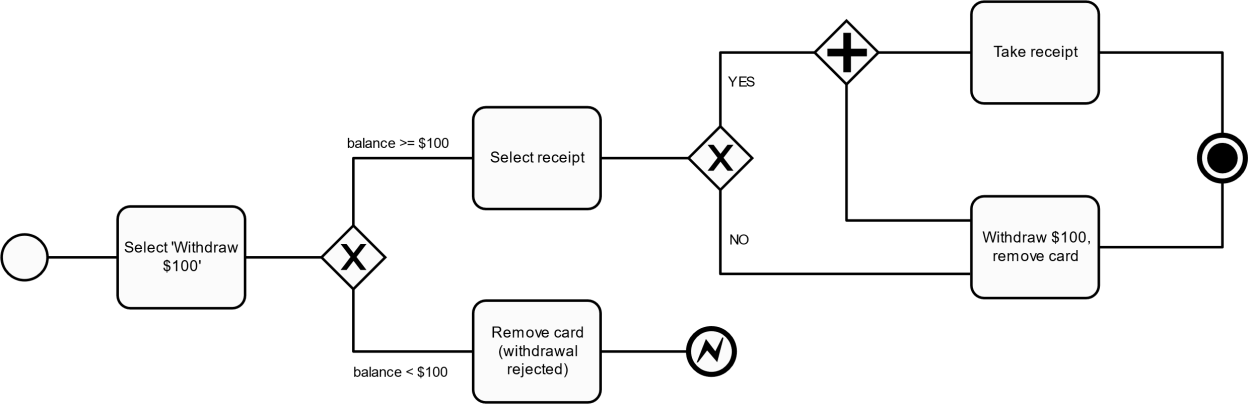
You would like to achieve the following coverage criterion ''execute all possible process tasks''. Consider the following test cases:
Test 1: balance = $100, receipt = YES
Test 2: balance = $120, receipt = NO
Test 3: balance = $85
Test 4: balance = $20, receipt = YES
Which of the following is the minimal set of test cases allowing to achieve required coverage?
Which one of the following combinations of given perspective and statement matches BEST?
Which one of the following statements regarding performance testing is MOST correct?
Get access to all 40 verified questions with detailed answers.
Unlock All CTFL-AcT Questions